Euro rises as Trump delays Iran strike, USD weakens
- ECB hike expectations rise as energy shock feeds inflation.
- Trump delays Iran attack, keeping traders focused on oil swings.
- Fed hike bets linger as Goolsbee warns inflation remains elevated.

The Euro advances late in the North American session, up by 0.26% amid a volatile session characterized by geopolitical headlines and broad US Dollar weakness across the board. At the time of writing, the EUR/USD pair trades at 1.1654 after bouncing off daily lows of 1.1608.
EUR/USD gains as Iran headlines and softer yields hit Dollar
Market mood is neutral, with headlines weighing and ultimately underpinning Oil prices, as news broke that the US was set to resume military action against Iran on Tuesday. However, US President Trump’s post on Truth Social saying he was delaying the attack on Iran to resume talks weighed on WTI, which is up more than 1%.
Last week, US inflation data on the consumer and producer sides sparked bets that the Federal Reserve would need to raise rates, not cut them. Consequently, US Treasury yields soared on Friday, yet as of writing, the 10-year T-note is down 1 basis point to 4.585%.
Data from Prime Terminal shows a 50% chance that the US central bank could increase borrowing costs towards the end of 2026.
Chicago Fed President Austan Goolsbee was hawkish on Monday, saying that inflation is too high and it would need to be at the forefront of mind when Kevin Warsh takes over as the Chair of the Fed. Goolsbee added that the “job market is stable” and that cutting rates could further ignite inflation.
The new Fed Chair, Kevin Warsh, will be sworn in this Friday, May 22nd, at the White House by US President Donald Trump.
Across the pond, the Eurozone economic docket was absent, yet Reuters revealed its latest poll on the European Central Bank. Investors expect a rate hike in the June meeting, and at least another one, as the energy shock triggered by the Middle East conflict is feeding into core inflation.
On Tuesday, the economic docket in the Eurozone will feature a speech by the ECB’s Chief Economist Philip Lane. Across the pond, the schedule will feature the ADP Employment Change 4-week average, housing data and a speech by Philadelphia Fed President Anna Paulson.
EUR/USD Price Forecast: Technical outlook
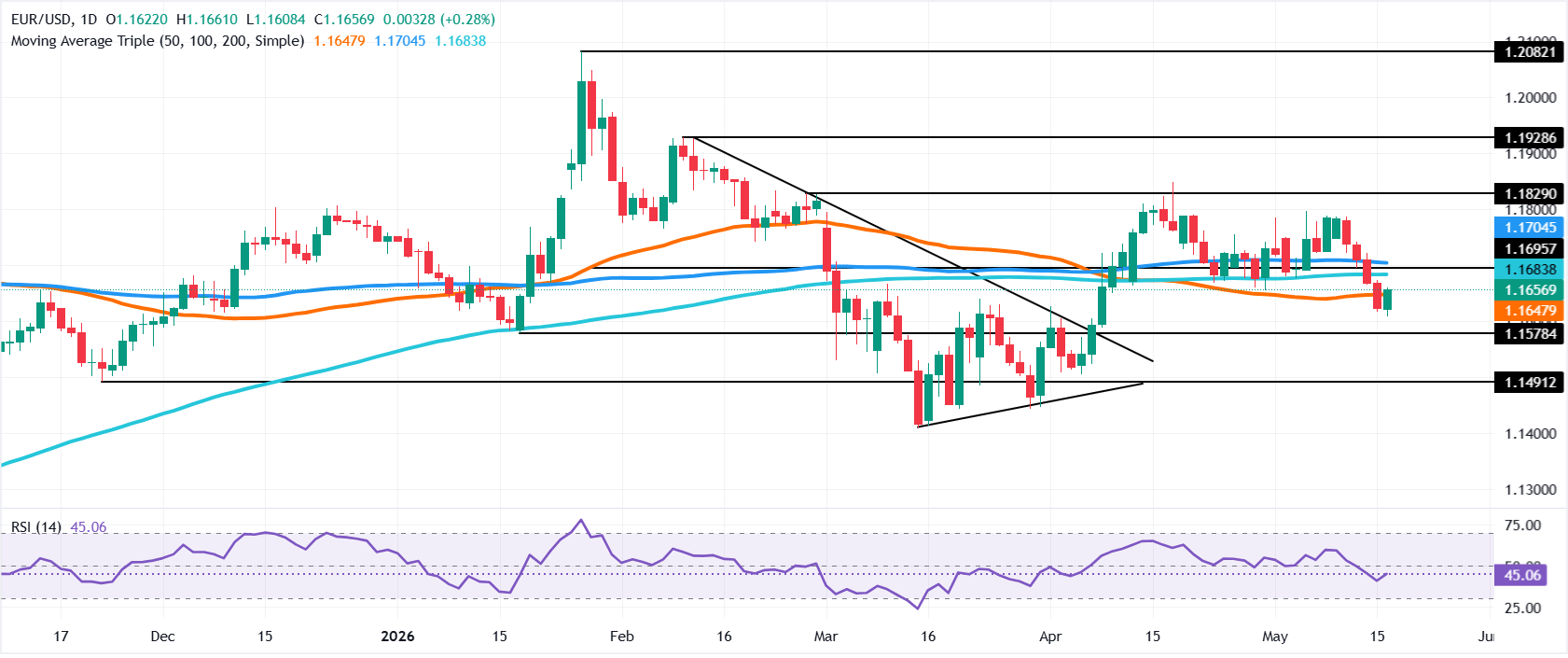
From a technical standpoint, the EUR/USD is poised to consolidate further, even though the Relative Strength Index (RSI) turned bearish. Above the current spot price lies the confluence of the 200-, the 100- and the 20-day Simple Moving Averages (SMAs), each at 1.1681, 1.1703 and 1.1707, respectively. A decisive break above this area would pave the way to challenge a downward resistance trendline at around 1.1750/1.1760, ahead of the 1.1800 figure.
On the downside, if EUR/USD drops below 1.1600, expect a test of the April 6 swing low of 1.1505.
Euro Price This week
The table below shows the percentage change of Euro (EUR) against listed major currencies this week. Euro was the strongest against the Japanese Yen.
| USD | EUR | GBP | JPY | CAD | AUD | NZD | CHF | |
|---|---|---|---|---|---|---|---|---|
| USD | -0.02% | -0.01% | 0.00% | -0.02% | -0.06% | -0.04% | -0.04% | |
| EUR | 0.02% | 0.02% | 0.04% | 0.02% | -0.01% | -0.06% | -0.00% | |
| GBP | 0.01% | -0.02% | 0.02% | -0.00% | -0.06% | -0.07% | -0.02% | |
| JPY | 0.00% | -0.04% | -0.02% | -0.02% | -0.12% | -0.06% | -0.08% | |
| CAD | 0.02% | -0.02% | 0.00% | 0.02% | -0.02% | -0.04% | -0.02% | |
| AUD | 0.06% | 0.00% | 0.06% | 0.12% | 0.02% | 0.00% | 0.02% | |
| NZD | 0.04% | 0.06% | 0.07% | 0.06% | 0.04% | -0.00% | -0.00% | |
| CHF | 0.04% | 0.00% | 0.02% | 0.08% | 0.02% | -0.02% | 0.00% |
The heat map shows percentage changes of major currencies against each other. The base currency is picked from the left column, while the quote currency is picked from the top row. For example, if you pick the Euro from the left column and move along the horizontal line to the US Dollar, the percentage change displayed in the box will represent EUR (base)/USD (quote).
Author

Christian Borjon Valencia
FXStreet
Markets analyst, news editor, and trading instructor with over 14 years of experience across FX, commodities, US equity indices, and global macro markets.

















