Euro tests a two-week top as US-Iran peace hopes boost risk appetite
- EUR/USD jumps nearly 0.8% on Wednesday to test two-week highs near 1.1800.
- News reports suggest that the US and Iran are close to a peace deal.
- Eurozone producer price inflation soared in March amid the impact of the US-Iran war.

The Euro (EUR) rallied nearly 0.8% against the US Dollar (USD) on Wednesday, to test the top of the last few weeks' trading range, right below 1.1800, at the time of writing. Growing hopes that the US-Iran war is nearing its end have sent the safe-haven US Dollar tumbling, while hot Eurozone Producer Prices Index (PPI) data provided additional support to the Euro.
A news report by Axios, citing two US officials and other sources briefed on the issue, affirmed earlier on Wednesday that the US and Iranian representatives are getting closer to a one-page memorandum of understanding to end the conflict and set the framework for more detailed nuclear negotiations at a later time.
Previously, US President Donald Trump announced a pause on the operation to escort vessels through the Strait of Hormuz, while on Tuesday, US Secretary of State Marco Rubio announced the end of the offensive stage, practically discarding a resumption of hostilities.
On the macroeconomic front, data released by Eurostat on Wednesday showed that producer prices accelerated to a one-year high of 2.1% year-over-year (YoY) in March from -3% in February, well above the 1.8% expected. These figures confirm the inflationary pressures of Iran’s war and add to the case of an upcoming rate hike by the European Central Bank (ECB). Month-on-month, producer prices jumped to a nearly 4-year high to 3.4%, from -0.6% in the previous month, also beating expectations of a 3.3% increment.
A few hours earlier, the Eurozone's final HCOB Services Purchasing Managers Index (PMI) figures corroborated that the sector's activity contracted in April, albeit at a somewhat softer pace than previously thought; 47.6 vs the 47.4 preliminary estimations. German Services PMI has been left unchanged, at 46.9. The French and Italian services activity also showed figures consistent with shrinking business activity.
The focus now is on the US ADP Employment Change report, due later on Wednesday. ADP figures are expected to show that private employment payrolls increased to 99K in April, from 62K in March, which, if confirmed, will set a positive precedent for the all-important Nonfarm Payrolls report, due next Friday.
Technical Analysis: Bulls are pushing against resistance around 1.1790
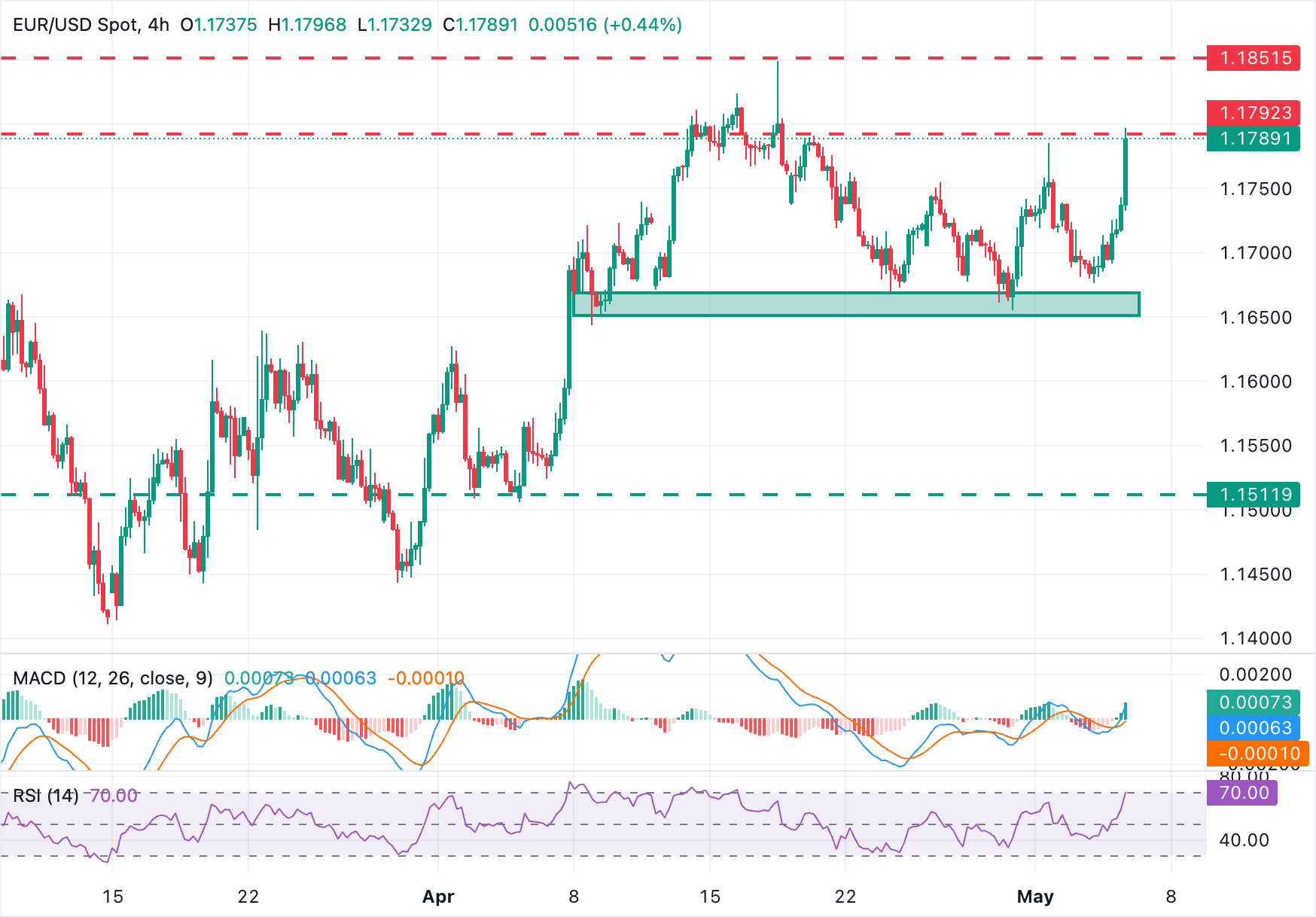
EUR/USD shows mounting bullish pressure as the pair reaches the top of the recent horizontal channel, at the 1.1790 area. Momentum indicators reveal that bulls have taken control with the 4-hour Relative Strength Index (RSI) approaching oversold levels, and the Moving Average Convergence Divergence (MACD) histogram, in the same timeframe, showing growing green bars.
A confirmation above the 1.1790 area (April 20, May 1 highs) would expose the April 17 high near 1.1850. Further up, the next target is the February 10 high, near 1.1930. On the downside, daily lows are at 1.1690, but the key support is in the area between 1.1645 and 1.1675, which has held downside attempts several times in April.
(The technical analysis of this story was written with the help of an AI tool.)
Economic Indicator
ADP Employment Change
The ADP Employment Change is a gauge of employment in the private sector released by the largest payroll processor in the US, Automatic Data Processing Inc. It measures the change in the number of people privately employed in the US. Generally speaking, a rise in the indicator has positive implications for consumer spending and is stimulative of economic growth. So a high reading is traditionally seen as bullish for the US Dollar (USD), while a low reading is seen as bearish.
Read more.Next release: Wed May 06, 2026 12:15
Frequency: Monthly
Consensus: 99K
Previous: 62K
Source: ADP Research Institute
Traders often consider employment figures from ADP, America’s largest payrolls provider, report as the harbinger of the Bureau of Labor Statistics release on Nonfarm Payrolls (usually published two days later), because of the correlation between the two. The overlaying of both series is quite high, but on individual months, the discrepancy can be substantial. Another reason FX traders follow this report is the same as with the NFP – a persistent vigorous growth in employment figures increases inflationary pressures, and with it, the likelihood that the Fed will raise interest rates. Actual figures beating consensus tend to be USD bullish.
Author

Guillermo Alcala
FXStreet
Graduated in Communication Sciences at the Universidad del Pais Vasco and Universiteit van Amsterdam, Guillermo has been working as financial news editor and copywriter in diverse Forex-related firms, like FXStreet and Kantox.