Euro folds as the Fed trades cuts for hikes
- EUR/USD dropped to its weakest level of the session after the June Federal Reserve decision.
- New projections flipped the 2026 rate path from a cut to a hike bias.
The Federal Reserve (Fed) left the federal funds rate at 3.50% to 3.75% on Wednesday, but the hold was the least interesting part of Kevin Warsh's first meeting as Chair. The Federal Open Market Committee (FOMC) delivered it on a unanimous 12 to 0 vote, a sharp break from April's fractured 8 to 4 split, and the statement dropped its easing bias entirely. The language on the timing of future adjustments vanished, replaced by a flat pledge to restore price stability.
The updated Summary of Economic Projections (SEP) did the real damage. The median 2026 federal funds projection jumped to roughly 3.8% from 3.4% in March, flipping the signal from a cut to a hike bias. The driver was a startling inflation revision: the median 2026 Personal Consumption Expenditures (PCE) forecast leapt to 3.6% from 2.7%, with the core reading marked up to 3.3%. The Fed has not merely shelved cuts; it has joined the hawks.
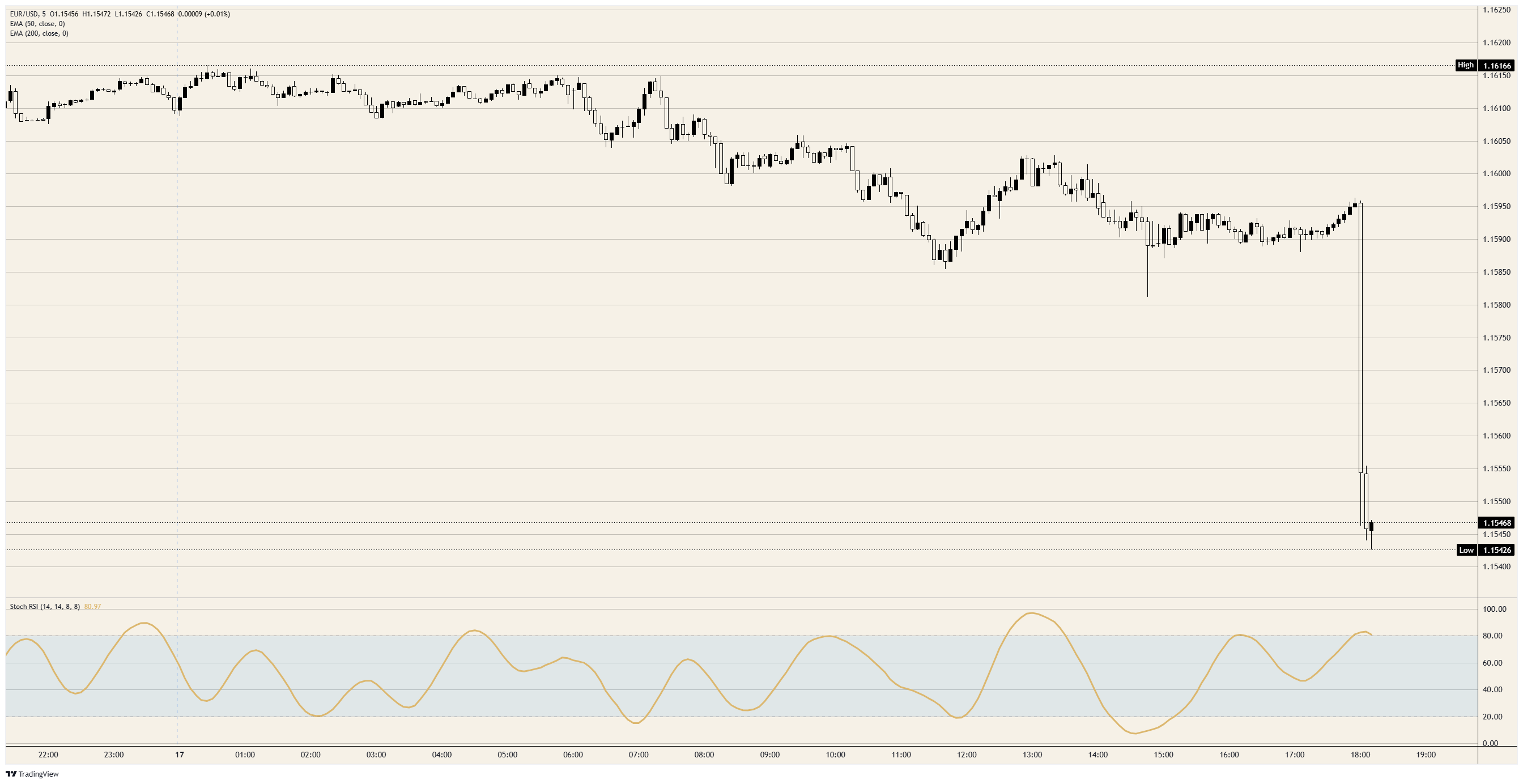
EUR/USD bore the brunt, falling close to 50 pips on the release from just below 1.1600 to the 1.1550 region, its lowest print of the day after a quiet, range-bound session.
The bias is bearish while price holds beneath 1.1550, with 1.1500 the obvious magnet below; only a reclaim of 1.1600 would suggest the move is being faded. Attention now turns to Warsh's first press conference as Chair at 18:30 GMT, the first test of how firmly he stands behind the hawkish dots.
EUR/USD 5-minute chart
Fed FAQs
Monetary policy in the US is shaped by the Federal Reserve (Fed). The Fed has two mandates: to achieve price stability and foster full employment. Its primary tool to achieve these goals is by adjusting interest rates. When prices are rising too quickly and inflation is above the Fed’s 2% target, it raises interest rates, increasing borrowing costs throughout the economy. This results in a stronger US Dollar (USD) as it makes the US a more attractive place for international investors to park their money. When inflation falls below 2% or the Unemployment Rate is too high, the Fed may lower interest rates to encourage borrowing, which weighs on the Greenback.
The Federal Reserve (Fed) holds eight policy meetings a year, where the Federal Open Market Committee (FOMC) assesses economic conditions and makes monetary policy decisions. The FOMC is attended by twelve Fed officials – the seven members of the Board of Governors, the president of the Federal Reserve Bank of New York, and four of the remaining eleven regional Reserve Bank presidents, who serve one-year terms on a rotating basis.
In extreme situations, the Federal Reserve may resort to a policy named Quantitative Easing (QE). QE is the process by which the Fed substantially increases the flow of credit in a stuck financial system. It is a non-standard policy measure used during crises or when inflation is extremely low. It was the Fed’s weapon of choice during the Great Financial Crisis in 2008. It involves the Fed printing more Dollars and using them to buy high grade bonds from financial institutions. QE usually weakens the US Dollar.
Quantitative tightening (QT) is the reverse process of QE, whereby the Federal Reserve stops buying bonds from financial institutions and does not reinvest the principal from the bonds it holds maturing, to purchase new bonds. It is usually positive for the value of the US Dollar.
Author

Joshua Gibson
FXStreet
Joshua joins the FXStreet team as an Economics and Finance double major from Vancouver Island University with twelve years' experience as an independent trader focusing on technical analysis.














