|

EUR/USD under pressure after US CPI and FOMC minutes

  • US headline and core CPI exceeded expectations, rising to 3.5% and 3.8% respectively in March.
  • FOMC minutes from March highlighted uncertainty about the persistence of high inflation and the efficacy of monetary policy.

The EUR/USD pair declined to 1.0739, representing a substantial decline of 1.1%. This decline has occurred following the release of hot inflation figures from the US which fueled hawkish bets on the Federal Reserve (Fed). The Federal Open Market Committee (FOMC) minutes from the March meeting didn’t trigger any reaction.

The US Bureau of Labor Statistics (BLS) revealed on Wednesday that the nation's inflation rate, reflected by the Consumer Price Index (CPI), increased from 3.2% in February to 3.5% in March on an annual basis. This outstripped the predicted market forecast of 3.4%. The yearly core CPI, which omits fluctuating food and energy costs, mirrored February's growth by rising 3.8%. Both the CPI and the core CPI climbed by 0.4% monthly, exceeding analysts' projection of 0.3%. As a reaction, US Treasury yields soared while the odds of a June Rate cut by the Fed declined to over 20%. The mix of hawkish bets as rising yields benefited the USD during the session.

On the other hand, the FOMC Minutes disclosed a general lack of assurance amongst participants concerning the persistence of high inflation rates, with recent data failing to bolster their trust in the economy cooling down and t in the inflation rate steadily reaching the 2% benchmark. With inflation running hot as well as the labor market, officials may change their language and slowly give up on the chances of a June rate cut by the Fed.

EUR/USD technical analysis

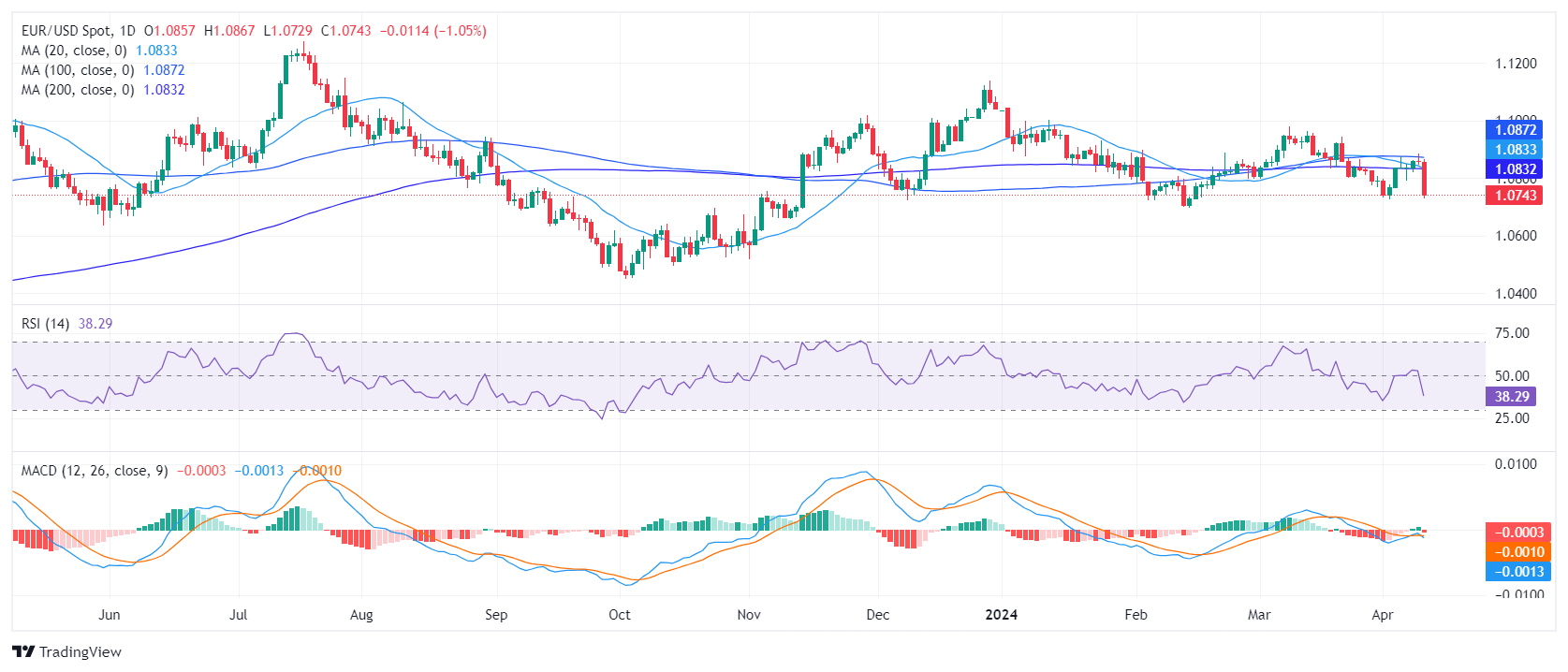
On the daily chart, the Relative Strength Index (RSI) fell within negative territory, with the latest reading at 38. This deviation from a positive trend suggests a shift in market dominance towards the sellers. Along with the RSI, the Moving Average Convergence Divergence (MACD) displayed a fresh red bar, indicating negative market momentum.

In the broader outlook, the EUR/USD also exhibits a bearish trend as it is positioned below key Simple Moving Averages (SMAs). SMAs are tools used to smooth out significant price data fluctuations over specific time periods to discern market trends. Specifically, today it fell below the 200-day SMA, typically considered a long-term trend indicator.
EUR/USD

Overview
Today last price1.0743
Today Daily Change-0.0114
Today Daily Change %-1.05
Today daily open1.0857
 
Trends
Daily SMA201.0843
Daily SMA501.083
Daily SMA1001.0873
Daily SMA2001.0833
 
Levels
Previous Daily High1.0885
Previous Daily Low1.0848
Previous Weekly High1.0876
Previous Weekly Low1.0725
Previous Monthly High1.0981
Previous Monthly Low1.0768
Daily Fibonacci 38.2%1.0862
Daily Fibonacci 61.8%1.0871
Daily Pivot Point S11.0842
Daily Pivot Point S21.0826
Daily Pivot Point S31.0804
Daily Pivot Point R11.0879
Daily Pivot Point R21.0901
Daily Pivot Point R31.0916

Author

Patricio Martín

Patricio is an economist from Argentina passionate about global finance and understanding the daily movements of the markets.


More from Patricio Martín
Share:

Editor's Picks

AUD/USD holds above 0.6950 as bullish USD caps gains

AUD/USD edges lower during the Asian session on Tuesday, stalling a two-day recovery move from a two-month low, touched last week. An extended rout in the fixed income market keeps US bond yields elevated near multi-year highs. This, along with geopolitical uncertainties, helps the US Dollar retain its bullish tone despite receding October Fed hike bets. However, expectations for another RBA rate hike this month could act as a tailwind for the Aussie.

USD/JPY rises back above 158.00 despite hawkish BoJ outlook

USD/JPY rises back above 158.00 in the early European morning on Tuesday. The pair strengthens as the Japanese Yen fails to find any inspiration from hawkish BoJ expectations and looming intervention risks. Meanwhile, geopolitical uncertainty and elevated US bond yields keep the US Dollar near its YTD high despite receding October Fed hike bets. This, in turn, helps the pair stay supported.

Gold hits two-month low as bears await break below $4,100 amid sustained USD strength

Gold attracts fresh sellers following the previous day's consolidative price move, and drops to a two-month low during the Asian session, with bears now awaiting a break below the $4,100 mark before positioning for further losses. Despite receding October Fed rate hike bets, the US Dollar retains its bullish tone and continues to undermine demand for the commodity.

Ripple and Stellar weaken as derivatives positioning fades
Ripple (XRP) and Stellar (XLM) face pressure trading below $1.499 and $0.220, respectively, on Tuesday after a modest correction at the start of the week. Traders should be cautious as weakening derivatives metrics and fading bullish momentum suggest further corrections for XRP and XLM. Derivatives data shows a weakening and cautious signal among traders.
The scarcity trade is gaining momentum – The biggest commodity moves may still be ahead
Something extraordinary is happening across global Commodity markets. Oil is above $100. Diesel has reached record prices. Copper has broken records. Global food prices are rising again. China is restricting fuel exports. Governments are releasing emergency reserves.
Eurozone inflation just hit 3.8%, its highest in three years. This chart shows why the ECB can’t simply hike its way out

The ECB would normally have a relatively straightforward answer to inflation running almost twice its target: raise interest rates. But these are not normal circumstances. This time, the bond market is already doing part of the tightening for it, leaving the ECB facing an increasingly difficult dilemma.