|

EUR/USD struggling to develop a foothold over 1.0800 as Fed rate call looms ahead

  • EUR/USD is up on the day, but paring back gains firmly into familiar levels.
  • Near-term momentum is getting hamstrung by major levels.
  • Markets are gearing up for the Fed's last showing of 2023.

EUR/USD climbed in early Tuesday trading before slipping back below 1.0800, driven back after US Consumer Price Index (CPI) inflation came in as markets forecast, showing an ongoing gradual easing of price growth in the US.

The Eurozone ZEW Economic Sentiment survey for December came in well above expectations, printing at 23.0 versus the forecast 12.0, vaulting easily over the November print of 13.8.

The Euro (EUR) rose through Tuesday’s early market sessions, tipping the EUR/USD into an intraday high of 1.0828 before getting dragged back down below 1.0800 after US CPI inflation came in as expected.

Read More: Forecasts from 10 major banks, crushing rate cut prospects

Headline US CPI inflation for November printed at 0.1% compared to October’s 0.0%, and annualized headline CPI price growth ticked down slightly from 3.2% to 3.1%.

Core CPI inflation came in at 4% for the year into November, and inflation appears to have been capped off in the US, but inflation continues to ebb slower than most market participants were hoping for.

Global markets wil be turning attention to Wednesday’s Federal Reserve (Fed) rate call. With the US central bank broadly expected to hold rates steady at 5.5%, investors will be paying significant attention to the Fed’s Monetary Policy Statement, as well as updates to the Fed’s Interest Rate Projections, or Dot Plot.

After the mid-week Fed hump will be the European Central Bank (ECB) on Thursday, which will also be delivering its last rate call of 2023 before heading into the new year. 

EUR/USD Technical Outlook 

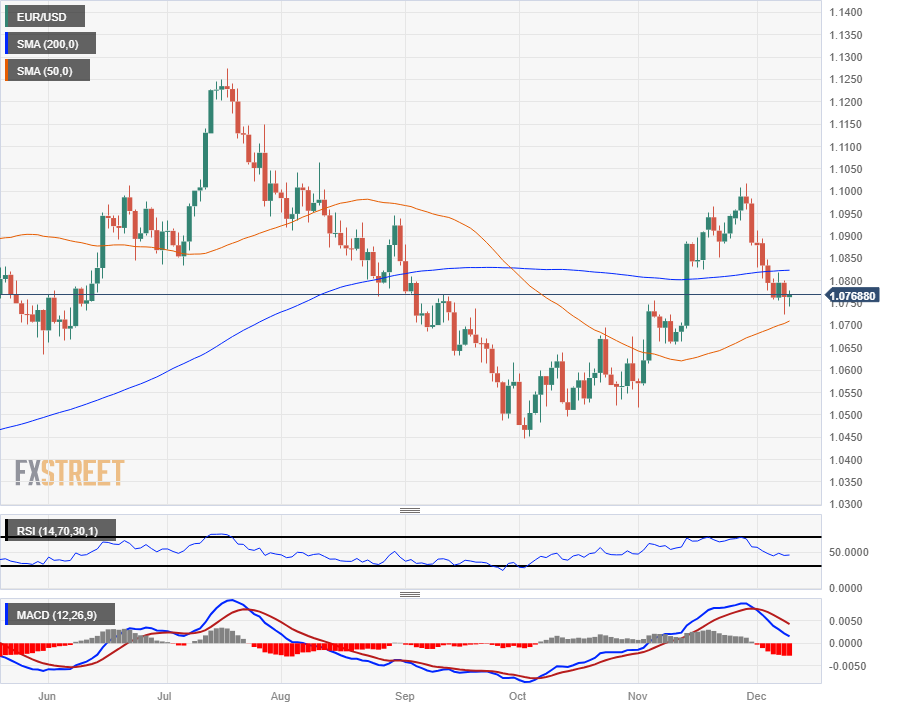
The EUR/USD remains trapped under the 200-hour Simple Moving Average (SMA) near 1.0820, getting rejected from the intraday significance level to trade on the south side of 1.0800 once again.

The pair has remained in a near-term bearish stance since shedding 1.1000 at the tail end of November, and a bullish rebound has yet to firmly materialize.

Daily candlesticks have the EUR/USD stuck in a congestion zone between the 200-day and 50-day SMAs, at 1.0825 and 1.0716 respectively. Firm technical support rests at the 1.0-700 handle just below current price action.

EUR/USD Daily Chart
EUR/USD Technical Levels

EUR/USD

Overview
Today last price1.0788
Today Daily Change0.0023
Today Daily Change %0.21
Today daily open1.0765
 
Trends
Daily SMA201.0874
Daily SMA501.071
Daily SMA1001.0761
Daily SMA2001.0823
 
Levels
Previous Daily High1.0779
Previous Daily Low1.0742
Previous Weekly High1.0895
Previous Weekly Low1.0724
Previous Monthly High1.1017
Previous Monthly Low1.0517
Daily Fibonacci 38.2%1.0765
Daily Fibonacci 61.8%1.0756
Daily Pivot Point S11.0745
Daily Pivot Point S21.0725
Daily Pivot Point S31.0707
Daily Pivot Point R11.0782
Daily Pivot Point R21.0799
Daily Pivot Point R31.0819

EUR/USD

Overview
Today last price1.0788
Today Daily Change0.0023
Today Daily Change %0.21
Today daily open1.0765
 
Trends
Daily SMA201.0874
Daily SMA501.071
Daily SMA1001.0761
Daily SMA2001.0823
 
Levels
Previous Daily High1.0779
Previous Daily Low1.0742
Previous Weekly High1.0895
Previous Weekly Low1.0724
Previous Monthly High1.1017
Previous Monthly Low1.0517
Daily Fibonacci 38.2%1.0765
Daily Fibonacci 61.8%1.0756
Daily Pivot Point S11.0745
Daily Pivot Point S21.0725
Daily Pivot Point S31.0707
Daily Pivot Point R11.0782
Daily Pivot Point R21.0799
Daily Pivot Point R31.0819

Author

Joshua Gibson

Joshua joins the FXStreet team as an Economics and Finance double major from Vancouver Island University with twelve years' experience as an independent trader focusing on technical analysis.


More from Joshua Gibson
Share:

Editor's Picks

AUD/USD flirts with 0.7000, lowest since early August amid bullish USD

AUD/USD hits a fresh low since early August during the Asian session on Friday and looks vulnerable near 0.7000 after breaking below the 200-day SMA overnight. Against the backdrop of the hawkish Fed, a two-day rally in oil prices revives inflation fears and continues to push US bond yields to multi-year highs. Adding to this, geopolitical risks lift the US Dollar to a two-month high, overshadowing RBA rate hike bets and weighing on the pair.

USD/JPY pulls back from three-week high after failing near 159.00

USD/JPY edges lower during the Asian session on Friday, stalling its recent strong move to a three-week high of 159.00 as Japanese Yen bears turn cautious amid intervention fears. Meanwhile, the US Dollar retains a strong bullish undertone as the Fed's hawkish outlook and oil-driven inflation fears continue to push US bond yields to multi-year peaks. Furthermore, the BoJ's dovish rate hike last week might cap JPY and support spot prices.

Gold treads water below $4,300

Gold grabs some buying attention and advances marginally at the end of the week, partially retracing the weekly decline, although it is still navigating below the key $4,300 mark per troy ounce. The fresh selling bias on the Greenback and the modest decline in US Treasury yields appear to support the humble advance in the precious metal.

Crypto Today: Bitcoin and Ethereum edge lower, XRP extends recovery as macro headwinds weigh

The broader cryptocurrency market is consolidating on Friday, with Bitcoin paring losses slightly above $84,000. Ethereum declines in tandem with BTC. Ripple (XRP), meanwhile, paints a different picture.


Fed vs BoJ: Both hiked. The market only believes one of them – and the chart shows which
The Federal Reserve (Fed) and the Bank of Japan (BoJ) have just done something remarkably similar. Both central banks raised interest rates by 25 basis points (bps) last week, both are confronting inflation risks, and both signal that future decisions will depend on incoming economic data.
Fed vs BoJ: Both hiked. The market only believes one of them – and the chart shows which

The Fed and the BoJ have just done something remarkably similar. Both central banks raised interest rates by 25 bps last week, both are confronting inflation risks, and both signal that future decisions will depend on incoming economic data.













