EUR/USD sinks below 1.16 as Fed’s hawkish cut and ECB hold weigh on Euro
- EUR/USD drops 0.30% after ECB holds rates steady as traders digest Fed’s hawkish 25-bps cut.
- Lagarde notes easing downside risks amid US–China truce and Mideast calm, but inflation outlook stays subdued.
- Powell hints at possible pause as FOMC splits, citing firm labor market and still-elevated inflation.

EUR/USD retreats on Thursday as the European Central Bank (ECB) decided to hold rates unchanged, but traders, still digesting the 'hawkish' cut by the Federal Reserve (Fed) on Wednesday, kept the shared currency below the 1.1600 figure. The pair trades at 1.1565, down 0.30%.
ECB’s Lagarde says policy is “in a good place” as risks ease
The ECB kept its three interest rates unchanged, with the Deposit Facility, Main Refinancing and Marginal Lending Rates holding steady at 2.00%, 2.15%, and 2.40%, respectively. ECB’s President Christine Lagarde noted that monetary policy is in a “good place” as economic risks diminish and the economy in the Eurozone (EZ) shows signs of resilience.
Lagarde added that the Europe-US trade, the Middle East war de-escalation and the trade truce between China and the US had mitigated downside risks to growth.
The ECB is expected to publish its economic projections through 2028 at the December meeting, and if some policymakers expect inflation to undershoot the bank’s target, it will justify the debate for further easing at the next meeting.
In the US, the Federal Reserve cut rates by 25 basis points and hinted at a possible pause in its easing cycle, citing a division in the Federal Open Market Committee (FOMC). Also, Fed Chair Jerome Powell revealed the central bank collected state data related to unemployment claims, and noted that the jobs market has not deteriorated as expected.
Daily market movers: Broad US Dollar strength, weighs on the Euro
- The US Dollar Index (DXY), which tracks the performance of the buck versus six currencies, climbs 0.37% to 99.50.
- ECB’s President Lagarde said that she would not complain about the economy expanding by 0.2% in Q3 in the EZ.
- The ECB’s monetary policy statement revealed that inflation is close to 2% and added that it’s not pre-committed to a particular rate path. The ECB noted, “The economy has continued to grow despite the challenging global environment."
- The Federal Reserve lowered its benchmark rate by 25 basis points to a range of 3.75%–4% in a 10–2 vote. The decision was not unanimous, with Fed Governor Stephen Miran favoring a larger 50-bps cut and Kansas City Fed President Jeffrey Schmid voting to hold rates steady.
- At the press conference, the Fed Chair Jerome Powell surprised the markets, saying “a further reduction in the policy rate at the December meeting is not a foregone conclusion — far from it.”
- Fed Chair Jerome Powell said the central bank’s primary focus remains on the labor market, noting that while official data is limited, state-level unemployment claims suggest the jobs market is not deteriorating sharply.
- Powell also mentioned that several FOMC members view interest rates as either at or near a neutral stance, indicating that monetary policy may be appropriately balanced given current economic conditions.
- Trade news between the US and China boosted the Greenback after President Trump met with his counterpart Xi Jinping. Trump said the meeting was "amazing," and that China agreed to resume soybean purchases. Consequently, Washington reduced fentanyl tariffs to 10% and cut tariffs on China’s goods from 57% to 47%. Trump added that rare earths issues were resolved and opened the door to discuss chips with China.
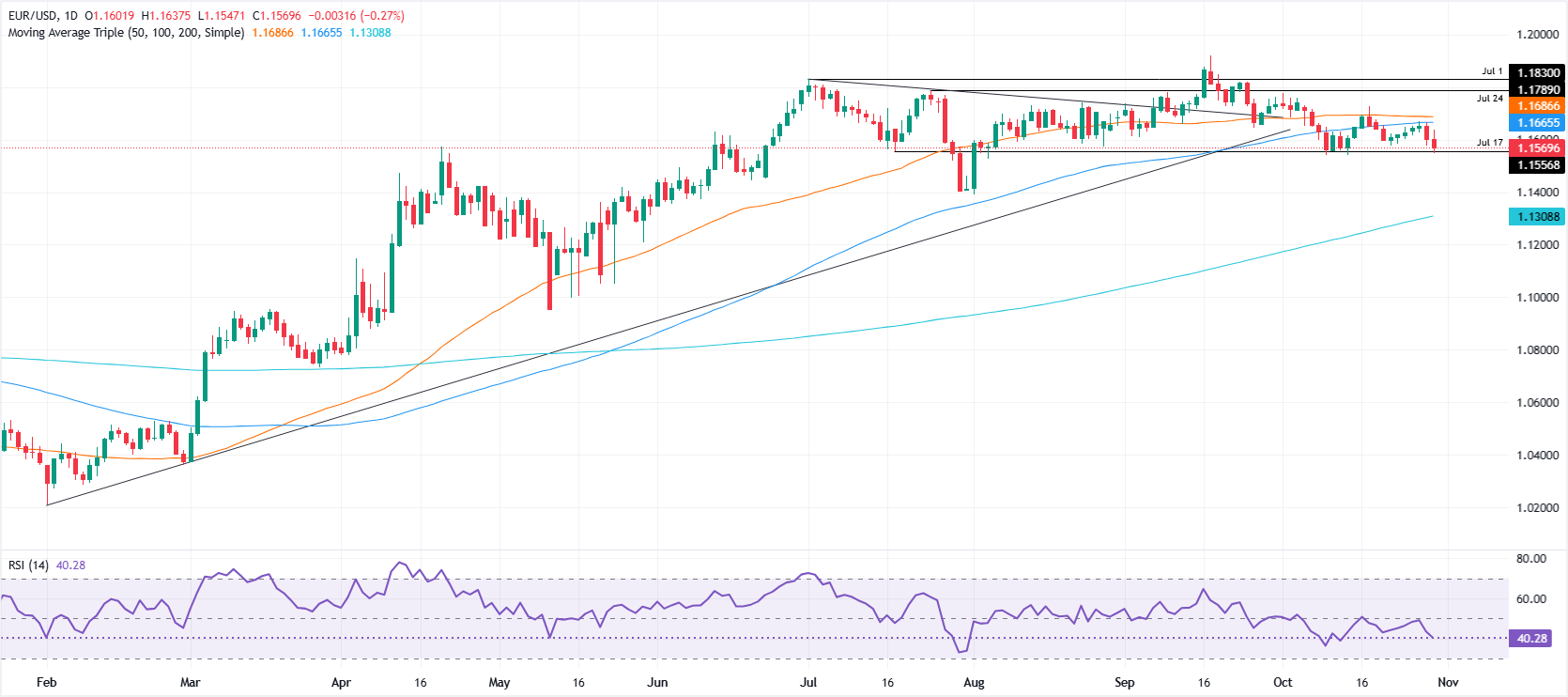
Technical outlook: EUR/USD turned bearish, sellers eye 1.1500
EUR/USD continues to trend downward after falling below 1.1600, with sellers eyeing further downside. Bearish momentum increased as depicted by the Relative Strength Index (RSI), reaching a lower trough.
With that said, the EUR/USD first support would be 1.1550, followed by the October 9 low of 1.1542. A breach of the latter will expose 1.1500 and the August 1 low of 1.1391.
Conversely, if EUR/USD climbs above 1.1600, the pair could consolidate within 1.1600-1.1650, before buyers clear the latter and target the 1.1700 milestone.
(This story was corrected on October 30 at 07:20 GMT to say the correct name of Chinese President Xi Jinping, not X Jinping.)
Euro FAQs
The Euro is the currency for the 20 European Union countries that belong to the Eurozone. It is the second most heavily traded currency in the world behind the US Dollar. In 2022, it accounted for 31% of all foreign exchange transactions, with an average daily turnover of over $2.2 trillion a day. EUR/USD is the most heavily traded currency pair in the world, accounting for an estimated 30% off all transactions, followed by EUR/JPY (4%), EUR/GBP (3%) and EUR/AUD (2%).
The European Central Bank (ECB) in Frankfurt, Germany, is the reserve bank for the Eurozone. The ECB sets interest rates and manages monetary policy. The ECB’s primary mandate is to maintain price stability, which means either controlling inflation or stimulating growth. Its primary tool is the raising or lowering of interest rates. Relatively high interest rates – or the expectation of higher rates – will usually benefit the Euro and vice versa. The ECB Governing Council makes monetary policy decisions at meetings held eight times a year. Decisions are made by heads of the Eurozone national banks and six permanent members, including the President of the ECB, Christine Lagarde.
Eurozone inflation data, measured by the Harmonized Index of Consumer Prices (HICP), is an important econometric for the Euro. If inflation rises more than expected, especially if above the ECB’s 2% target, it obliges the ECB to raise interest rates to bring it back under control. Relatively high interest rates compared to its counterparts will usually benefit the Euro, as it makes the region more attractive as a place for global investors to park their money.
Data releases gauge the health of the economy and can impact on the Euro. Indicators such as GDP, Manufacturing and Services PMIs, employment, and consumer sentiment surveys can all influence the direction of the single currency. A strong economy is good for the Euro. Not only does it attract more foreign investment but it may encourage the ECB to put up interest rates, which will directly strengthen the Euro. Otherwise, if economic data is weak, the Euro is likely to fall. Economic data for the four largest economies in the euro area (Germany, France, Italy and Spain) are especially significant, as they account for 75% of the Eurozone’s economy.
Another significant data release for the Euro is the Trade Balance. This indicator measures the difference between what a country earns from its exports and what it spends on imports over a given period. If a country produces highly sought after exports then its currency will gain in value purely from the extra demand created from foreign buyers seeking to purchase these goods. Therefore, a positive net Trade Balance strengthens a currency and vice versa for a negative balance.
Author

Christian Borjon Valencia
FXStreet
Markets analyst, news editor, and trading instructor with over 14 years of experience across FX, commodities, US equity indices, and global macro markets.

















