EUR/USD Price Forecast: Struggles to return above 20-day EMA, eyes on Fed policy
- EUR/USD ticks lower to near 1.1580 as the US Dollar gains ahead of the Fed’s policy decision.
- The Fed is expected to leave interest rates unchanged for the fourth meeting in a row.
- ECB’s Kazaks highlights the need to act again, while warning of upside inflation risks.

The EUR/USD pair trades marginally lower at around 1.1580 during the European trading session on Tuesday. The major currency pair drops as the US Dollar (USD) rises, with investors awaiting the Federal Reserve’s (Fed) monetary policy announcement on Wednesday.
As of writing, the US Dollar Index (DXY), which gauges the Greenback’s value against six major currencies, trades 0.1% higher to near 99.75.
The impact of the Fed’s policy announcement will be significant on the US Dollar, as it will be the first one under new Chairman Kevin Warsh. Fed Chair Warsh will likely maintain a neutral approach on the monetary policy outlook, at times when inflationary pressures have accelerated due to elevated energy prices.
According to the CME FedWatch tool, the Fed is expected to leave interest rates unchanged in the 3.50%-3.75% range for the fourth meeting in a row.
Meanwhile, the Euro (EUR) trades higher among its risky peers amid expectations that the European Central Bank (ECB) could tighten monetary conditions further.
ECB Governing Council member Martins Kazaks said on Monday that the central bank “needs to act again, if needed,” while predicting upside inflation risks to persist.
EUR/USD technical analysis
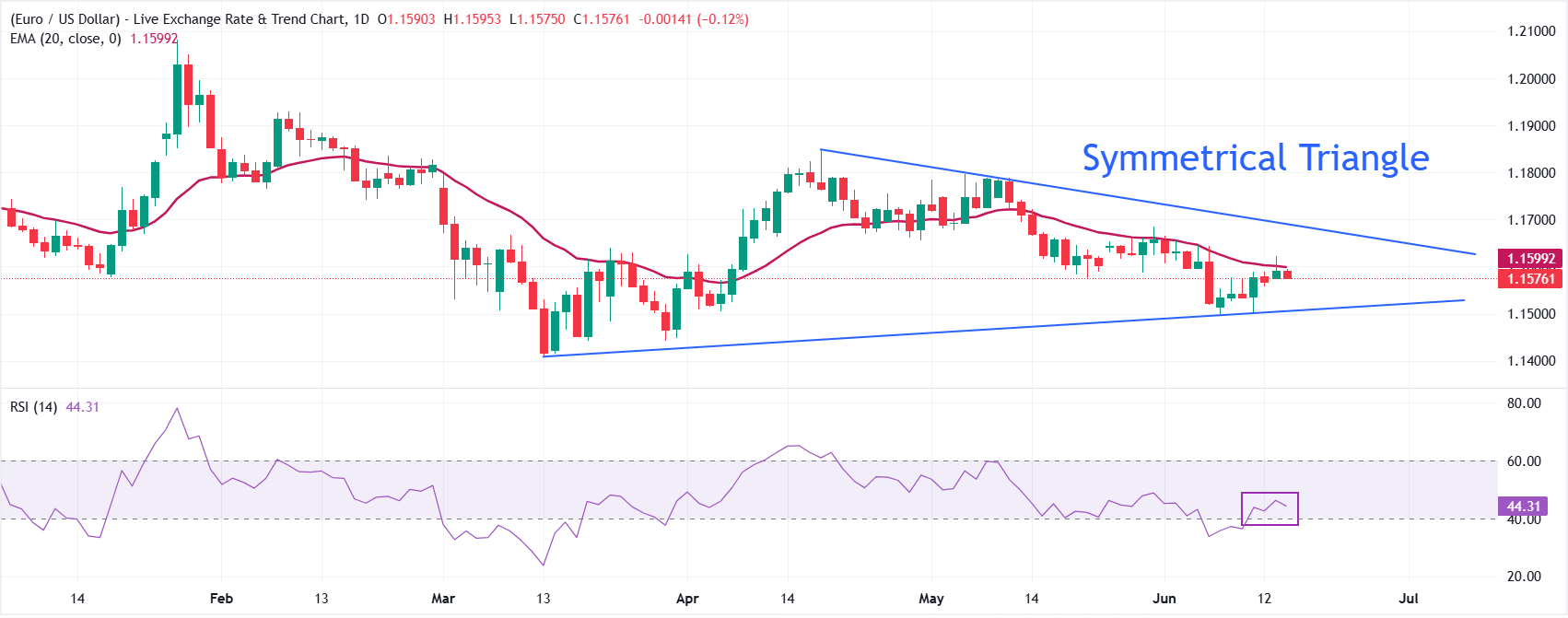
EUR/USD trades lower at around 1.1580, holding a modest bearish bias as it sits just under the 20-period Exponential Moving Average (EMA) at 1.1599 and beneath the descending resistance trend line that comes in from 1.1849.
The price remains above the prior upward support trend line anchored at 1.1409, but the Relative Strength Index (RSI) at around 44 stays below the midline, hinting that recovery attempts are fragile while sellers retain the upper hand.
On the topside, immediate resistance is located at the 20-period EMA near 1.1600, with further hurdles at the downtrend’s break price around 1.1687 and then the 1.1849 origin of the descending line. On the downside, initial support is seen near the former uptrend break area at 1.1506, with a deeper floor at the 1.1409 trend-line start, where a decisive break would reinforce the broader bearish tone.
(The technical analysis of this story was written with the help of an AI tool.)
Economic Indicator
Fed Interest Rate Decision
The Federal Reserve (Fed) deliberates on monetary policy and makes a decision on interest rates at eight pre-scheduled meetings per year. It has two mandates: to keep inflation at 2%, and to maintain full employment. Its main tool for achieving this is by setting interest rates – both at which it lends to banks and banks lend to each other. If it decides to hike rates, the US Dollar (USD) tends to strengthen as it attracts more foreign capital inflows. If it cuts rates, it tends to weaken the USD as capital drains out to countries offering higher returns. If rates are left unchanged, attention turns to the tone of the Federal Open Market Committee (FOMC) statement, and whether it is hawkish (expectant of higher future interest rates), or dovish (expectant of lower future rates).
Read more.Next release: Wed Jun 17, 2026 18:00
Frequency: Irregular
Consensus: 3.75%
Previous: 3.75%
Source: Federal Reserve
Author

Sagar Dua
FXStreet
Sagar Dua is associated with the financial markets from his college days. Along with pursuing post-graduation in Commerce in 2014, he started his markets training with chart analysis.