EUR/USD Price Forecast: Brace for a further sell-off toward 1.1200
- EUR/USD rises to near 1.1395 as the US Dollar corrects ahead of the US CPI data for June.
- US President Trump claims toll rights near the Strait of Hormuz for providing safety to ships.
- Investors await Fed Chair Warsh’s first testimony before Congress.

The Euro (EUR) is up 0.12% to near 1.1395 against the US Dollar (USD) during the early European trading session on Tuesday. The major currency pair rises as the US Dollar corrects ahead of the United States (US) Consumer Price Index (CPI) data for June, which will be published at 12:30 GMT.
At press time, the US Dollar Index (DXY), which gauges the Greenback’s value against six major currencies, trades 0.1% lower to near 101.17. The DXY rose 0.3% to near 101.33 the previous day.
The Greenback strengthened as US President Donald Trump announced the blockade on Iranian seaports and claimed that the US is the rightful recipient of transit fees from ships transiting through the Strait of Hormuz. Washington’s claim on toll fees has lifted oil prices and US Treasury Yields significantly.
The US CPI report is expected to show that the headline inflation cooled down to 3.8% Year-on-Year (YoY) from the previous reading of 4.2%, with core figures growing steadily by 2.9%.
Later in the day, investors will also pay close attention to comments from Federal Reserve (Fed) Chair Kevin Warsh’s first testimony before the US House Financial Services Committee.
EUR/USD technical analysis
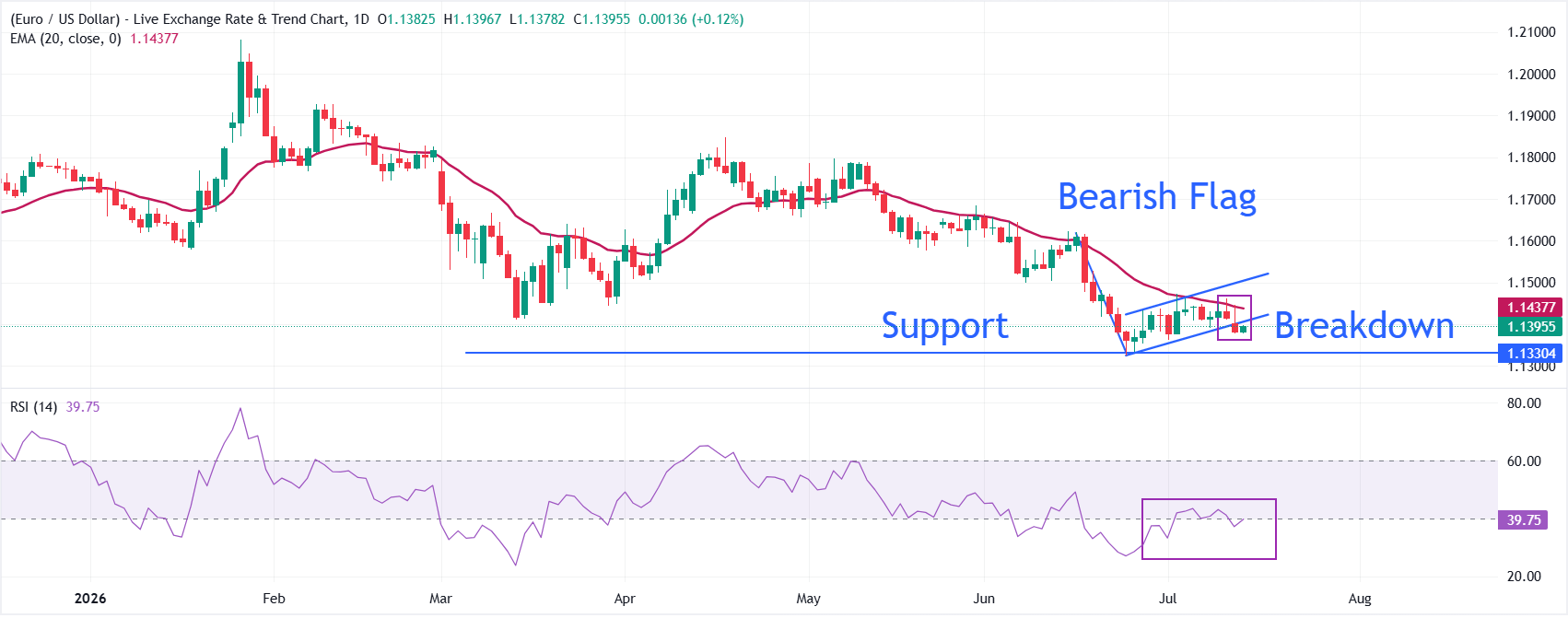
Bias: EUR/USD trades higher at around 1.1395 at press time. However, the near-term bias of the pair is bearish as spot holds below the 20-period Exponential Moving Average (EMA) at 1.1438 and has delivered a Bearish Flag breakdown.
Momentum: The Relative Strength Index (RSI) at 39.7 stays below the neutral 50 line, hinting at lingering downside pressure rather than outright oversold conditions.
Resistance: On the topside, initial resistance is located at the former channel floor around 1.1411, followed by the 20-period EMA at 1.1438, which reinforces the bearish cap, ahead of the channel top near 1.1509 and the more distant trend-line barrier at 1.1618.
Support: On the downside, the major currency pair could slide toward 1.1300 and the 29 May 2025 low of 1.1210 if it breaks below the June low of 1.1325.
(The technical analysis of this story was written with the help of an AI tool. Know more.)
Economic Indicator
Consumer Price Index (YoY)
Inflationary or deflationary tendencies are measured by periodically summing the prices of a basket of representative goods and services and presenting the data as The Consumer Price Index (CPI). CPI data is compiled on a monthly basis and released by the US Department of Labor Statistics. The YoY reading compares the prices of goods in the reference month to the same month a year earlier.The CPI is a key indicator to measure inflation and changes in purchasing trends. Generally speaking, a high reading is seen as bullish for the US Dollar (USD), while a low reading is seen as bearish.
Read more.Next release: Tue Jul 14, 2026 12:30
Frequency: Monthly
Consensus: 3.8%
Previous: 4.2%
Source: US Bureau of Labor Statistics
The US Federal Reserve (Fed) has a dual mandate of maintaining price stability and maximum employment. According to such mandate, inflation should be at around 2% YoY and has become the weakest pillar of the central bank’s directive ever since the world suffered a pandemic, which extends to these days. Price pressures keep rising amid supply-chain issues and bottlenecks, with the Consumer Price Index (CPI) hanging at multi-decade highs. The Fed has already taken measures to tame inflation and is expected to maintain an aggressive stance in the foreseeable future.
Author

Sagar Dua
FXStreet
Sagar Dua is associated with the financial markets from his college days. Along with pursuing post-graduation in Commerce in 2014, he started his markets training with chart analysis.

















