EUR/USD Price Forecast: At make or a break near 1.1330
- EUR/USD rises to near 1.1356 as the US Dollar is under pressure.
- Traders trim hawkish Fed bets as Fed Williams argues against the urgency of further interest rate hikes.
- Investors await the flash German HICP data for September.

The Euro (EUR) is up 0.13% at around 1.1356 against the US Dollar (USD) during the European trading session on Wednesday. The major currency pair gains as the US Dollar comes under pressure, with traders reassessing hawkish Federal Reserve (Fed) expectations after remarks from New York Fed Bank President John Williams in which he refuted urgency after a September interest rate hike.
US Dollar Price Today
The table below shows the percentage change of US Dollar (USD) against listed major currencies today. US Dollar was the weakest against the British Pound.
| USD | EUR | GBP | JPY | CAD | AUD | NZD | CHF | |
|---|---|---|---|---|---|---|---|---|
| USD | -0.13% | -0.48% | -0.13% | -0.07% | 0.23% | -0.10% | 0.04% | |
| EUR | 0.13% | -0.32% | 0.00% | 0.06% | 0.34% | 0.03% | 0.17% | |
| GBP | 0.48% | 0.32% | 0.31% | 0.40% | 0.67% | 0.37% | 0.52% | |
| JPY | 0.13% | 0.00% | -0.31% | 0.06% | 0.37% | 0.02% | 0.20% | |
| CAD | 0.07% | -0.06% | -0.40% | -0.06% | 0.30% | -0.04% | 0.13% | |
| AUD | -0.23% | -0.34% | -0.67% | -0.37% | -0.30% | -0.32% | -0.16% | |
| NZD | 0.10% | -0.03% | -0.37% | -0.02% | 0.04% | 0.32% | 0.16% | |
| CHF | -0.04% | -0.17% | -0.52% | -0.20% | -0.13% | 0.16% | -0.16% |
The heat map shows percentage changes of major currencies against each other. The base currency is picked from the left column, while the quote currency is picked from the top row. For example, if you pick the US Dollar from the left column and move along the horizontal line to the Japanese Yen, the percentage change displayed in the box will represent USD (base)/JPY (quote).
Analysts at MUFG note that the US Dollar’s recent upward momentum has been checked by comments from Fed’s Williams, who “pushed back strongly against building market expectations for the Fed to hike rates again as soon as next month just before the US mid-term elections.”
However, Fed’s Williams didn’t rule out the possibility of further policy tightening. “If economy meets expectations, one further hike likely this year,” Williams said.
According to the CME FedWatch tool, the odds of the Fed delivering an interest rate hike in October have diminished to 44.8% from 70.9% seen on Monday.
On the Euro front, investors await the German preliminary Harmonized Index of Consumer Prices (HICP) data for September, which will be published at 12:00 GMT. The HICP report is expected to show that price pressures accelerated to 3.1% Year-on-Year (YoY) from the final reading of 2.9% in August. On a monthly basis, price pressures are anticipated to have grown 0.5%, faster than the previous reading of 0.2%.
The German inflation data is expected to significantly influence European Central Bank’s (ECB) interest rate projections.
EUR/USD Technical Analysis
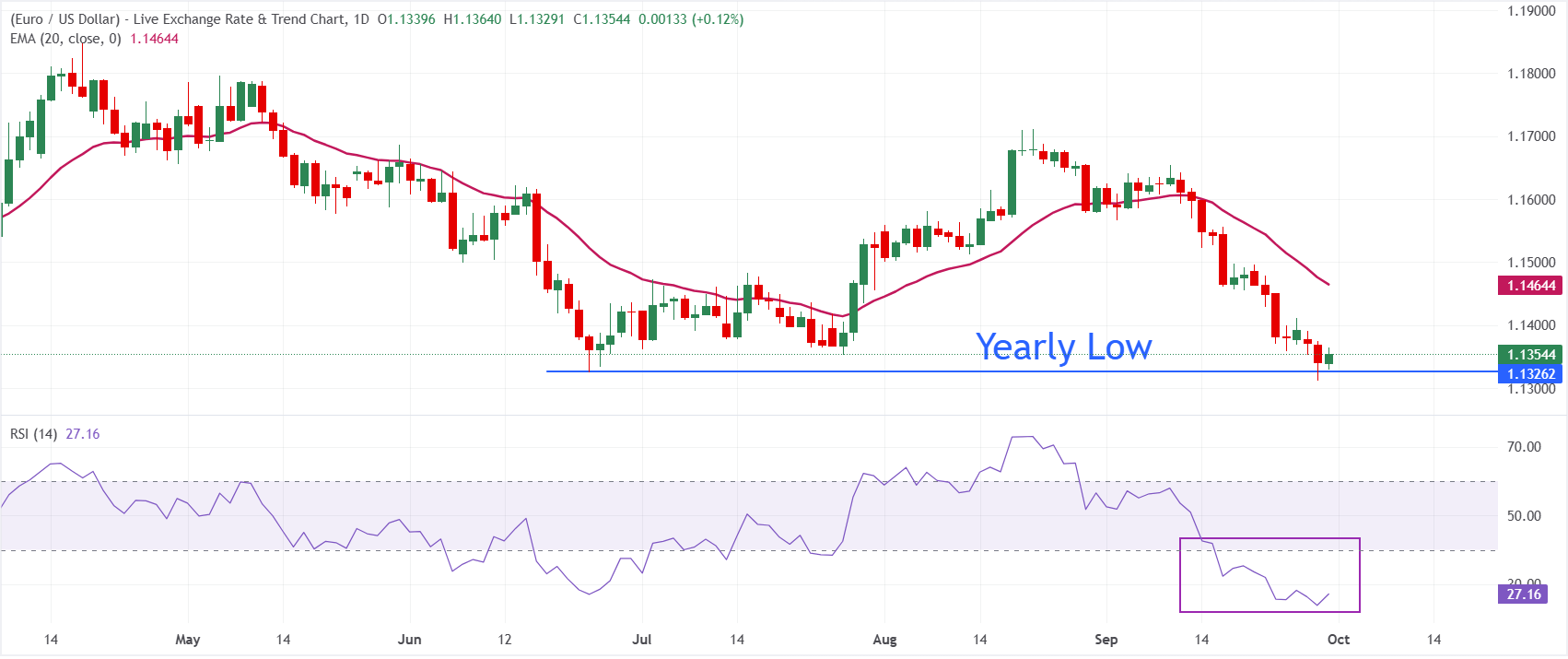
In the daily chart, EUR/USD trades at 1.1355, extending a bearish near-term tone as spot holds below the 20-period exponential moving average (EMA) at 1.1464, which acts as immediate overhead resistance. The pair remains under pressure, but the Relative Strength Index (14) around 27 suggests oversold conditions that could slow the downside, rather than trigger a sustained rebound while price remains capped beneath the EMA.
On the topside, initial resistance is located at the 20-day EMA at 1.1464, and a daily close above this barrier would hint at a corrective recovery rather than a trend change. Looking down, the pair could enter a fresh leg of downside if it decisivly falls below the September 29 low at 1.1312.
(The technical analysis of this story was written with the help of an AI tool. Know more.)
Economic Indicator
Harmonized Index of Consumer Prices (YoY)
The Harmonized Index of Consumer Prices (HICP), released by the German statistics office Destatis on a monthly basis, is an index of inflation based on a statistical methodology that has been harmonized across all European Union (EU) member states to facilitate comparisons. The YoY reading compares prices in the reference month to a year earlier. Generally, a high reading is bullish for the Euro (EUR), while a low reading is bearish.
Read more.Next release: Wed Sep 30, 2026 12:00 (Prel)
Frequency: Monthly
Consensus: 3.1%
Previous: 2.9%
Author

Sagar Dua
FXStreet
Sagar Dua is associated with the financial markets from his college days. Along with pursuing post-graduation in Commerce in 2014, he started his markets training with chart analysis.