EUR/USD hits lows at 1.1775 despite upbeat Industrial Production data
- EUR/USD edges down to session lows at 1.1775 from highs beyond 1.1800 on Tuesday.
- Eurozone Industrial Production increased beyond expectations in February.
- Hopes of a new round of US-Iran negotiations keep the safe haven US Dollar on the defensive.

The Euro (EUR) edges down against the US Dollar (USD) on Wednesday for the first time in the last eight days. The pair trades at 1.1785, at the time of writing, after having reached fresh six-week highs above 1.1810 on Tuesday. Investors have broadly ignored the upbeat Eurozone Industrial Production data, although market hopes of a new round of peace talks between the US and Iran are keeping the Euro steady near recent highs.
Data released by Eurostat earlier on Wednesday revealed that factory output bounced up to a 0.4% growth in February, following a 0.8% decline in January and beating market expectations of a 0.3% gain. The market, however, paid little attention to these figures as they do not reflect the impact of the war in Iran.
With the focus in the Middle East, US President Donald Trump boosted risk appetite on Tuesday, affirming in an interview with the New York Post that peace talks might resume in Islamabad over the next two days. Iranian authorities did not comment on the matter, but United Nations Secretary-General António Guterres affirmed that it is “very probable” that talks will resume this week.
Meanwhile, the US military announced that the blockade in the Strait of Hormuz has been "fully implemented". This measure shuts Iran’s sea trade, which, according to the US Central Command, accounts for about 90% of the country's economy, putting pressure on the Islamic Republic to close a deal, but also worsening the chokehold of global Oil supply.
Also on Tuesday, European Central Bank (ECB) President Christine Lagarde warned that the region’s economy has moved between the ECB’s baseline and adverse scenarios but refused to commit to any specific data for further rate hikes and maintained her data-dependent stance.
In the US, March Producer Price Index (PPI) figures revealed that prices at factory gates rose to a 4% year-on-year rate, from 3.4% in February, but below the 4.6% reading anticipàted by the market. Excluding food and energy, the core PPI rose at a steady 3.8% yearly rate, below the 4.2% expected.
Technical Analysis: Consolidating gains near 1.1825 resistance
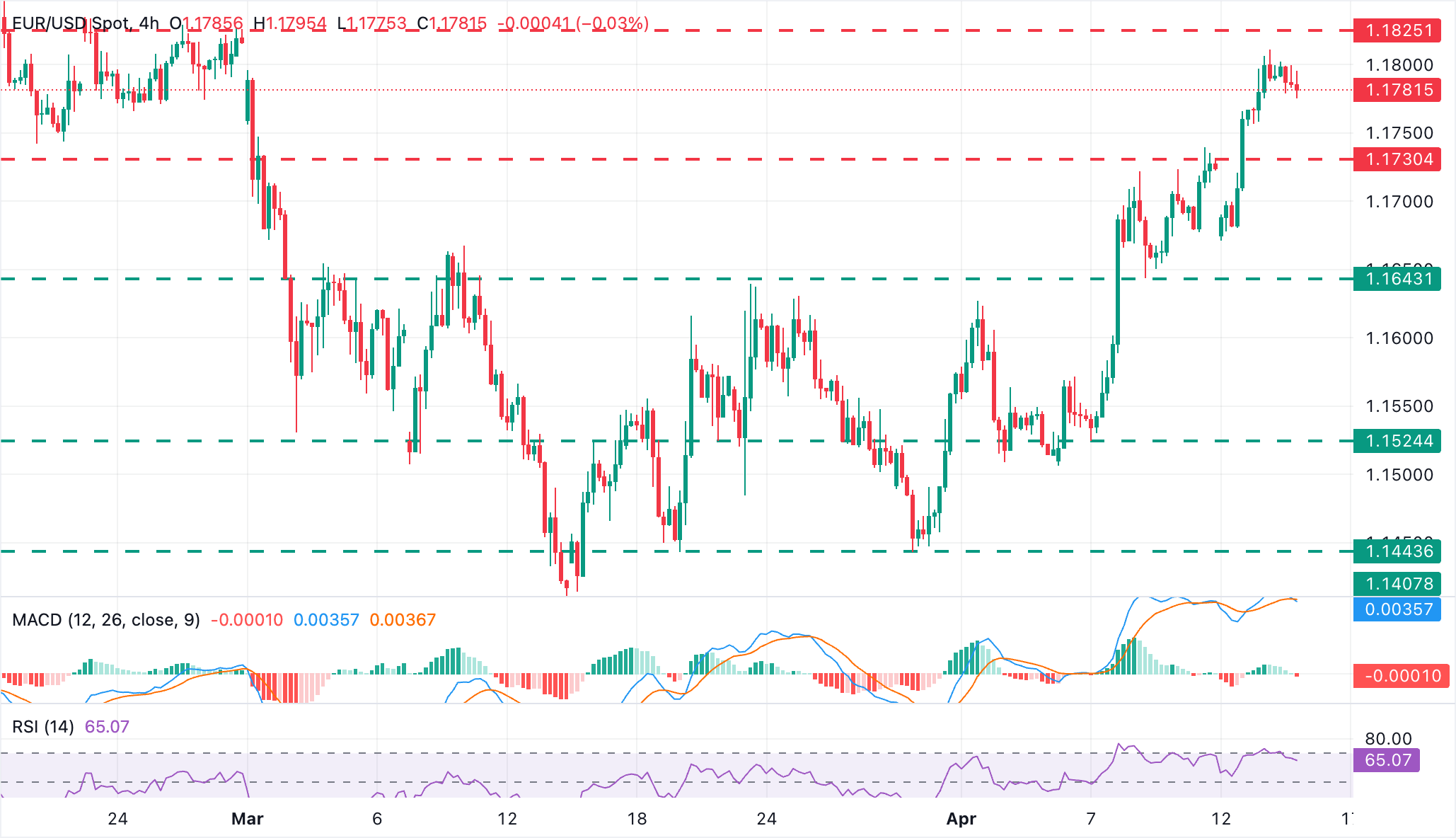
EUR/USD maintains a constructive bullish tone as it holds comfortably near six-week highs. The Relative Strength Index (RSI ) in the four-hour chart stays in positive territory, although the Moving Average Convergence Divergence (MACD) histogram has turned negative, highlighting a weakening bullish momentum.
On the topside, initial resistance aligns at 1.1825, which held bulls on February 26 and 27. Further up, the next target is the February 9, 10, and 11 highs, around 1.1930.
On the downside, downside attempts remain contained above the 1.1780 area for now, closing the path towards previous highs, at the 1.1720-1.1730 area, ahead of the April 8 and 9 lows, near 1.1650.
(The technical analysis of this story was written with the help of an AI tool.)
(This story was corrected on April 15 at 10:05 GMT to add that data stating that sea trade accounts for approximately 90% of the country's economy comes from the US Central Command.)
(This story was corrected on April 15 at 11.30 GMT to say that the EUR/USD trades at 1.1785, and not at 1.1685 as previously stated.)
Economic Indicator
Industrial Production s.a. (MoM)
The Industrial Production index, released by Eurostat on a monthly basis, measures changes in the price-adjusted output of industry. It is a widely-followed indicator to gauge the strength in the Eurozone’s manufacturing sector. Generally, a high reading is seen as bullish for the Euro (EUR), while a low reading is seen as bearish.
Read more.Last release: Wed Apr 15, 2026 09:00
Frequency: Monthly
Actual: 0.4%
Consensus: 0.3%
Previous: -1.5%
Source: Eurostat
Economic Indicator
Industrial Production w.d.a. (YoY)
The Industrial Production is released by the Eurostat. It shows the volume of production of Industries such as factories and manufacturing. Up trend is regarded as inflationary which may anticipate interest rates to rise. Usually, if high industrial production growth comes out, this may generate a positive sentiment (or bullish) for the EUR, while low industrial production is seen as a negative sentiment (or bearish).
Read more.Last release: Wed Apr 15, 2026 09:00
Frequency: Monthly
Actual: -0.6%
Consensus: -1%
Previous: -1.2%
Source: Eurostat
,
Author

Guillermo Alcala
FXStreet
Graduated in Communication Sciences at the Universidad del Pais Vasco and Universiteit van Amsterdam, Guillermo has been working as financial news editor and copywriter in diverse Forex-related firms, like FXStreet and Kantox.














