EUR/USD dips amid strong US retail sales and renewed Fed tightening concerns
- US Retail Sales outpace expectations, with core sales jumping 1%, influencing the GDP consumer spending outlook.
- Wall Street banks, including Goldman Sachs, adjust Q3 GDP predictions in light of robust US economic indicators.
- Fed’s Kashkari highlights persistent inflation concerns and the resilience of the US economy, keeping rate hike speculations alive.

EUR/USD extended its losses on Tuesday for two straight days and clings above the 1.0900 figure after solid data from the United States (US) reignited worries of additional tightening by the Federal Reserve (Fed) amidst a resilient US economy. At the time of writing, the EUR/USD exchanges hands at 1.0903, gaining 0.02% as the Asian session begins.
Solid US economic data and Wall Street’s revised GDP forecasts put pressure on the Euro, as EUR/USD hovers above 1.0900
The EUR/USD seesawed during the session after the US Department of Commerce revealed that Retail Sales in the US exceeded forecasts of 0.4% MoM, with July sales growing by 0.7%, while excluding Autos, also called core retail sales, jumped 1%, smashing estimates of 0.4%. Core Retail Sales correspond closely with the Gross Domestic Product (GDP) consumer spending component.
Initially, the data sent the EUR/USD sliding but options expiring at 10:00 AM NY cut, at around 1.0930-3 topping 1.1 billion and at 1.0940 2.3 billion, triggered a rally in the pair. Past the cut, the EUR/USD reversed its course, finishing the session near the day’s lows.
Following the data, some banks on Wall Street, like Goldman Sachs, revised their Q3 Gross Domestic Product (GDP) forecasts to a 2.2% annualized rate. The Atlanta’s Fed GDPNow model, which estimates GDP expectations, updated its model after Retail sales data showed GDP jumping to 5% from 4.1% foreseen on August 8.
Meanwhile, bets for a pause on hikes by the Federal Reserve (Fed) in September remain intact at 89% after the data, while for November, it stood above 30% chance.
Other data from the US Department of Labor showed that Import and Export Prices rose above estimates. At the same time, the New York Federal Reserve revealed its Manufacturing Index plunged to -19, exceeding projections of -1, after business conditions improved in July.
Minnesota’s Fed President Neil Kashkari crossed the wires, expressing that inflation is still too high, even though he feels good about its progress while noting uncertainty about whether the Fed has done enough or needs to do more. He added US central bank officials are surprised by the economy’s resilience.
EUR/USD Price Analysis: Technical outlook
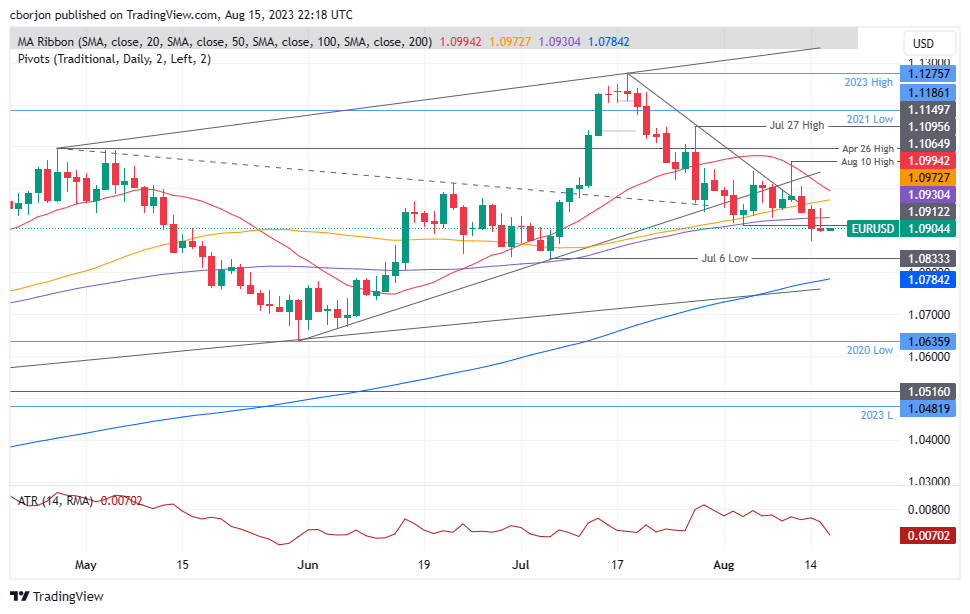
The EUR/USD remains neutral to downward bias, with the pair continuing to print lower highs and lower lows, seen as a pivotal reason for defining a downtrend. On Tuesday, sellers stepped in, dragging the exchange rate below the 100-day Exponential Moving Average (EMA), as they eye a break below the current week’s low of 1.0874. A breach of the latter will expose the July 6 daily low of 1.0833, followed by the 1.0800 mark and the 200-day EMA at 1.0784. Contrarily, EUR/USD buyers must keep prices above 1.0900 if they want to challenge the daily EMAs as first resistance levels, with the 100-day EMA at 1.0930, the 50-day EMA at 1.0972 and the 20-day EMA at 1.0994.
Author

Christian Borjon Valencia
FXStreet
Markets analyst, news editor, and trading instructor with over 14 years of experience across FX, commodities, US equity indices, and global macro markets.