EUR/USD stalls below 1.1435 with US manufacturing data and Fed Powell on focus
- EUR/USD appreciates on Monday, as fresh tariff threats and a trade rift with China hit the USD.
- Looming concerns about US fiscal stability are undermining confidence in US assets.
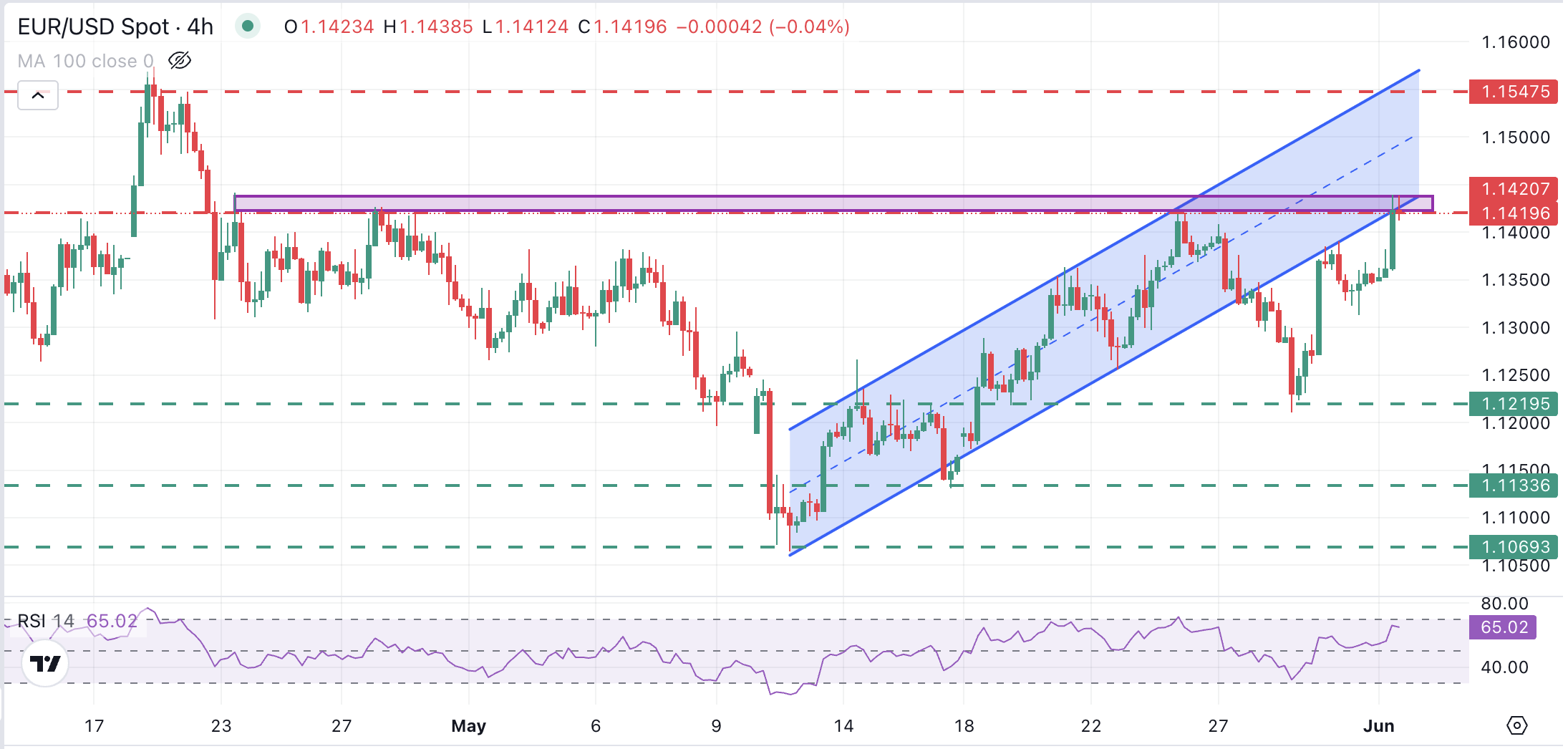
- Euro bulls are being challenged at the 1.1415 -1.1435 resistance area.

EUR/USD has lost bullish momentum after a strong rally during Monday's Asian and early European sessions. The pair hit resistance at 1.1435, but it remains standing comfortably above 1.1400 at the time of writing, as US President Donald Trump’s tariff threats, a new trade rift with China, and ongoing debt concerns keep the US Dollar under pressure.
Trump rattled markets late Friday, announcing to double tariffs on Steel and Aluminum imports, from 25% to 50%. Investors are wary that such levies will hurt economic growth and boost US inflation.
Beyond that, the US president has further poisoned an already frail trade relationship with China, complaining that Beijing violated an agreement on minerals. Chinese authorities have deemed the accusations as “groundless and threatened to respond with forceful measures.”
The focus now is on the US ISM Manufacturing PMI, due later today, ahead of a string of Federal Reserve speakers, ending with Chairman Powell. The market will be attentive to their conclusions on the latest inflation figures to assess the chances of a rate cut in July,
US Dollar PRICE Today
The table below shows the percentage change of US Dollar (USD) against listed major currencies today. US Dollar was the strongest against the Canadian Dollar.
| USD | EUR | GBP | JPY | CAD | AUD | NZD | CHF | |
|---|---|---|---|---|---|---|---|---|
| USD | -0.63% | -0.53% | -0.81% | -0.32% | -0.77% | -0.94% | -0.64% | |
| EUR | 0.63% | 0.09% | -0.16% | 0.30% | -0.14% | -0.34% | -0.02% | |
| GBP | 0.53% | -0.09% | -0.25% | 0.22% | -0.22% | -0.43% | -0.11% | |
| JPY | 0.81% | 0.16% | 0.25% | 0.49% | 0.03% | -0.16% | 0.07% | |
| CAD | 0.32% | -0.30% | -0.22% | -0.49% | -0.45% | -0.64% | -0.32% | |
| AUD | 0.77% | 0.14% | 0.22% | -0.03% | 0.45% | -0.14% | 0.19% | |
| NZD | 0.94% | 0.34% | 0.43% | 0.16% | 0.64% | 0.14% | 0.32% | |
| CHF | 0.64% | 0.02% | 0.11% | -0.07% | 0.32% | -0.19% | -0.32% |
The heat map shows percentage changes of major currencies against each other. The base currency is picked from the left column, while the quote currency is picked from the top row. For example, if you pick the US Dollar from the left column and move along the horizontal line to the Japanese Yen, the percentage change displayed in the box will represent USD (base)/JPY (quote).
Daily digest market movers: The US Dollar opens the week on the back foot
- The Euro is drawing support from US Dollar weakness, with market sentiment faltering ahead of a busy week in terms of data. Asian markets are posting losses, with European and US indexes pointing to negative openings. The US Dollar Index dips 0.3%, retracing Friday’s gains.
- Eurozone's May Manufacturing PMI has been confirmed at 49.4, which marks the fifth consecutive improvement and its best reading in almost three years. German Manufacturing activity, however, has been revised down to 48.3, from a previous 48.8 estimation, which highlights the soft momentum of the region's major economy.
- Earlier on Monday, Federal Reserve (Fed) Governor Christopher Waller remained optimistic about the possibility of interest rate cuts in the coming months, despite higher inflationary tensions stemming from tariffs. His comments have increased negative pressure on the US Dollar.
- The US Personal Consumption Expenditures (PCE) Price Index data released on Friday endorses Fed Waller’s views. The central bank’s inflation gauge of choice year-over-year (YoY) eased to 2.1% in April, from the previous 2.3% and beyond market expectations of a 2.2% reading. Likewise, the core PCE YoY moderated to 2.5% from 2.7% in March.
- US Treasury Secretary Scott Bessent affirmed on Sunday that he is confident that the latest rift with China will be solved when Trump and Chinese President Xi Jinping have a conversation. Beijing’s reactions to the accusation, however, do not give the impression that the Chinese authorities are going to take the first step.
- Euro bulls are likely to be challenged on an event-packed week. Eurozone CPI will be released on Tuesday. Previous inflation data from member countries suggests that price pressures have continued cooling, which paves the way for further monetary easing by the European Central Bank (ECB).
- On Thursday, the ECB is widely expected to cut interest rates for the eighth consecutive time. ECB President Christine Lagarde will try to deliver a neutral message, but with the Eurozone economy stalled and inflation coming down to target, the bank will be forced to ease monetary policy further to support growth. This might trigger some Euro selling.
- In the US, the focus today will be on May’s ISM Manufacturing PMI, which is expected to have improved from the previous month, although still at levels consistent with contraction in the sector’s activity. The US Dollar would need a positive surprise to ease concerns about an economic slowdown.
Technical analysis: EUR/USD is struggling at the 1.1415 - 1.1435 resistance area
EUR/USD is moving up on Monday, with technical indicators pointing higher. Price action has returned to levels right below 1.1400, and looks likely to test the area between 1.1415 and 1.1435 where the pair faces several resistance levels.
A successful move above this area would put bulls back in control and shift the focus towards 1.1545.
Failure to break this level, on the contrary, might put the May 30 low at 1.1315 back in play ahead of the 1.1220 support area.
EUR/USD 4-Hour Chart
Fed FAQs
Monetary policy in the US is shaped by the Federal Reserve (Fed). The Fed has two mandates: to achieve price stability and foster full employment. Its primary tool to achieve these goals is by adjusting interest rates. When prices are rising too quickly and inflation is above the Fed’s 2% target, it raises interest rates, increasing borrowing costs throughout the economy. This results in a stronger US Dollar (USD) as it makes the US a more attractive place for international investors to park their money. When inflation falls below 2% or the Unemployment Rate is too high, the Fed may lower interest rates to encourage borrowing, which weighs on the Greenback.
The Federal Reserve (Fed) holds eight policy meetings a year, where the Federal Open Market Committee (FOMC) assesses economic conditions and makes monetary policy decisions. The FOMC is attended by twelve Fed officials – the seven members of the Board of Governors, the president of the Federal Reserve Bank of New York, and four of the remaining eleven regional Reserve Bank presidents, who serve one-year terms on a rotating basis.
In extreme situations, the Federal Reserve may resort to a policy named Quantitative Easing (QE). QE is the process by which the Fed substantially increases the flow of credit in a stuck financial system. It is a non-standard policy measure used during crises or when inflation is extremely low. It was the Fed’s weapon of choice during the Great Financial Crisis in 2008. It involves the Fed printing more Dollars and using them to buy high grade bonds from financial institutions. QE usually weakens the US Dollar.
Quantitative tightening (QT) is the reverse process of QE, whereby the Federal Reserve stops buying bonds from financial institutions and does not reinvest the principal from the bonds it holds maturing, to purchase new bonds. It is usually positive for the value of the US Dollar.
Author

Guillermo Alcala
FXStreet
Graduated in Communication Sciences at the Universidad del Pais Vasco and Universiteit van Amsterdam, Guillermo has been working as financial news editor and copywriter in diverse Forex-related firms, like FXStreet and Kantox.