Euro drops against Japanese Yen as Bessent’s FX remarks boost JPY
- US Treasury Secretary Bessent backs Japan’s concerns over excessive exchange-rate volatility.
- German inflation rises, lifting bets on ECB rate hike.
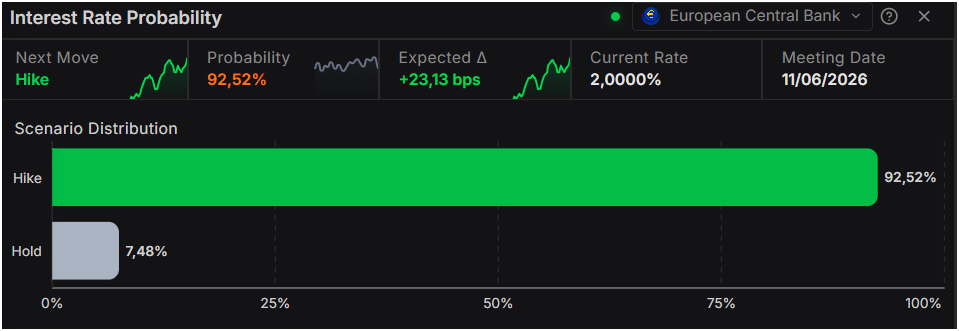
- Traders price in a 92% chance of an ECB rate increase in June.

EUR/JPY falls by some 0.18% on Tuesday as the Japanese Yen (JPY) strengthens after US Treasury Secretary Scott Bessent said excess volatility in the FX markets is undesirable. At the time of writing, the cross-pair trades at 184.93 after peaking at around 185.46.
Yen gains as US-Japan officials warn against FX volatility
Bessent met with the Japanese Prime Minister Sanae Takaichi during his trip to Tokyo. He stated, “I believe the fundamentals of the Japanese economy are strong and resilient, and that will be reflected in the exchange rate.” His comments confirmed what the Japanese Finance Minister Satsuki Katayama said earlier, that she and Bessent reaffirmed close efforts to tackle exchange rate moves.
Inflationary pressures build in Europe; ECB expected to hike
Data in Europe revealed that Germany’s Harmonized Index of Consumer Prices (HICP) rose by 2.9% YoY in April, as expected. Other data showed that economic sentiment in Germany improved in the ZEW Survey of Economic Sentiment from May, rising to -10.2, up from -17.2 and exceeding forecasts of -19.8.
Meanwhile, money markets had begun to price in European Central Bank (ECB) rate hikes due to high energy prices sparked by the US-Iran conflict. Data from Prime Terminal revealed a 92% chance for a 25 basis points increase at the ECB’s June 11 meeting, with traders seeing the ECB’s Deposit Rate ending the year at 2.75%.
ECB’s Joachim Nagel said that if inflation expectations de-anchor, “we will see in June” the chance of a rate hike. ECB’s Patsalides was dovish, saying that there are scenarios in which the ECB wouldn’t need to raise rates.
EUR/JPY Price Forecast: Technical outlook
In the daily chart, EUR/JPY trades at 184.93. The cross holds above the clustered support formed by the simple moving average (SMA) bundle around 184.80 and the two upward-sloping trend-line break levels at 184.19 and 183.85, which together suggest the broader uptrend remains intact despite recent consolidation. The Relative Strength Index (14) sits near 48, hinting at neutral momentum and pointing to a market that is pausing rather than reversing while price stays supported by this underlying structure.
On the downside, immediate support is seen at the SMA cluster near 184.80, with the rising trend lines around 184.19 and 183.85 providing a deeper buffer if sellers press lower. As long as EUR/JPY holds above these levels, dips are likely to be viewed as corrective within the prevailing bullish structure, with the absence of nearby overhead resistance implying that a sustained break higher would open the way for further gains once momentum re-energizes.
(The technical analysis of this story was written with the help of an AI tool.)
Euro Price Today
The table below shows the percentage change of Euro (EUR) against listed major currencies today. Euro was the strongest against the British Pound.
| USD | EUR | GBP | JPY | CAD | AUD | NZD | CHF | |
|---|---|---|---|---|---|---|---|---|
| USD | 0.48% | 0.72% | 0.28% | 0.32% | 0.38% | 0.38% | 0.51% | |
| EUR | -0.48% | 0.23% | -0.17% | -0.19% | -0.11% | -0.10% | 0.03% | |
| GBP | -0.72% | -0.23% | -0.43% | -0.43% | -0.35% | -0.34% | -0.21% | |
| JPY | -0.28% | 0.17% | 0.43% | -0.01% | 0.05% | 0.06% | 0.19% | |
| CAD | -0.32% | 0.19% | 0.43% | 0.01% | 0.07% | 0.07% | 0.19% | |
| AUD | -0.38% | 0.11% | 0.35% | -0.05% | -0.07% | 0.01% | 0.13% | |
| NZD | -0.38% | 0.10% | 0.34% | -0.06% | -0.07% | -0.01% | 0.13% | |
| CHF | -0.51% | -0.03% | 0.21% | -0.19% | -0.19% | -0.13% | -0.13% |
The heat map shows percentage changes of major currencies against each other. The base currency is picked from the left column, while the quote currency is picked from the top row. For example, if you pick the Euro from the left column and move along the horizontal line to the US Dollar, the percentage change displayed in the box will represent EUR (base)/USD (quote).
Author

Christian Borjon Valencia
FXStreet
Markets analyst, news editor, and trading instructor with over 14 years of experience across FX, commodities, US equity indices, and global macro markets.