Dow Jones Industrial Average extends backslide as AI rally sputters
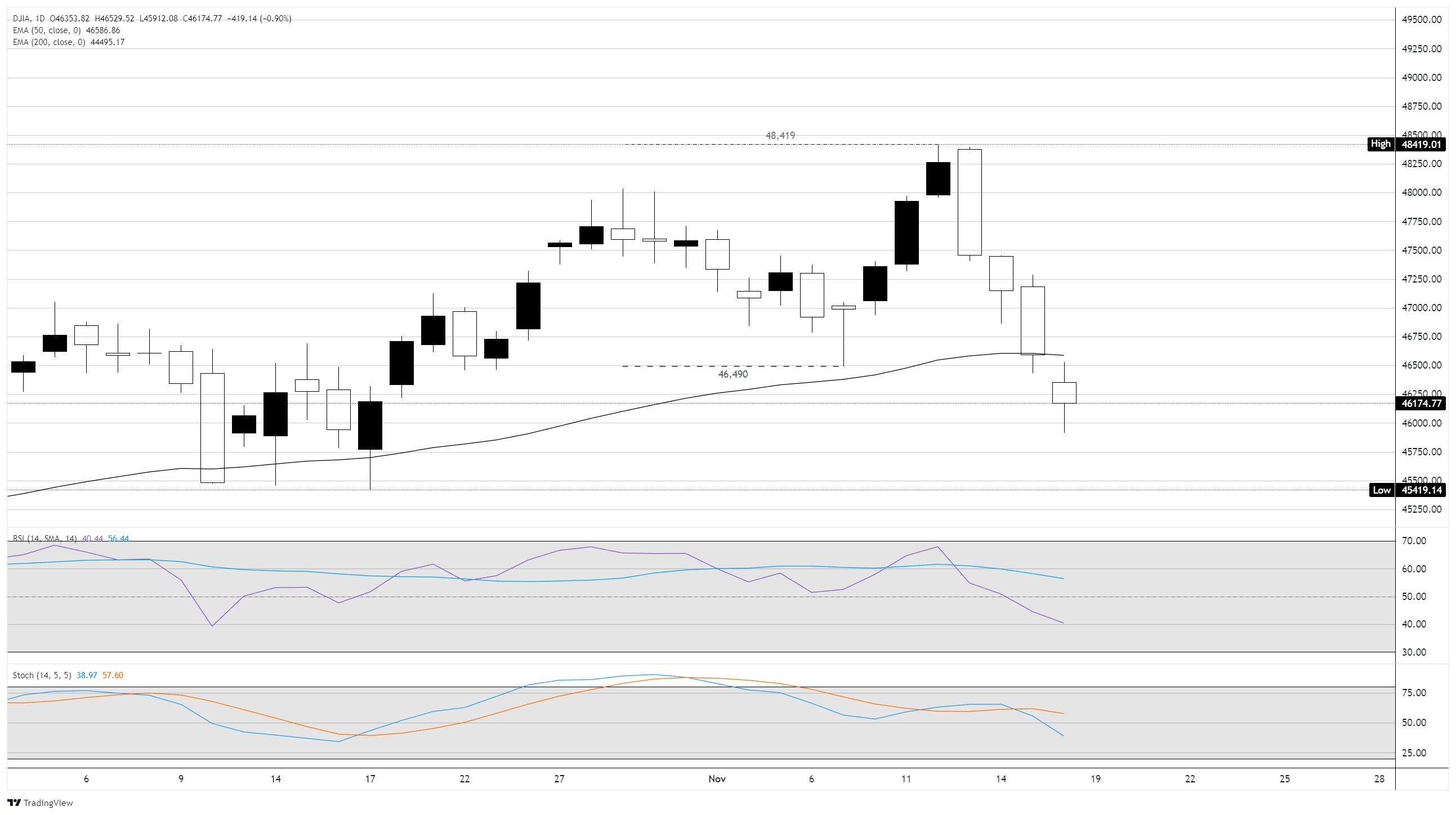
- The Dow Jones fell below key moving averages for the first time in over a month on Tuesday.
- Equities continue to face fresh challenges from concerning US data, AI spend fears, and murky Fed expectations.
- Investors are looking ahead to backdated NFP jobs figures due on Thursday.

The Dow Jones Industrial Average faced renewed downside pressure on Tuesday, tumbling 680 points from the previous day’s close at its lowest before finding a half-hearted technical floor near 46,255. The major equity index has pushed into a fourth consecutive bearish day as investors face headwinds on multiple fronts.
Limited US jobs data does little to help the mood
US labor data continues to tease around the edges of a steepening downturn after US Initial Jobless Claims came in within familiar territory, rising slightly to 232K from the previous print of 219K. ADP’s Employment Change 4-week average improved to -2.5K from the previous -11.25K, but still remains in negative territory. The figures, while not necessarily downbeat on a release-to-release basis, highlight the growing difficulty for the US economy to generate fresh employment opportunities, a requisite for the thundering economic growth that global markets and the Trump administration both require to hit their forecasts and expectations.
The AI rally’s chic chip magnet, Nvidia (NVDA), fell another 1.4% on Tuesday, slipping below $185 per share. Nvidia is down over 15% from record highs posted at the end of October, and has closed in the red or next to flat for all but three of the last 14 consecutive trading sessions. Nvidia’s latest quarterly report is due after the closing bell on Wednesday.
AI investment spend and capex obligations are no longer freely juicing the valuations of tech firms. Another circular investment deal was announced on Tuesday that would see LLM startup Anthropic engage in a roundabout spending spree to the tune of $30 billion with Microsoft (MSFT) and Nvidia. Despite the vast sums of money being earmarked for circular investment schemes between AI flagships and data hardware providers, very little of it is blazing a path towards profitability from LLM ventures that are struggling to find a reliable customer base willing to shell out enough money that will overtake the oceans of equity being poured into building and maintaining AI services.
Key data due this week, will draw plenty of attention
September’s backdated Nonfarm Payrolls (NFP) report, whose release was suspended following the longest US government closure in history, will see daylight on Thursday. Investors are keen to see the figures despite the stale date on the bag as it will serve as one of the few key datapoints available to the Federal Reserve (Fed) before the central bank’s next interest rate decision on December 10.
Fedspeak from various Fed officials has spread into a wider array of stances than is typically seen from the group of policymakers with a history of delivering carefully crafted statements. Key members of the Fed’s Board of Governors, specifically President Donald Trump’s hand-picked policy wonk Stephen Miran, have taken an abruptly dovish stance on interest rates, championing massive interest rate cuts at a time when inflation remains a tricky, sticky beast. Cooler heads with a firmer grasp on the realities of the importance of not stoking further inflation in the name of chasing cheaper debt funding are expected to continue prevailing within the Fed’s rate meetings for the time being.
According to the CME’s FedWatch tool, rate markets are seeing fifty-fifty odds of an interest rate cut in December. Rate market watchers are favouring January to see a third interest rate cut, as Fed decision makers are unlikely to move in either direction following a total data blackout from the government shutdown.
Dow Jones daily chart
Dow Jones FAQs
The Dow Jones Industrial Average, one of the oldest stock market indices in the world, is compiled of the 30 most traded stocks in the US. The index is price-weighted rather than weighted by capitalization. It is calculated by summing the prices of the constituent stocks and dividing them by a factor, currently 0.152. The index was founded by Charles Dow, who also founded the Wall Street Journal. In later years it has been criticized for not being broadly representative enough because it only tracks 30 conglomerates, unlike broader indices such as the S&P 500.
Many different factors drive the Dow Jones Industrial Average (DJIA). The aggregate performance of the component companies revealed in quarterly company earnings reports is the main one. US and global macroeconomic data also contributes as it impacts on investor sentiment. The level of interest rates, set by the Federal Reserve (Fed), also influences the DJIA as it affects the cost of credit, on which many corporations are heavily reliant. Therefore, inflation can be a major driver as well as other metrics which impact the Fed decisions.
Dow Theory is a method for identifying the primary trend of the stock market developed by Charles Dow. A key step is to compare the direction of the Dow Jones Industrial Average (DJIA) and the Dow Jones Transportation Average (DJTA) and only follow trends where both are moving in the same direction. Volume is a confirmatory criteria. The theory uses elements of peak and trough analysis. Dow’s theory posits three trend phases: accumulation, when smart money starts buying or selling; public participation, when the wider public joins in; and distribution, when the smart money exits.
There are a number of ways to trade the DJIA. One is to use ETFs which allow investors to trade the DJIA as a single security, rather than having to buy shares in all 30 constituent companies. A leading example is the SPDR Dow Jones Industrial Average ETF (DIA). DJIA futures contracts enable traders to speculate on the future value of the index and Options provide the right, but not the obligation, to buy or sell the index at a predetermined price in the future. Mutual funds enable investors to buy a share of a diversified portfolio of DJIA stocks thus providing exposure to the overall index.
Author

Joshua Gibson
FXStreet
Joshua joins the FXStreet team as an Economics and Finance double major from Vancouver Island University with twelve years' experience as an independent trader focusing on technical analysis.

















