Dow Jones Industrial Average taps fresh record highs on Monday
- The Dow Jones rose on Monday as equities resumed their upward momentum.
- The Fed’s rate cut last week bolstered general market sentiment, but yields remain elevated.
- Fed policy statements are beginning to diverge wildly as the next rate-cutting cycle begins.

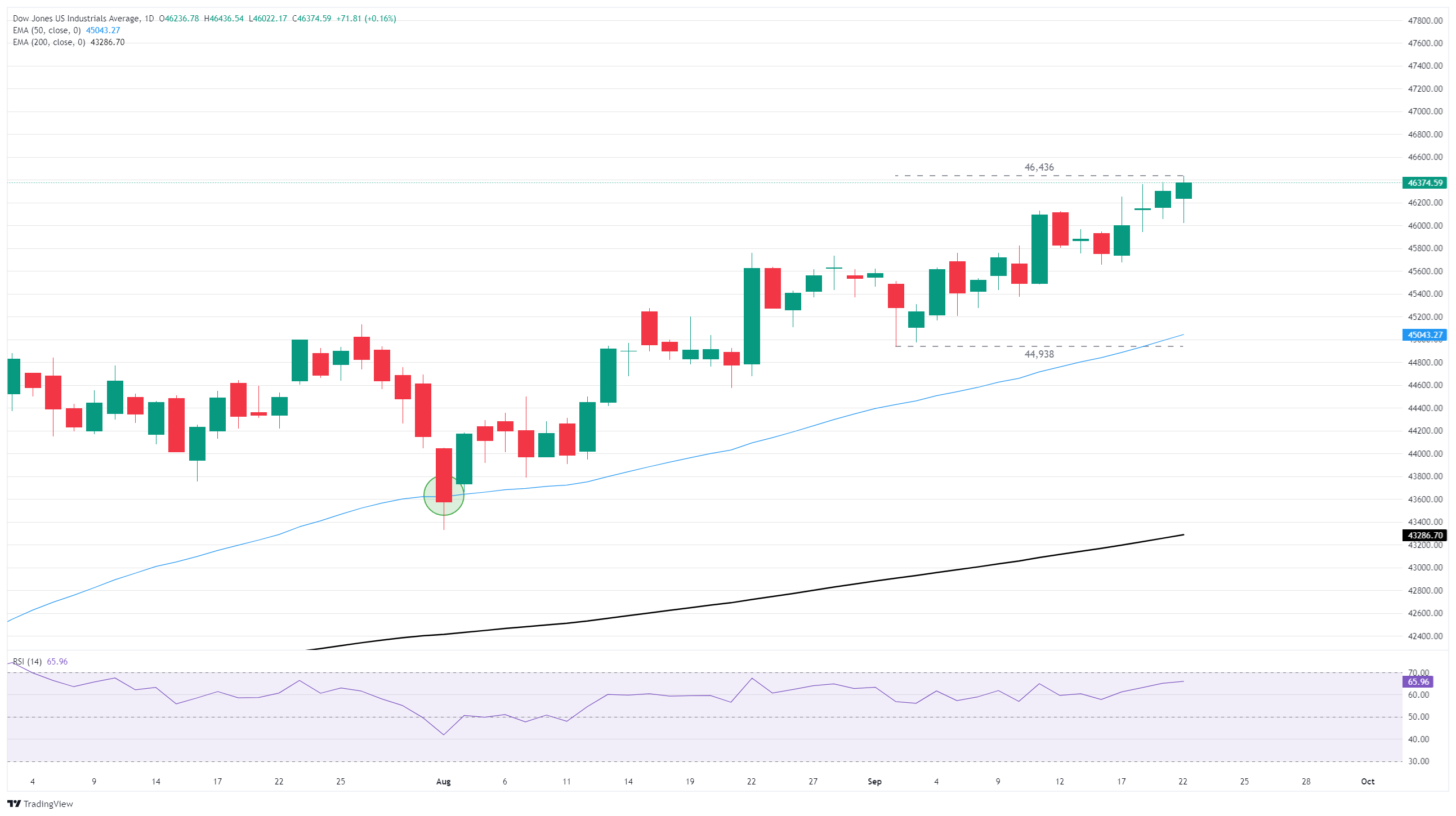
The Dow Jones Industrial Average (DJIA) rose on Monday, testing fresh all-time highs above 46,400. Despite some early session volatility, the Dow is following the rest of the US market higher to kick off the new trading week, with all major indexes showing green across the board.
After closing in the green for two straight weeks, the Dow Jones is firmly on its way to a third bullish weekly candle, pushing bids above last week’s all-time highs to chalk in a fresh peak on Monday. The Dow is up around 2% in September alone, a month that has historically seen ill-tempered equity market performance.
Fed's internal divergence on rate forecast begins to widen
A flurry of Federal Reserve (Fed) policymaker statements greeted markets on Monday, and the narrative thread surrounding policy rate targets is beginning to diverge wildly across the voting body. Donald Trump’s hand-picked Board of Governors member, Stephen Miran, is ramping up his rate-cutting rhetoric, declaring on Monday that the fed funds rate is 200 basis points too high, while also asserting that achieving net zero immigration will both bolster the labor market and tamp down inflation, a policy stance that does not appear to be shared by any of his fellow Fed board members.
A smattering of economic data will greet markets throughout the week. S&P Global Purchasing Managers Index (PMI) survey results for September are due on Tuesday and are expected to show a general decline in both the manufacturing and services segments. US Gross Domestic Product (GDP) growth is slated for Wednesday, and median market forecasts expect annualized Q2 growth to hold steady at 3.3%.
This week’s key data release is set for Friday, when the latest Personal Consumption Expenditures Price Index (PCE) inflation from August will drop on markets. Core PCE inflation is expected to tick down to 0.2% MoM from 0.3%, while the yearly figure is forecast to hold steady at 2.9%, well above the Fed’s 2.0% target.
Dow Jones daily chart
Dow Jones FAQs
The Dow Jones Industrial Average, one of the oldest stock market indices in the world, is compiled of the 30 most traded stocks in the US. The index is price-weighted rather than weighted by capitalization. It is calculated by summing the prices of the constituent stocks and dividing them by a factor, currently 0.152. The index was founded by Charles Dow, who also founded the Wall Street Journal. In later years it has been criticized for not being broadly representative enough because it only tracks 30 conglomerates, unlike broader indices such as the S&P 500.
Many different factors drive the Dow Jones Industrial Average (DJIA). The aggregate performance of the component companies revealed in quarterly company earnings reports is the main one. US and global macroeconomic data also contributes as it impacts on investor sentiment. The level of interest rates, set by the Federal Reserve (Fed), also influences the DJIA as it affects the cost of credit, on which many corporations are heavily reliant. Therefore, inflation can be a major driver as well as other metrics which impact the Fed decisions.
Dow Theory is a method for identifying the primary trend of the stock market developed by Charles Dow. A key step is to compare the direction of the Dow Jones Industrial Average (DJIA) and the Dow Jones Transportation Average (DJTA) and only follow trends where both are moving in the same direction. Volume is a confirmatory criteria. The theory uses elements of peak and trough analysis. Dow’s theory posits three trend phases: accumulation, when smart money starts buying or selling; public participation, when the wider public joins in; and distribution, when the smart money exits.
There are a number of ways to trade the DJIA. One is to use ETFs which allow investors to trade the DJIA as a single security, rather than having to buy shares in all 30 constituent companies. A leading example is the SPDR Dow Jones Industrial Average ETF (DIA). DJIA futures contracts enable traders to speculate on the future value of the index and Options provide the right, but not the obligation, to buy or sell the index at a predetermined price in the future. Mutual funds enable investors to buy a share of a diversified portfolio of DJIA stocks thus providing exposure to the overall index.
Author

Joshua Gibson
FXStreet
Joshua joins the FXStreet team as an Economics and Finance double major from Vancouver Island University with twelve years' experience as an independent trader focusing on technical analysis.














