Dow Jones Industrial Average futures slip on Oil surge, hot US Retail Sales
- DJIA futures pared overnight gains after stronger-than-expected US Retail Sales rekindled inflation concerns and lifted Treasury yields.
- Oil rallied with WTI jumping 4% above $93 per barrel ahead of Wednesday's Iran ceasefire deadline.
- UnitedHealth surged over 6% on a Q1 beat and raised guidance; Amazon climbed on a $25 billion Anthropic investment.
- Focus shifts to Fed's Waller speech, Jobless Claims, and flash PMI data later this week.

Dow Jones Industrial Average (DJIA) futures eased in Tuesday's session, with the contract printing a fresh overnight high near 49,800 before reversing sharply as traders digested a trio of hotter-than-expected US Retail Sales prints and hawkish testimony from Federal Reserve (Fed) Chair-designate Kevin Warsh. The broader cash session saw the DJIA shed roughly 0.2%, the S&P 500 slip 0.3%, and the Nasdaq Composite dip 0.1% as Oil prices ripped higher on renewed Middle East uncertainty.
Hot Retail Sales reignite inflation worry
March Retail Sales surprised sharply to the upside, printing 1.7% month-over-month against a 1.4% consensus. The Control Group reading, which feeds directly into Gross Domestic Product (GDP), came in at 0.7% versus 0.2% expected, while the ex-Autos figure hit 1.9% against 1.4%. The data reinforced the view that US consumers are still spending aggressively despite elevated rates, complicating the Federal Reserve's easing path. DJIA futures rolled over almost immediately after the 12:30 GMT release as Treasury yields pushed higher.
Warsh delivers hawkish message, Waller on deck
Fed Chair-designate Warsh's 14:00 GMT testimony carried a 7.0 hawkish rating in the FXStreet speech tracker, weighing further on rate-sensitive sectors and adding to the afternoon selling pressure. The commentary reinforced market concern that the next Fed chair may be less dovish than President Trump's public rhetoric has suggested. Traders now turn to Fed Governor Christopher Waller's 18:30 GMT speech for further policy cues, with his recent average skew running moderately dovish.
Oil jumps as Iran ceasefire wobbles
West Texas Intermediate (WTI) futures jumped 4% to trade above $93 per barrel, while Brent futures added 2% to top $98, reversing a chunk of last week's decline. Trump told CNBC he expects a "great deal" with Iran but warned the US military is "ready" to strike if no agreement is reached by Wednesday's ceasefire expiration, adding he does not want to extend it. Trump had earlier accused Iran of violating the ceasefire "numerous times" in a Truth Social post. Strait of Hormuz traffic has been choppy, with vessel attacks over the weekend stalling a brief recovery in commercial shipping flow.
UnitedHealth and Amazon stand out
UnitedHealth (UNH) jumped more than 6% after Q1 results topped Wall Street expectations and the health insurance giant hiked its full-year earnings outlook, providing a rare bright spot for the blue-chip index. Amazon (AMZN) climbed over 1% after announcing an investment of up to $25 billion in Artificial Intelligence startup Anthropic, extending the mega-cap's push into AI infrastructure and underscoring continued capex momentum across the sector.
Price action and key levels
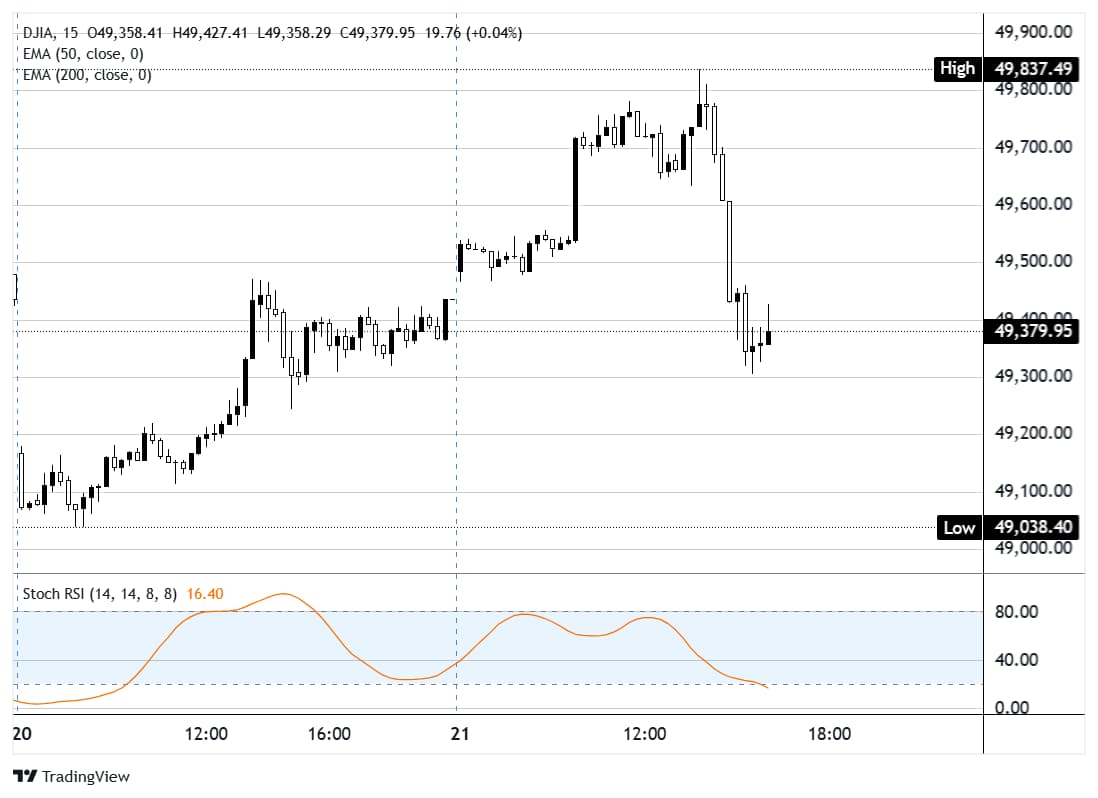
DJIA futures traced a wide two-session range between roughly 49,000 on the low side and just shy of 49,800 at the top, currently trading back near 49,400 after giving up most of the morning rally. The Stochastic Relative Strength Index sits deeply oversold near 16.50 on the 15-minute chart, leaving scope for a near-term technical bounce. Bulls need to reclaim the 49,800 zone to reassert upside momentum, while a decisive break below 49,000 would open room for a test of deeper support.
Looking ahead, traders eye Thursday's Initial Jobless Claims and S&P Global flash Purchasing Managers Index (PMI) readings for April, followed by Friday's University of Michigan (UoM) Consumer Sentiment print, where 1-year inflation expectations at 4.8% and 5-year at 3.4% remain the key data to watch.
Dow Jones 15-minute chart
Dow Jones FAQs
The Dow Jones Industrial Average, one of the oldest stock market indices in the world, is compiled of the 30 most traded stocks in the US. The index is price-weighted rather than weighted by capitalization. It is calculated by summing the prices of the constituent stocks and dividing them by a factor, currently 0.152. The index was founded by Charles Dow, who also founded the Wall Street Journal. In later years it has been criticized for not being broadly representative enough because it only tracks 30 conglomerates, unlike broader indices such as the S&P 500.
Many different factors drive the Dow Jones Industrial Average (DJIA). The aggregate performance of the component companies revealed in quarterly company earnings reports is the main one. US and global macroeconomic data also contributes as it impacts on investor sentiment. The level of interest rates, set by the Federal Reserve (Fed), also influences the DJIA as it affects the cost of credit, on which many corporations are heavily reliant. Therefore, inflation can be a major driver as well as other metrics which impact the Fed decisions.
Dow Theory is a method for identifying the primary trend of the stock market developed by Charles Dow. A key step is to compare the direction of the Dow Jones Industrial Average (DJIA) and the Dow Jones Transportation Average (DJTA) and only follow trends where both are moving in the same direction. Volume is a confirmatory criteria. The theory uses elements of peak and trough analysis. Dow’s theory posits three trend phases: accumulation, when smart money starts buying or selling; public participation, when the wider public joins in; and distribution, when the smart money exits.
There are a number of ways to trade the DJIA. One is to use ETFs which allow investors to trade the DJIA as a single security, rather than having to buy shares in all 30 constituent companies. A leading example is the SPDR Dow Jones Industrial Average ETF (DIA). DJIA futures contracts enable traders to speculate on the future value of the index and Options provide the right, but not the obligation, to buy or sell the index at a predetermined price in the future. Mutual funds enable investors to buy a share of a diversified portfolio of DJIA stocks thus providing exposure to the overall index.
Author

Joshua Gibson
FXStreet
Joshua joins the FXStreet team as an Economics and Finance double major from Vancouver Island University with twelve years' experience as an independent trader focusing on technical analysis.

















