Crude Oil rallies again as Saudi Arabia's route around Hormuz shuts
- WTI Crude Oil rallies 3% to just above $100.00 as Saudi Arabia's bypass pipeline shuts
- Yanbu's tanks hold four days of exports against a three-to-five-week pipeline repair
- Four commodity vessels cleared Hormuz on Monday against a US target near 50 a night

West Texas Intermediate (WTI) Crude Oil trades just above $100.00, up about 3% on the day. It is on track for a third straight weekly gain. Saudi Arabia shut its East-West pipeline on Friday, and until it reopens the price is set by the tank farm at the pipeline's Red Sea end, which holds about four days of exports. Brent, the seaborne benchmark, trades near $108.00. The Fed meets on the consequences on Wednesday.
The pipeline built for a blocked strait lasted six months of one
Saudi Arabia built the East-West pipeline in 1981, during the Iran-Iraq war, so that its Crude Oil could reach the Red Sea port of Yanbu without passing the Strait of Hormuz. It has been the kingdom's export route since Iran blocked the strait in March. The pipe can carry 7 million barrels a day and Yanbu's berths can load about 4.5 million, so the port was always the narrower end.
Drones launched from Iraq's Maysan province hit the line on Thursday, and Riyadh shut it on Friday as a precaution. It blames Iran-backed militias, Tehran denies it, and two regional officials put the repair at three to five weeks. Yanbu's tanks hold about 15 million barrels, four days at the rate they have been loading, and Asian refiners due there this week had no word on delays as of Monday.
The barrel that replaces a Yanbu cargo loads on the Texas coast, which is why a pumping station south of Medina prices West Texas Crude Oil. Kpler puts a month's outage at 120 million barrels, on the assumption that the pipeline was carrying 4.5 million a day. In August it carried 2 million, because Houthi attacks had made the Red Sea leg riskier. The same line lost a pumping station in April, fell to 700K barrels a day and was declared repaired in three days, which is the event that ends this rally whenever it comes.
The alternative to the pipeline is doing four ships a day
Kpler counted four commodity vessels through the Strait of Hormuz on Monday, down from ten on Sunday, against a US target of about 50 a night by the middle of this month. During the summer truce, which lapsed in August, Kpler had about 6 million barrels a day clearing the Gulf, 40% of what the strait carried in 2025.
President Trump says the waterway is acceptable for now, with the US Navy escorting tankers. The Islamic Revolutionary Guard Corps (IRGC) says a Panama-flagged tanker struck a mine. Oman's foreign minister postponed Monday's regional meeting on reopening the strait, citing the need for agreement, which is what the meeting was for.
Yanbu's cargoes are not clear of the war either. They sail north to Suez, and the Houthis, who are reported to hold Perim Island at the mouth of the Red Sea, have begun targeting Saudi ships on that leg as well. The strait and the pipeline are the two ways Gulf Crude Oil reaches a ship, and a barrel loaded at Corpus Christi needs neither, which is what the $100.00 is for.
The reserve built for this has been spent on this
The barrel added 3% on Tuesday against a Dollar Index just under 100 and a Fed that is expected to raise its rate at 18:00 GMT on Wednesday, with the quarter-point priced at 92.5%. Both are supposed to work against it: a stronger Dollar makes the same barrel dearer for every buyer outside the United States, and a higher overnight rate makes it costlier to hold one in a tank. The Fed is moving in part because of this chart, since consumer prices rose 3.4% in the year to August, much of it fuel.
The American Petroleum Institute's inventory count lands at 20:30 GMT on Tuesday, and the Energy Information Administration (EIA) publishes its own at 14:30 GMT on Wednesday. Last week's report had commercial Crude Oil stocks down 0.4 million barrels to 424.1 million, level with the five-year average. The Strategic Petroleum Reserve (SPR) held 285.4 million barrels, its lowest since November 1982, having lent out 130 million since the week the war began. Diesel topped $6 a gallon last week for the first time, which is the demand response the Fed is meeting on Wednesday to arrange.
Levels and bias
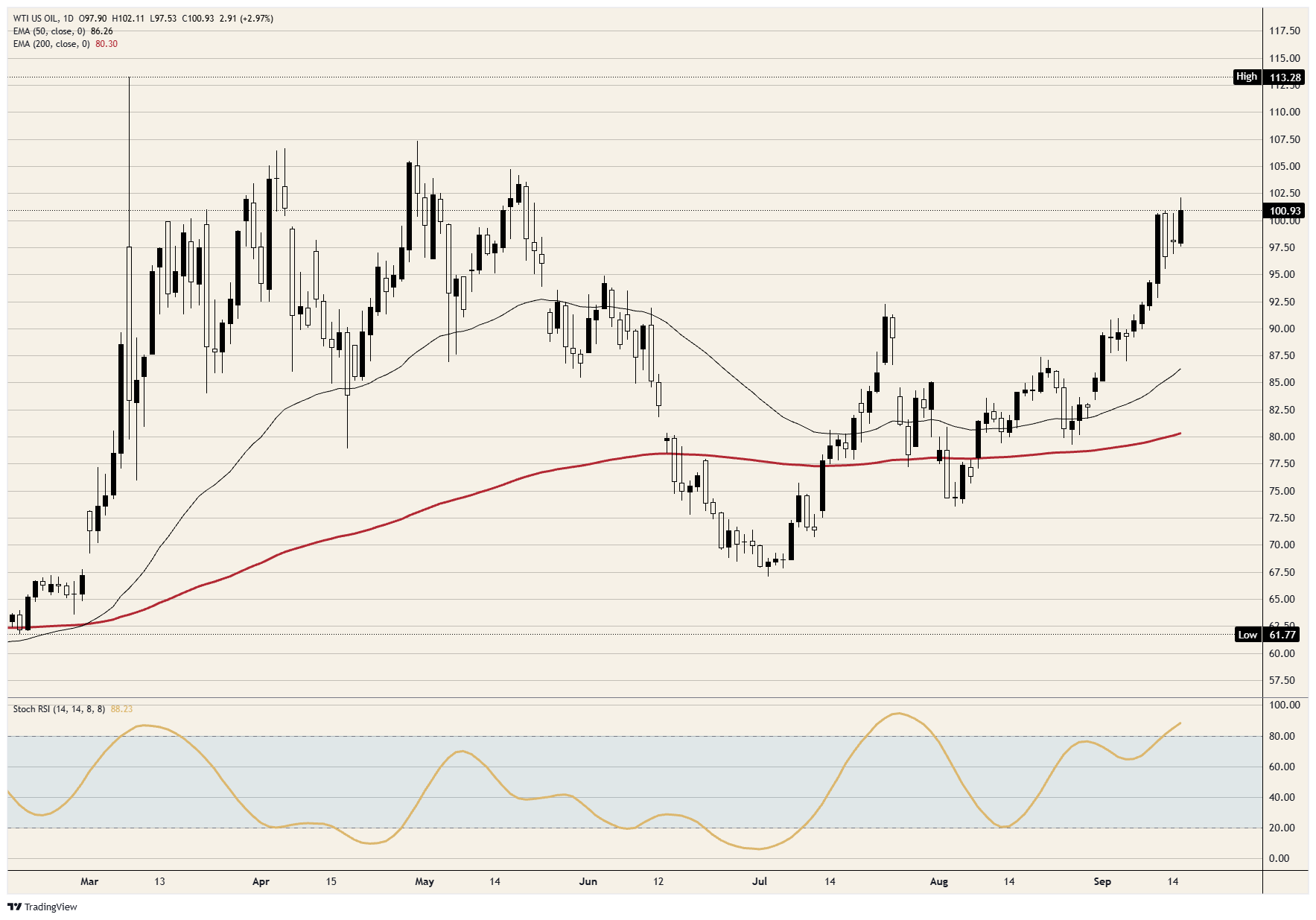
Resistance: Today's high just above $102.00 is the first hurdle. The mid-May highs just under $105.00 are the ones that matter, the last prices paid before the slide to July's low, and the late-April high near $107.50 sits behind them.
Support: Today's low just above $97.50 is the first floor. Friday's low near $95.50 is the one that matters, and last Wednesday's high near $94.50, the top of the range Thursday's attack broke, is beneath it.
Bias: Higher while Friday's low near $95.50 holds on any pullback, with the mid-May highs just under $105.00 the first objective and $107.50 the second. The daily Stochastic Relative Strength Index (Stoch RSI), a momentum gauge, reads near 88, above the 80 line where the March and late-July rallies both topped within days of crossing it. A daily close beneath $94.50 voids the case.
WTI spot daily chart
WTI Oil FAQs
WTI Oil is a type of Crude Oil sold on international markets. The WTI stands for West Texas Intermediate, one of three major types including Brent and Dubai Crude. WTI is also referred to as “light” and “sweet” because of its relatively low gravity and sulfur content respectively. It is considered a high quality Oil that is easily refined. It is sourced in the United States and distributed via the Cushing hub, which is considered “The Pipeline Crossroads of the World”. It is a benchmark for the Oil market and WTI price is frequently quoted in the media.
Like all assets, supply and demand are the key drivers of WTI Oil price. As such, global growth can be a driver of increased demand and vice versa for weak global growth. Political instability, wars, and sanctions can disrupt supply and impact prices. The decisions of OPEC, a group of major Oil-producing countries, is another key driver of price. The value of the US Dollar influences the price of WTI Crude Oil, since Oil is predominantly traded in US Dollars, thus a weaker US Dollar can make Oil more affordable and vice versa.
The weekly Oil inventory reports published by the American Petroleum Institute (API) and the Energy Information Agency (EIA) impact the price of WTI Oil. Changes in inventories reflect fluctuating supply and demand. If the data shows a drop in inventories it can indicate increased demand, pushing up Oil price. Higher inventories can reflect increased supply, pushing down prices. API’s report is published every Tuesday and EIA’s the day after. Their results are usually similar, falling within 1% of each other 75% of the time. The EIA data is considered more reliable, since it is a government agency.
OPEC (Organization of the Petroleum Exporting Countries) is a group of 12 Oil-producing nations who collectively decide production quotas for member countries at twice-yearly meetings. Their decisions often impact WTI Oil prices. When OPEC decides to lower quotas, it can tighten supply, pushing up Oil prices. When OPEC increases production, it has the opposite effect. OPEC+ refers to an expanded group that includes ten extra non-OPEC members, the most notable of which is Russia.
Author

Joshua Gibson
FXStreet
Joshua joins the FXStreet team as an Economics and Finance double major from Vancouver Island University with twelve years' experience as an independent trader focusing on technical analysis.