Crude Oil goes vertical on fresh explosions in southern Iran
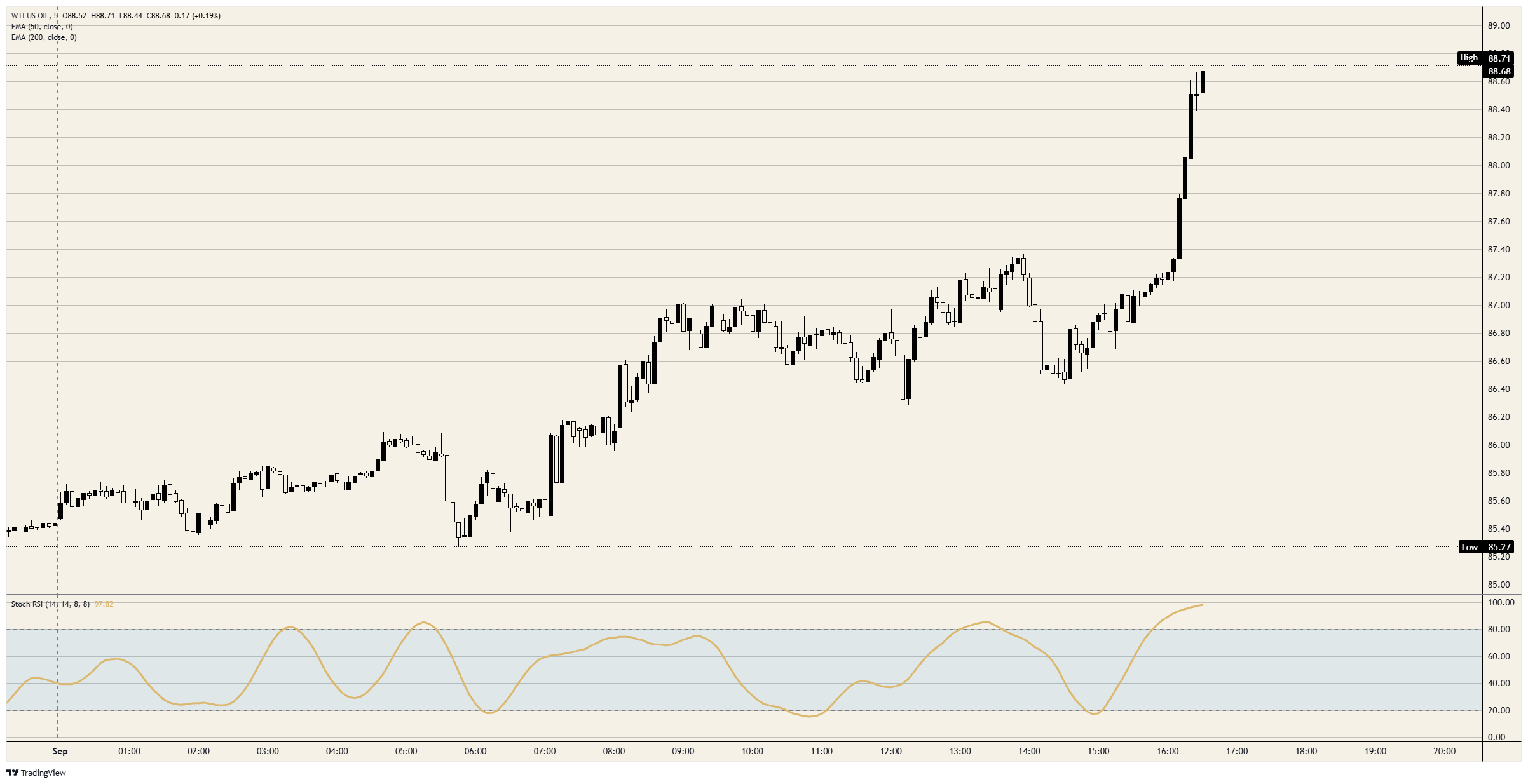
- WTI trades just above $88.00 after a session high just short of $89.00.
- Better than a dollar and a quarter added in three five-minute bars.
- Jask hit, the export terminal built to bypass the Strait of Hormuz.

Crude Oil reached its session high in a straight line rather than a grind, with West Texas Intermediate (WTI) pinned beneath $87.50 through the afternoon before taking better than a dollar and a quarter in three consecutive five-minute bars to print just short of $89.00. It has since given back better than half a dollar to trade just above $88.00, and Brent ran with it to near $93.50.
WTI, 5-minute chart
A campaign, priced before it was confirmed
Central Command has confirmed that American forces began striking Islamic Revolutionary Guard Corps targets at 16:00 GMT, citing recent attempted attacks on commercial shipping in the Strait of Hormuz and on American personnel in the region. The tape had already done its repricing by the time that statement landed, moving on the first wire reports roughly ten minutes after the strikes began.
Reporting sourced to three United States officials had the president weighing a Central Command plan for precisely this, limited strikes inside the strait to stop Iran rebuilding the radar and missile capability it uses to threaten shipping. A campaign with a stated objective and no announced end date prices very differently from one retaliatory night, which is why the repricing arrived all at once instead of building through the afternoon.
The step up sits in the map, not the tonnage
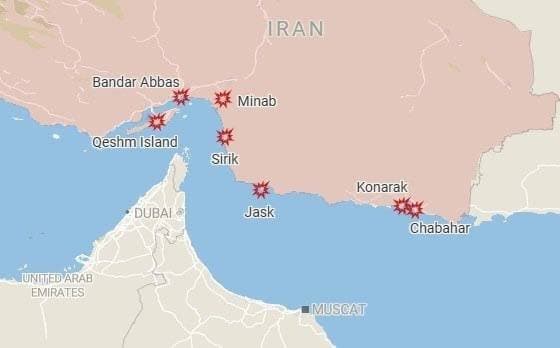
Sunday's action was two rocket launchers on Larak Island, described at the time as limited and precise. What arrived on Tuesday runs the length of the southern coast, with reported targets at Bandar Abbas, Minab, Qeshm and Sirik inside the strait, and at Jask, Konarak and Chabahar beyond it.
That geography is the escalation. Jask is Iran's terminal on the Gulf of Oman, the end of a pipeline built so barrels could leave the country without passing through the Strait of Hormuz, and Chabahar is the only Iranian ocean port outside the Persian Gulf and the workaround to the naval blockade since April. Hitting the bypass alongside the chokepoint attacks export capacity rather than transit capacity, which is the difference between barrels delayed and barrels gone.
The awkward part for anyone chasing the move is the stated objective. The plan exists to make the strait passable, so a version of it that works ends with more barrels moving rather than fewer. Tehran has framed its own reply, with the country's parliament speaker warning this week that if Iran is barred from exporting through the Persian Gulf, no other producer will export either.
No damage assessment exists yet and nothing in the reporting confirms a barrel removed, so what is being bought here is a direction of travel. That has been worth paying for since Sunday, and the give-back off the highs is the market marking the difference between an intention and a shortfall.
Levels to watch
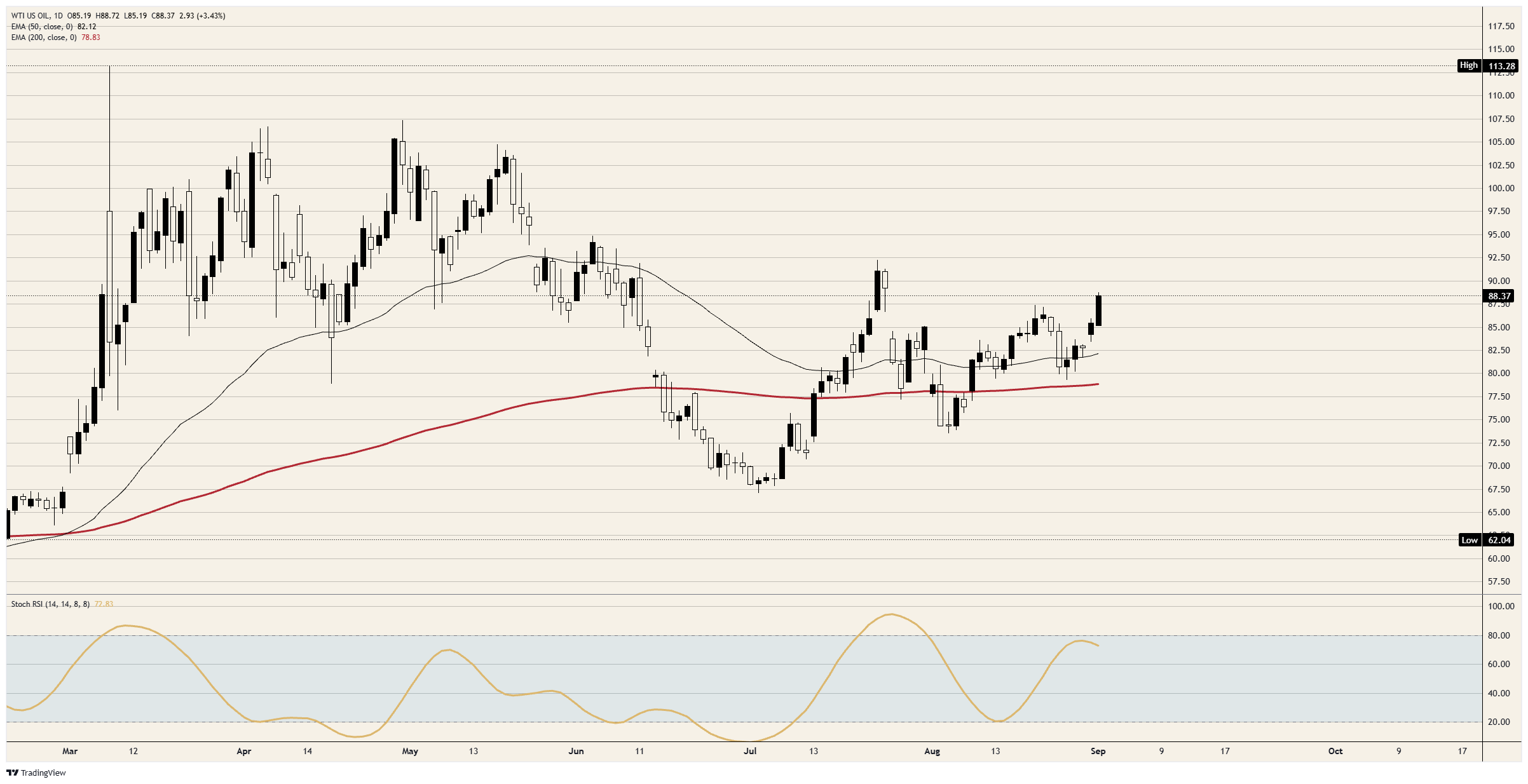
Resistance: The session high just short of $89.00 caps the move, and the round number above it is the first thing a continuation has to take. Beyond that the late-July spike just above $92.00 is the next real mark on the chart, with Brent's equivalent near $96.00.
Support: The reclaimed August ceiling just short of $87.50 is the level a genuine breakout has to defend on the retest, with the session low just above $85.00 beneath it. Further back, the 50-day Exponential Moving Average (EMA) near $82.00 carries the whole August advance.
Bias: Higher while $87.50 holds on the pullback, with the late-July peak above $92.00 the objective. The 5-minute Stochastic Relative Strength Index (Stoch RSI) near 95 is rolling over from the spike and the tape has already surrendered better than half a dollar, so the retest comes first. The daily reading near 73 still has room above it. Invalidation on a daily close beneath $87.00.
WTI daily chart
WTI Oil FAQs
WTI Oil is a type of Crude Oil sold on international markets. The WTI stands for West Texas Intermediate, one of three major types including Brent and Dubai Crude. WTI is also referred to as “light” and “sweet” because of its relatively low gravity and sulfur content respectively. It is considered a high quality Oil that is easily refined. It is sourced in the United States and distributed via the Cushing hub, which is considered “The Pipeline Crossroads of the World”. It is a benchmark for the Oil market and WTI price is frequently quoted in the media.
Like all assets, supply and demand are the key drivers of WTI Oil price. As such, global growth can be a driver of increased demand and vice versa for weak global growth. Political instability, wars, and sanctions can disrupt supply and impact prices. The decisions of OPEC, a group of major Oil-producing countries, is another key driver of price. The value of the US Dollar influences the price of WTI Crude Oil, since Oil is predominantly traded in US Dollars, thus a weaker US Dollar can make Oil more affordable and vice versa.
The weekly Oil inventory reports published by the American Petroleum Institute (API) and the Energy Information Agency (EIA) impact the price of WTI Oil. Changes in inventories reflect fluctuating supply and demand. If the data shows a drop in inventories it can indicate increased demand, pushing up Oil price. Higher inventories can reflect increased supply, pushing down prices. API’s report is published every Tuesday and EIA’s the day after. Their results are usually similar, falling within 1% of each other 75% of the time. The EIA data is considered more reliable, since it is a government agency.
OPEC (Organization of the Petroleum Exporting Countries) is a group of 12 Oil-producing nations who collectively decide production quotas for member countries at twice-yearly meetings. Their decisions often impact WTI Oil prices. When OPEC decides to lower quotas, it can tighten supply, pushing up Oil prices. When OPEC increases production, it has the opposite effect. OPEC+ refers to an expanded group that includes ten extra non-OPEC members, the most notable of which is Russia.
Author

Joshua Gibson
FXStreet
Joshua joins the FXStreet team as an Economics and Finance double major from Vancouver Island University with twelve years' experience as an independent trader focusing on technical analysis.