Confirming a trend using Dow Theory

A trend is very simply a directional movement of price that remains in effect long enough to be identified and still be profitable. Recently there has been much debate over whether the recent run higher in stock has been part of a new bull market or just. Bear market rally. Well, here is a look at what Dow Theory has to say about it.
A brief history of Dow Theory
The Dow Theory was initiated by Charles Dow who died, at a relatively young age, in December 1902. Some of Dow’s friends compiled what is known as ‘Dow Theory’ posthumously as a tribute to their friend’s insightful observations. The Primary trend is according to Dow theory, inviolate. In other words, it is free from being tampered with. Safe, solid, and secure. A Primary trend takes place over many months and sometimes years.
Charles Dow’s way of defying the primary trend
For Dow, a Primary trend was only confirmed in the following situation. When ‘New Highs in the Dow Jones Industrial Average was confirmed by new highs in the Dow Jones Transportation Average’. The same could be said of a Primary bear trend, but the new lows need confirming.
Dow Theory for the modern era
Some analysts prefer to look at the Russell 2000 and the S&P500 as a replacement for the indexes Dow used. The Russell 2000 consists of small US companies with high growth and a strong tech base. The S&P500 represents the most highly capitalised US companies. So, the Primary trend is confirmed when ‘new lows in the S&P500 are confirmed by new low lows in the Russell 2000’. So, what does that show? It shows that the latest primary bear trend was confirmed when the S&P500 made new lows on April 25.
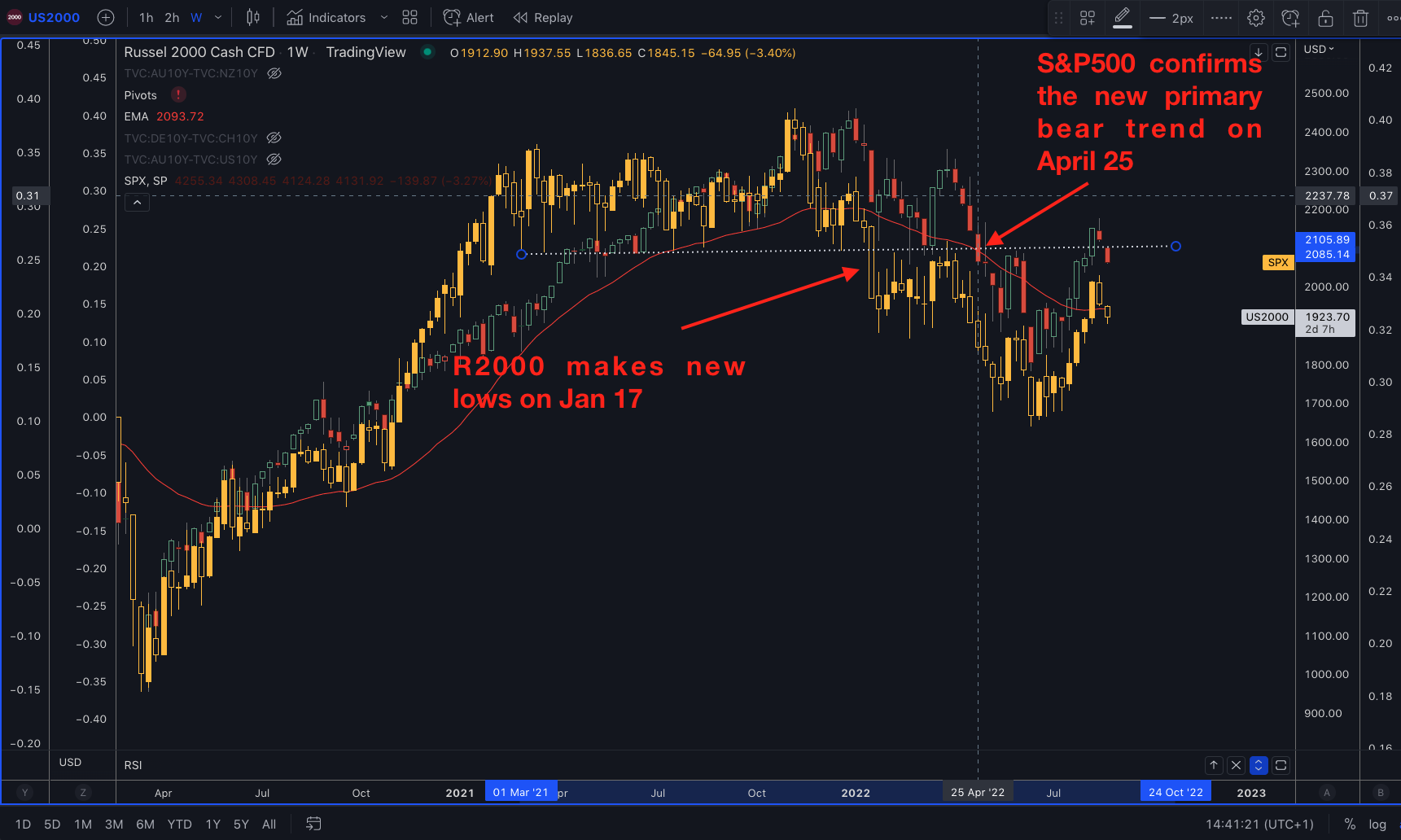
According to Dow Theory, we have simply seen a secondary trend which has been a correction of the primary bull trend. Will Jerome Powell maintain a hawkish stance and send both the R2000 and S&P500 lower in line with that trend? Or will he take a more dovish approach and allow another correction higher in US stocks?
Learn more about HYCM
Author

Giles Coghlan LLB, Lth, MA
Financial Source
Giles is the chief market analyst for Financial Source. His goal is to help you find simple, high-conviction fundamental trade opportunities. He has regular media presentations being featured in National and International Press.

















