Canadian Dollar snaps win streak as Greenback bids return to the fold
- The Canadian Dollar lost ground against the US Dollar on Tuesday.
- Risk aversion has pushed the Greenback higher across the board, forcing the Loonie lower.
- The Israel-Iran conflict, plus a sharp contraction in US Retail Sales, has sparked a risk-off play.


The Canadian Dollar (CAD) shed weight against the US Dollar (USD) on Tuesday, tumbling around one-half of one percent as risk aversion grips investors and send them piling back into the safe haven Greenback. The Israel-Iran conflict continues to heat up, pummeling investor hopes for a quick resolution, and US President Donald Trump is making matters worse by conveying threats to get directly involved in the altercation.
Meaningful Canadian economic data remains functionally absent from the data release schedule this week, and will remain that way until key Canadian Consumer Price Index (CPI) inflation data due at the end of the month. Inflation figures are not expected to provide much support for the Loonie as markets brace for an accelerating downturn in the Canadian economy, keeping the Canadian Dollar at the mercy of global market flows.
Daily digest market movers: Canadian Dollar recedes as Greenback bids come back to life
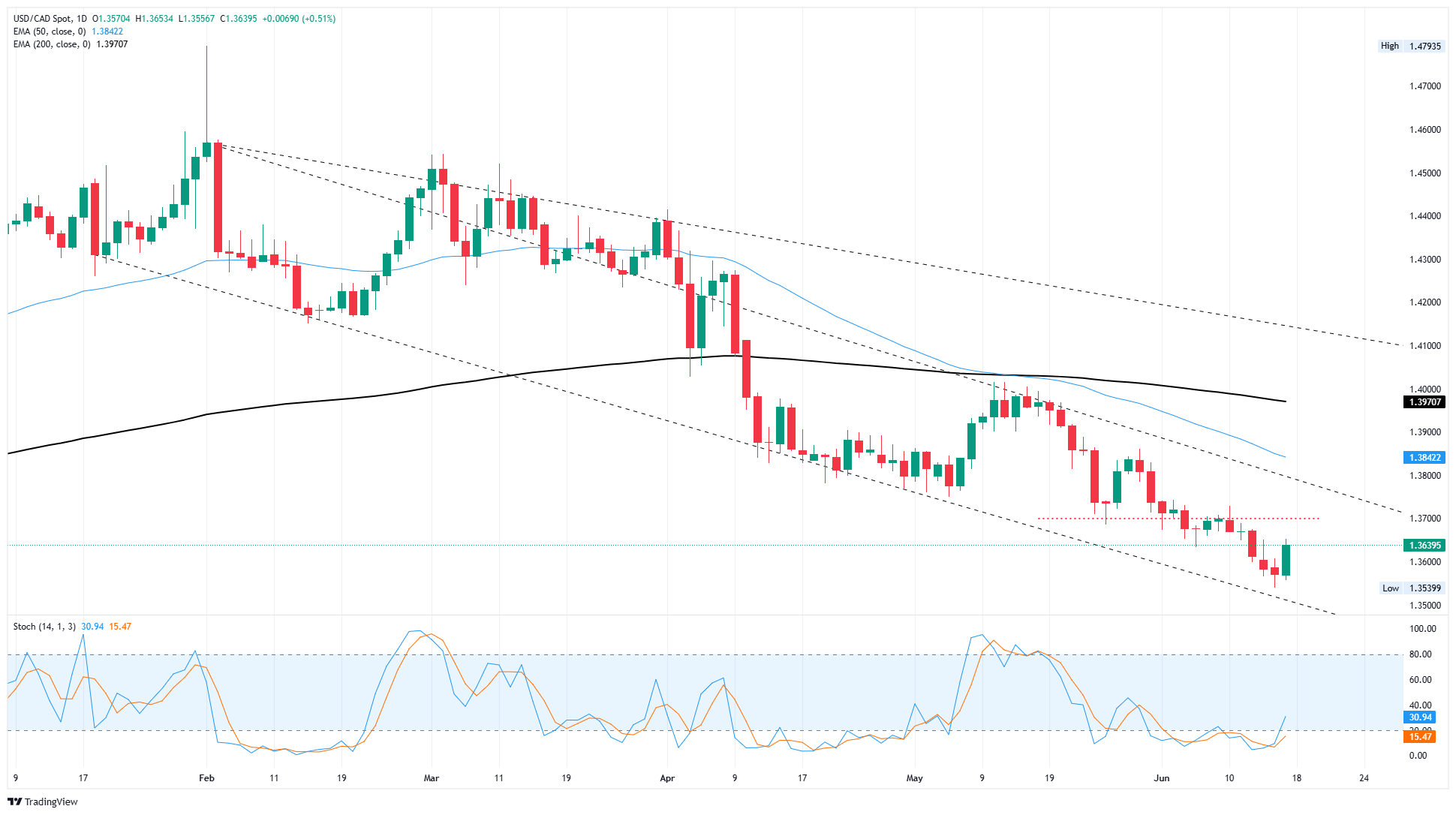
- The Canadian Dollar is receding in the wake of broad-market safe haven flows back into the US Dollar, falling half a percent on Tuesday and pushing USD/CAD back above 1.3600.
- Israel and Iran have extended their tit-for-tat missile strikes into a fifth straight day.
- US President Donald Trump has expressed a willingness to get American assets and personnel directly involved in the conflict, sparking a fresh wave of risk aversion.
- US Retail Sales also contracted more than expected in May, pushing down hopes for a September rate cut.
- The Federal Reserve’s (Fed) next rate call is due on Wednesday, and markets expect another flat hold.
Canadian Dollar price forecast
Tuesday’s walkback of broad-market risk positioning has pulled the Loonie down against the Greenback, bolstering USD/CAD into the 1.3650 region and snapping a multi-session losing streak. The pair is still trapped below key technical resistance priced in near the 1.3700 handle, and bullish momentum has limited room to run before USD/CAD bumps into a sloped ceiling from a descending trendline drawn off the last swing high in mid-May.
USD/CAD daily chart
Canadian Dollar FAQs
The key factors driving the Canadian Dollar (CAD) are the level of interest rates set by the Bank of Canada (BoC), the price of Oil, Canada’s largest export, the health of its economy, inflation and the Trade Balance, which is the difference between the value of Canada’s exports versus its imports. Other factors include market sentiment – whether investors are taking on more risky assets (risk-on) or seeking safe-havens (risk-off) – with risk-on being CAD-positive. As its largest trading partner, the health of the US economy is also a key factor influencing the Canadian Dollar.
The Bank of Canada (BoC) has a significant influence on the Canadian Dollar by setting the level of interest rates that banks can lend to one another. This influences the level of interest rates for everyone. The main goal of the BoC is to maintain inflation at 1-3% by adjusting interest rates up or down. Relatively higher interest rates tend to be positive for the CAD. The Bank of Canada can also use quantitative easing and tightening to influence credit conditions, with the former CAD-negative and the latter CAD-positive.
The price of Oil is a key factor impacting the value of the Canadian Dollar. Petroleum is Canada’s biggest export, so Oil price tends to have an immediate impact on the CAD value. Generally, if Oil price rises CAD also goes up, as aggregate demand for the currency increases. The opposite is the case if the price of Oil falls. Higher Oil prices also tend to result in a greater likelihood of a positive Trade Balance, which is also supportive of the CAD.
While inflation had always traditionally been thought of as a negative factor for a currency since it lowers the value of money, the opposite has actually been the case in modern times with the relaxation of cross-border capital controls. Higher inflation tends to lead central banks to put up interest rates which attracts more capital inflows from global investors seeking a lucrative place to keep their money. This increases demand for the local currency, which in Canada’s case is the Canadian Dollar.
Macroeconomic data releases gauge the health of the economy and can have an impact on the Canadian Dollar. Indicators such as GDP, Manufacturing and Services PMIs, employment, and consumer sentiment surveys can all influence the direction of the CAD. A strong economy is good for the Canadian Dollar. Not only does it attract more foreign investment but it may encourage the Bank of Canada to put up interest rates, leading to a stronger currency. If economic data is weak, however, the CAD is likely to fall.
Author
Joshua Gibson
FXStreet
Joshua joins the FXStreet team as an Economics and Finance double major from Vancouver Island University with twelve years' experience as an independent trader focusing on technical analysis.

















