|

Buyers likely to support Nikkei Futures pullback, eyeing 72,870 extension [Video]

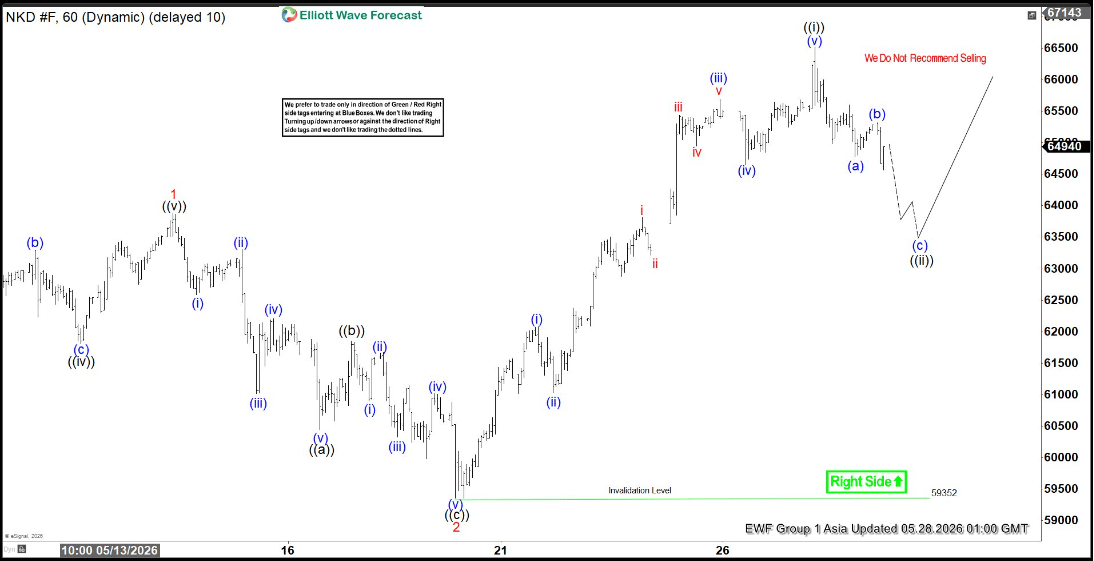
Nikkei Futures (NKD) continues to demonstrate remarkable strength as it extends into new all‑time highs, reinforcing the bullish sequence that began from the March 23, 2026 low. This upward momentum favors additional gains in the near term. From the March 23 low, wave 1 concluded at 63,880, followed by a corrective pullback in wave 2 that ended at 59,352. The internal subdivision of wave 2 unfolded as a zigzag, a common corrective structure, before the Index resumed higher. The decisive break above the wave 1 peak confirmed that wave 3 had begun, signaling continuation of the impulsive advance.

From wave 2, the initial leg wave (i) ended at 62,075, while the subsequent pullback in wave (ii) found support at 61,040. The rally extended further, with wave (iii) reaching 65,695, before a modest dip in wave (iv) concluded at 64,650. The final leg, wave (v), advanced to 66,520, completing wave ((i)) of a higher degree. At present, a corrective phase in wave ((ii)) is unfolding, designed to retrace the cycle from the May 20, 2026 low. This correction is expected to provide a healthy consolidation before the broader rally resumes.

In the near term, as long as the pivotal support at 59,352 remains intact, the pullback should ultimately find support within the typical 3, 7, or 11 swing sequence. Consequently, the broader outlook continues to favor further upside once the current consolidation completes, maintaining the bullish trajectory established since March.

Nikkei Futures 60-minute Elliott Wave chart
Nikkei Futures Elliott Wave [Video]
Youtube preview

Author

Elliott Wave Forecast Team

Elliott Wave Forecast Team

ElliottWave-Forecast.com

More from Elliott Wave Forecast Team
Share:

Editor's Picks

AUD/USD holds above 0.6950 as bullish USD caps gains

AUD/USD edges lower during the Asian session on Tuesday, stalling a two-day recovery move from a two-month low, touched last week. An extended rout in the fixed income market keeps US bond yields elevated near multi-year highs. This, along with geopolitical uncertainties, helps the US Dollar retain its bullish tone despite receding October Fed hike bets. However, expectations for another RBA rate hike this month could act as a tailwind for the Aussie.

USD/JPY rises back above 158.00 despite hawkish BoJ outlook

USD/JPY rises back above 158.00 in the early European morning on Tuesday. The pair strengthens as the Japanese Yen fails to find any inspiration from hawkish BoJ expectations and looming intervention risks. Meanwhile, geopolitical uncertainty and elevated US bond yields keep the US Dollar near its YTD high despite receding October Fed hike bets. This, in turn, helps the pair stay supported.

Gold rebounds from two-month lows as US Dollar, Treasury yields retreat

Gold (XAU/USD) rebounds on Tuesday as a pullback in US Treasury yields weighs on the US Dollar (USD), helping the metal recover after falling to a two-month low of $4,104 during Asian trading hours. At the time of writing, XAU/USD trades around $4,173, up 0.82% on the day.

Crypto Today: Bitcoin, Ethereum, XRP bulls battle to restart uptrend amid ETF outflows

Bitcoin upholds a robust bullish outlook, trading at $85,837 on Tuesday as sellers push to regain control over the trend. Altcoins, meanwhile, reflect Bitcoin’s ranging action, with Ethereum trading sideways above $2,700 and Ripple hovering around the pivotal $1.50 level.

Japanese Yen nears 158.00: Two analysts agree it's bullish, and disagree on how far the breakout goes

The JPY is drifting near 158.00 against the USD ahead of a busy week of Japanese data and a still-unclear BoJ timetable. The two most recent FXStreet analyses agree on the direction, but they disagree on the target and the mechanism.

Eurozone inflation just hit 3.8%, its highest in three years. This chart shows why the ECB can’t simply hike its way out

The ECB would normally have a relatively straightforward answer to inflation running almost twice its target: raise interest rates. But these are not normal circumstances. This time, the bond market is already doing part of the tightening for it, leaving the ECB facing an increasingly difficult dilemma.