British Pound Sterling waits on a forecast the tape has already outrun
- GBP/USD holds a shade under 1.3300 for a second session, pinned beneath a converged moving-average band that has capped every attempt this month.
- Thursday brings a rate decision, minutes and a fresh quarterly forecast round from the Bank of England, with consensus pointing to an unchanged 3.75% on an unchanged 7-2 vote.
- That forecast was conditioned before the war premium drained out of energy, which leaves its inflation profile describing a market that no longer trades.

The Pound spends Tuesday almost perfectly still, trading just under 1.3300 with a session range under 40 pips between a floor above 1.3250 and a ceiling fractionally above 1.3300. That is a second consecutive day of near-total inertia beneath a shelf that took three weeks of defence to break, and it arrives with two central bank decisions and the Federal Reserve's preferred inflation gauge all landing inside three days.
Inertia this deep into a week that heavy is not indecision so much as a verdict, and the verdict is that Sterling is not the variable being solved for. The Dollar Index sits near a five-week high, the front end of the American curve still carries a live hike tail into Wednesday, and the British contribution this week is a document nobody expects to change the rate.
Washington sets the level before London gets a turn
Federal Open Market Committee members opened a two-day meeting on Tuesday, with the decision due at 18:00 GMT Wednesday and the press conference half an hour behind it. Rate futures put the odds of a hike at just over 30%, trimmed from just under 36% at the weekend, so the market has taken money off the July meeting without taking tightening out of the curve.
What the curve did instead was push the same tightening further out. Cumulative odds of at least one hike run above 76% by the September meeting and above 91% by December, with two or more priced at roughly 58%. A Dollar valued against that profile does not need Wednesday to deliver anything, which is exactly why the Pound cannot manufacture a rally out of its own calendar.
A forecast conditioned on a premium that has drained
The Bank of England publishes its decision, minutes and quarterly report at 11:00 GMT Thursday, with the Governor's briefing at 11:30 GMT. Forecast rounds of that kind condition their inflation and growth profiles on market and futures averages struck days before publication, a sensible convention in a quiet quarter and a trap in this one.
Crude Oil has fallen for a third consecutive session as the American and Iranian stand-down runs into a fourth day, with Brent near $84.00 and West Texas Intermediate near $79.00, roughly 16% below last Thursday's peak. The energy path underpinning Thursday's inflation profile was fixed while that premium was still in the price. Canada's own July forecast round hit the identical problem three weeks ago in the opposite direction, and its Governor conceded the point at the podium.
The report also carries the projections that condition the market's own tightening path, which means a softer energy profile lands directly on the two quarter-point rises the curve holds into next spring. A committee that has not changed Bank Rate since December has every incentive to leave that path undisturbed, and the likeliest result is a document that reads more hawkish than the tape it purports to describe.
The vote is the least informative item on the sheet
Consensus expects 3.75% held on a 7-2 split, with two members again preferring 4.00% and none preferring a cut, reproducing June's arithmetic exactly. A vote that repeats itself carries no information, which pushes the entire event risk into the projections and the tone of the briefing. Money markets meanwhile carry Bank Rate approaching 4.25% inside roughly six months.
The tail worth watching is a third dissenter rather than a change in the rate itself. June's split had already doubled the hawkish minority from the single voice recorded in April, so a move to three would mark a second consecutive meeting of expansion inside a committee that has sat still since December. That is the one outcome capable of pulling this pair back through the moving-average band on British merits alone.
The awkward part is that the projections face two directions at once. A profile conditioned on expensive energy reads hawkish against a tape that has cheapened, but the stand-down behind that cheapening is sourced to munitions depth rather than to a signed agreement, and Tehran denies any negotiation beyond a channel with Oman on Strait passage. The forecast can be wrong either way, and this pair will trade the hawkish reading first.
The week ahead
Wednesday's decision is the pivot for every Dollar pair, with no Summary of Economic Projections attached, leaving the statement and the press conference to carry the whole signal. Thursday at 11:00 GMT delivers the British side, where the split and the report land together.
Thursday at 12:30 GMT then stacks the American releases that matter more to Sterling than anything in that report: June core Personal Consumption Expenditures at 0.2% MoM and 3.3% YoY against 3.4% previously, second-quarter Gross Domestic Product at 2.1% annualized, and initial jobless claims at 200K after a 187K print. Friday adds the second-quarter Employment Cost Index at 0.8% and the final University of Michigan survey, where one-year inflation expectations sit at 4.2%.
Technical outlook
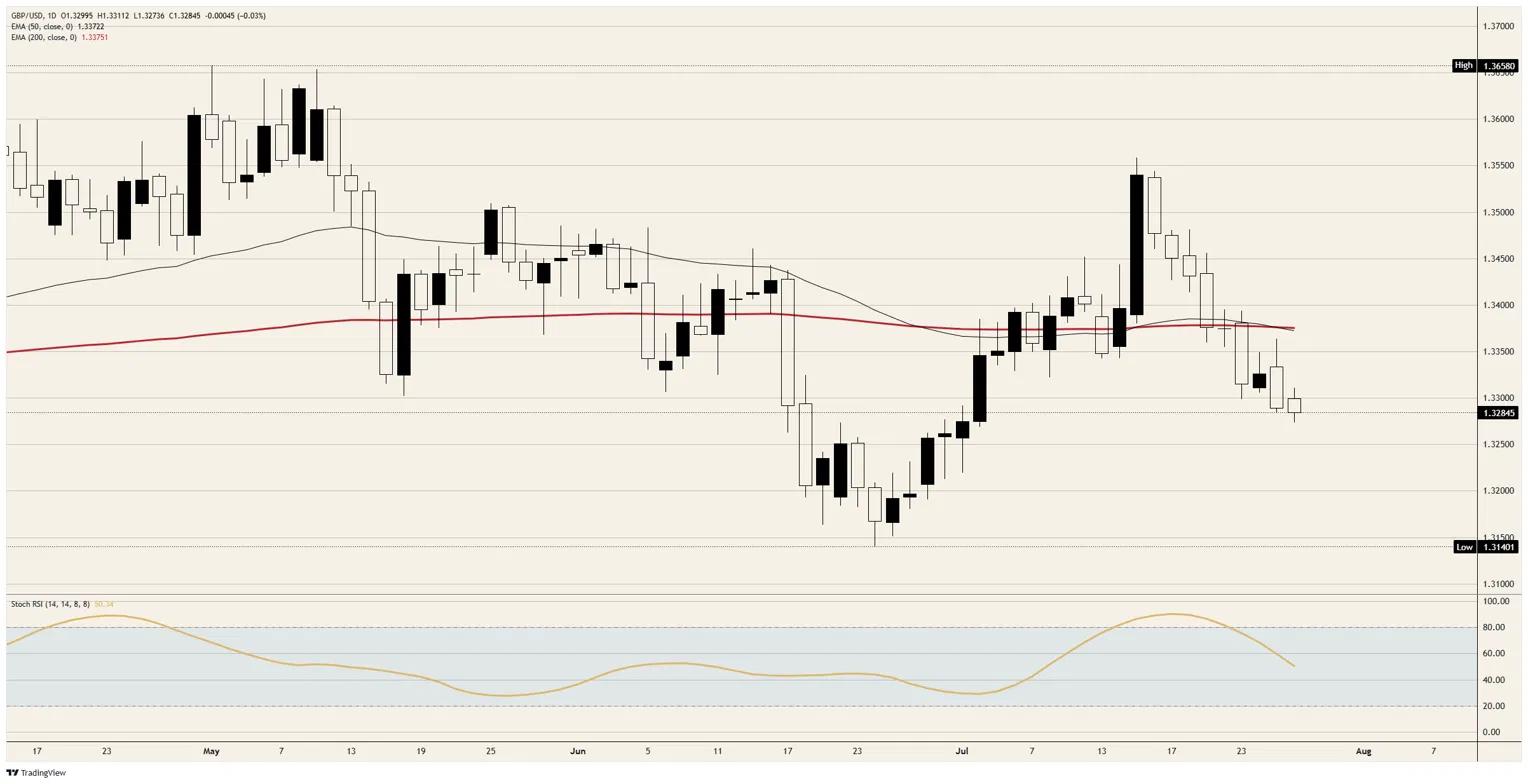
Resistance: 1.3300 is the first line and the failed shelf, with the converged 50-day and 200-day Exponential Moving Averages just below 1.3400 the band that has capped every attempt this month. A daily close above it reopens the mid-July peak near 1.3550.
Support: 1.3250 marks Tuesday's floor and the first objective, with 1.3200 beneath it. The summer base just under 1.3150 remains the structural line and has not been tested since late June.
Bias: Bearish. The daily Stochastic Relative Strength Index near 50 leaves room in both directions, so the case rests on structure rather than momentum: price beneath a declining moving-average band, a shelf lost after three weeks of defence, and an event calendar whose first two items belong to the Dollar. Sell strength into the band. Invalidation is a daily close above 1.3400.
GBP/USD daily chart
Pound Sterling FAQs
The Pound Sterling (GBP) is the oldest currency in the world (886 AD) and the official currency of the United Kingdom. It is the fourth most traded unit for foreign exchange (FX) in the world, accounting for 12% of all transactions, averaging $630 billion a day, according to 2022 data. Its key trading pairs are GBP/USD, also known as ‘Cable’, which accounts for 11% of FX, GBP/JPY, or the ‘Dragon’ as it is known by traders (3%), and EUR/GBP (2%). The Pound Sterling is issued by the Bank of England (BoE).
The single most important factor influencing the value of the Pound Sterling is monetary policy decided by the Bank of England. The BoE bases its decisions on whether it has achieved its primary goal of “price stability” – a steady inflation rate of around 2%. Its primary tool for achieving this is the adjustment of interest rates. When inflation is too high, the BoE will try to rein it in by raising interest rates, making it more expensive for people and businesses to access credit. This is generally positive for GBP, as higher interest rates make the UK a more attractive place for global investors to park their money. When inflation falls too low it is a sign economic growth is slowing. In this scenario, the BoE will consider lowering interest rates to cheapen credit so businesses will borrow more to invest in growth-generating projects.
Data releases gauge the health of the economy and can impact the value of the Pound Sterling. Indicators such as GDP, Manufacturing and Services PMIs, and employment can all influence the direction of the GBP. A strong economy is good for Sterling. Not only does it attract more foreign investment but it may encourage the BoE to put up interest rates, which will directly strengthen GBP. Otherwise, if economic data is weak, the Pound Sterling is likely to fall.
Another significant data release for the Pound Sterling is the Trade Balance. This indicator measures the difference between what a country earns from its exports and what it spends on imports over a given period. If a country produces highly sought-after exports, its currency will benefit purely from the extra demand created from foreign buyers seeking to purchase these goods. Therefore, a positive net Trade Balance strengthens a currency and vice versa for a negative balance.
Author

Joshua Gibson
FXStreet
Joshua joins the FXStreet team as an Economics and Finance double major from Vancouver Island University with twelve years' experience as an independent trader focusing on technical analysis.