British Pound Sterling borrows a month it did not earn
- GBP/USD holds near 1.3600, flat on a 32-pip range, 90 pips off the high.
- The Pound is up 2.2% since late July, the Dollar Index down 2.3%.
- Select committee hearings Thursday are the first BoE event since July 30.

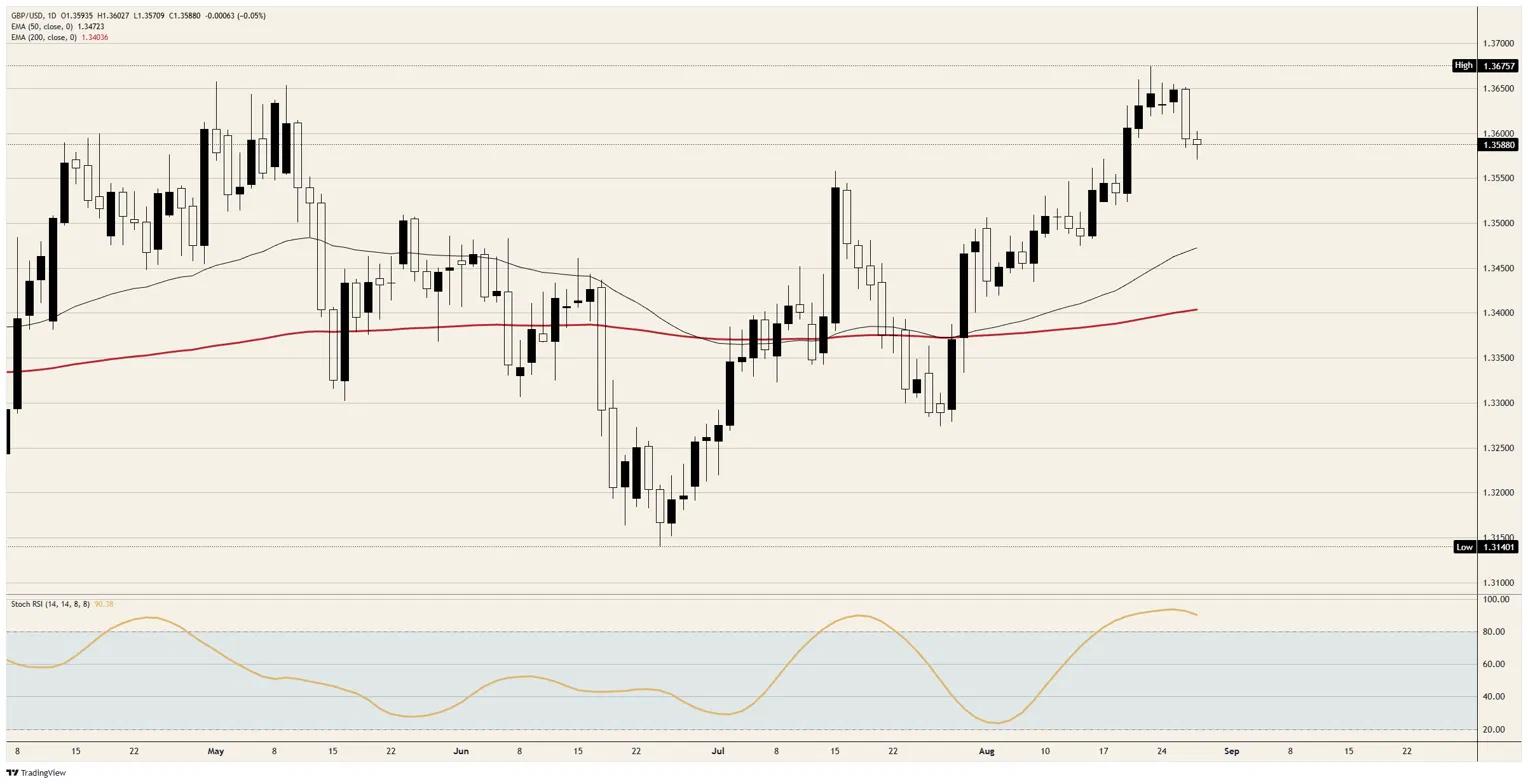
GBP/USD holds near 1.3600 on Thursday, effectively unchanged at minus 0.05% across a range of barely thirty pips, a third session of drift beneath the high just short of 1.3700 posted earlier this week. The pair sits more than a cent above a steeply rising 50-day Exponential Moving Average (EMA) near 1.3450, and the daily Stochastic Relative Strength Index (Stoch RSI) above 90 has started to roll over.
The month is borrowed
Sterling has added roughly 2.2% against the Dollar since the last days of July, when the pair sat near 1.3300. Across the same stretch the Dollar Index has lost roughly 2.3%, falling from just beneath 101.50 to just above 99.00. The two figures differ by about a tenth of a percentage point, which accounts for the entire four-cent move on the other side of the quote.
The Bank of England has been on hold since July 30 and the next decision is September 17, so there has been no domestic policy event in five weeks for any of this to attach itself to. July inflation printed 2.9% with services easing to 3.4% and producer input prices falling, the labour figures softened, and none of it argued for urgency. The Pound has not been bought so much as the Dollar has been sold in front of it, which is a different trade with a different owner.
The posted gap explains none of it. Bank Rate sits at 3.75% against a US target range of 3.50% to 3.75%, so on the nominal spread the two are level, exactly as they were level at 1.3300. What moved is the expected gap, and it moved on the American side: a chair who has removed forward guidance entirely, three July dissents for a hike the committee did not deliver, and a market that has spent August deciding it cannot read the reaction function. Sterling's advantage this month is the absence of somebody else's.
The yield bidding Sterling is a charge
The conventional case rests on a real-rate advantage of roughly 62 basis points and long gilt yields holding above 5%, with the ten-year sitting some 35 to 45 basis points above its Treasury equivalent. Read as carry, that is a reason to own the currency. Read against a country carrying the second-lowest gross debt burden in the Group of Seven, it is a premium being charged rather than a return being offered, and the distinction decides whether the last four cents survive an autumn.
The bill arrives October 28. Borrowing across the first four months of the fiscal year already runs a couple of billion pounds beyond the official forecast, last month produced an unexpected deficit as inflation-linked staff costs consumed strong income tax receipts, and a government installed in July on a promise to use every inch of give inside the existing rules has to show the arithmetic in public. A currency bid on a term premium is long the exact thing that Budget tests.
The British side gets a microphone next week
Friday belongs entirely to the Dollar. The Fed Chair's first Jackson Hole keynote lands at 14:00 GMT as prepared text with no questions taken, sharing the minute with the preliminary annual benchmark revision to the establishment survey. The Chicago Purchasing Managers Index (PMI) precedes it at 13:45 GMT with a 57 consensus from 57.6 prior, and the final August Michigan readings hold at 51 on sentiment and 50.6 on expectations, with one-year inflation expectations at 4.3% and the five-year at 3.3%, each unchanged from the preliminary.
Next Thursday brings the first genuinely British event since July 30. Monetary Policy Report hearings put the committee in front of a select committee under questioning, which for a nine-member panel carrying three hike votes against a Governor resisting is a higher-information setting than any set-piece speech. The Governor then speaks at 08:50 GMT Friday, roughly four hours before August payrolls, where the prior print was minus 23K and unemployment 4.1%. The pair gets one day to establish a domestic reason and then hands itself straight back to the Dollar.
Levels
Resistance: The high just short of 1.3700 is the first line, with the 1.3700 handle immediately above it and 1.3750 the next mark on a break.
Support: 1.3550 is the near shelf and 1.3500 the one that matters, with the 50-day EMA near 1.3450 and the 200-day near 1.3400 beneath.
Bias: Bullish above 1.3500. The trend is intact with price more than a cent clear of both rising averages, but a Stoch RSI above 90 rolling over after a four-cent month argues for consolidation rather than extension into the keynote. Invalidation on a daily close beneath 1.3500, which puts the 50-day EMA in play.
GBP/USD daily chart
Pound Sterling FAQs
The Pound Sterling (GBP) is the oldest currency in the world (886 AD) and the official currency of the United Kingdom. It is the fourth most traded unit for foreign exchange (FX) in the world, accounting for 12% of all transactions, averaging $630 billion a day, according to 2022 data. Its key trading pairs are GBP/USD, also known as ‘Cable’, which accounts for 11% of FX, GBP/JPY, or the ‘Dragon’ as it is known by traders (3%), and EUR/GBP (2%). The Pound Sterling is issued by the Bank of England (BoE).
The single most important factor influencing the value of the Pound Sterling is monetary policy decided by the Bank of England. The BoE bases its decisions on whether it has achieved its primary goal of “price stability” – a steady inflation rate of around 2%. Its primary tool for achieving this is the adjustment of interest rates. When inflation is too high, the BoE will try to rein it in by raising interest rates, making it more expensive for people and businesses to access credit. This is generally positive for GBP, as higher interest rates make the UK a more attractive place for global investors to park their money. When inflation falls too low it is a sign economic growth is slowing. In this scenario, the BoE will consider lowering interest rates to cheapen credit so businesses will borrow more to invest in growth-generating projects.
Data releases gauge the health of the economy and can impact the value of the Pound Sterling. Indicators such as GDP, Manufacturing and Services PMIs, and employment can all influence the direction of the GBP. A strong economy is good for Sterling. Not only does it attract more foreign investment but it may encourage the BoE to put up interest rates, which will directly strengthen GBP. Otherwise, if economic data is weak, the Pound Sterling is likely to fall.
Another significant data release for the Pound Sterling is the Trade Balance. This indicator measures the difference between what a country earns from its exports and what it spends on imports over a given period. If a country produces highly sought-after exports, its currency will benefit purely from the extra demand created from foreign buyers seeking to purchase these goods. Therefore, a positive net Trade Balance strengthens a currency and vice versa for a negative balance.
Author

Joshua Gibson
FXStreet
Joshua joins the FXStreet team as an Economics and Finance double major from Vancouver Island University with twelve years' experience as an independent trader focusing on technical analysis.

















