British Pound rises as Oil slide softens USD, Fed hike bets increase
- Oil retreat pressures Dollar as US-Iran talks regain attention.
- US and UK PMIs show resilience, supporting cautious risk appetite.
- Fed and BoE decisions could reset GBP/USD’s downside path.
The Pound Sterling advances by some 0.20% on Friday as Oil prices tumble, weighing on the US Dollar, while the US-Iran conflict signals a further escalation, which market participants ignored. Despite registering daily gains, the GBP/USD is poised to finish the week with losses of nearly 0.70%.
GBP/USD rebounds as oil weakness offsets Fed hike repricing
Risk appetite has improved as Pakistan’s efforts to help resume talks between the US and Iran provided a tailwind for risk assets. Meanwhile, the US President Trump revealed that China and Russia are not “giving or selling weapons” to Iran, he posted on his Truth Social network. In the meantime, an article in the Wall Street Journal states that “Trump is losing patience over an Iran war with no clear end in sight,” which opens the door to further escalation, as revealed by some US officials.
Data from the US, released by S&P Global, showed that manufacturing activity is easing, as the Manufacturing PMI index fell from 53.9 to 53.8, below estimates for a 54.5 expansion. The Services PMI improved from 51.2 to 53.6, crushing forecasts of 51, boosted by the World Cup hosted in the country.
The scenario hasn’t changed, as expectations are that the Federal Reserve may increase rates in 2026. For the July meeting, the odds of keeping rates unchanged at 3.50%-3.75% stand at 59%, while the odds of a hike stand at 41%, up nearly 8% from a day ago.
In the UK, S&P Global reported that the Composite, Services, and Manufacturing PMIs all expanded, compared to June’s readings, exceeding forecasts. Meanwhile, investors remain uncertain about the fiscal policy of new Prime Minister Andy Burnham, which has capped the GBP/USD pair's advance.
Next week, the Federal Reserve is expected to hold rates unchanged. However, as this week progressed, the chance of a rate increase could reach 50%. This opens the door for a live meeting and an interesting discussion amongst the FOMC board. On Thursday, the Bank of England is most likely to hold rates unchanged, with odds standing at 88%.
Given the backdrop, if the Fed raises rates and the BoE holds, this opens the door to further GBP/USD downside, as the US widens its interest rate differential versus the UK.
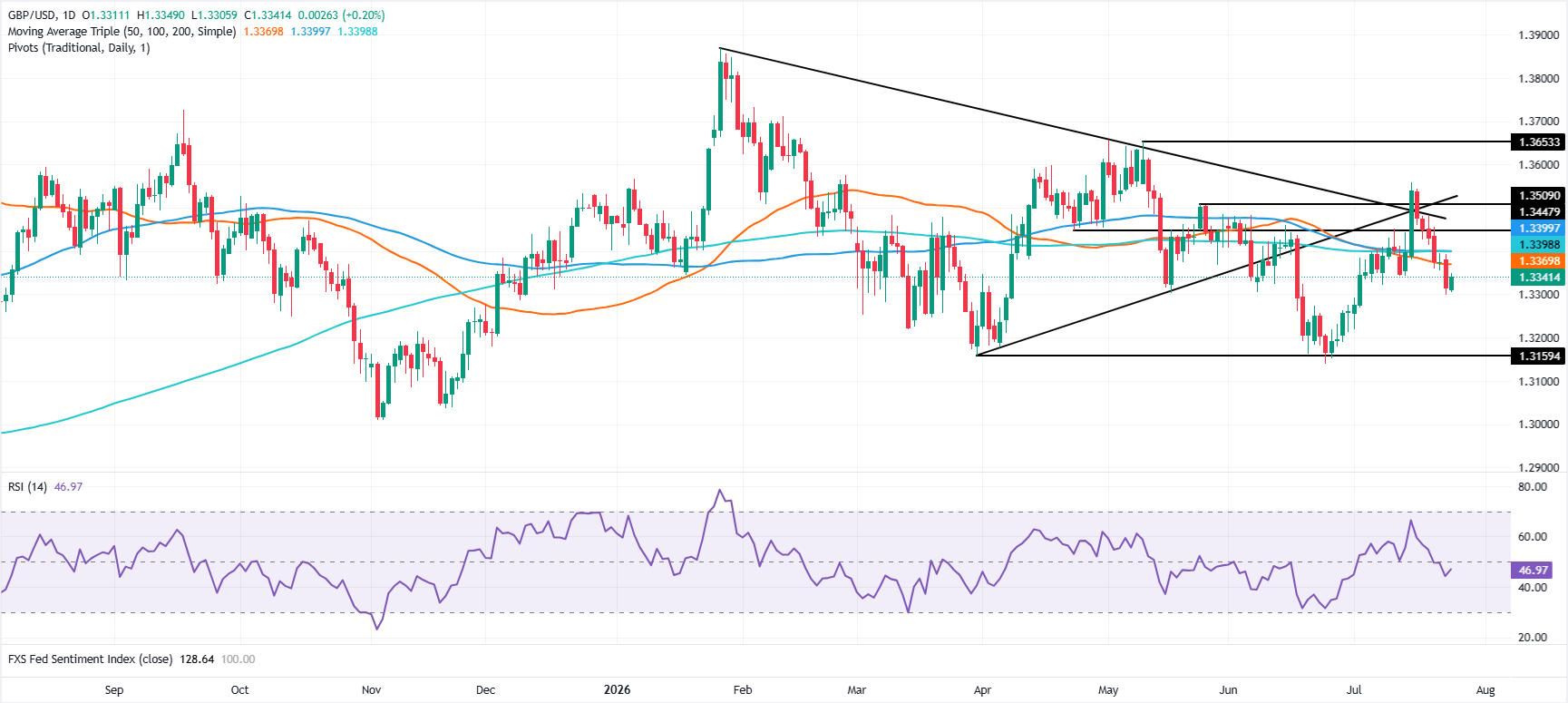
GBP/USD Price Forecast: Technical outlook
Pound Sterling Price This week
The table below shows the percentage change of British Pound (GBP) against listed major currencies this week. British Pound was the strongest against the Swiss Franc.
| USD | EUR | GBP | JPY | CAD | AUD | NZD | CHF | |
|---|---|---|---|---|---|---|---|---|
| USD | 0.39% | 0.84% | 0.85% | 0.47% | -0.41% | 0.58% | 1.02% | |
| EUR | -0.39% | 0.45% | 0.39% | 0.07% | -0.79% | 0.18% | 0.62% | |
| GBP | -0.84% | -0.45% | -0.07% | -0.39% | -1.24% | -0.27% | 0.21% | |
| JPY | -0.85% | -0.39% | 0.07% | -0.29% | -1.20% | -0.32% | 0.27% | |
| CAD | -0.47% | -0.07% | 0.39% | 0.29% | -0.83% | -0.02% | 0.60% | |
| AUD | 0.41% | 0.79% | 1.24% | 1.20% | 0.83% | 0.98% | 1.46% | |
| NZD | -0.58% | -0.18% | 0.27% | 0.32% | 0.02% | -0.98% | 0.48% | |
| CHF | -1.02% | -0.62% | -0.21% | -0.27% | -0.60% | -1.46% | -0.48% |
The heat map shows percentage changes of major currencies against each other. The base currency is picked from the left column, while the quote currency is picked from the top row. For example, if you pick the British Pound from the left column and move along the horizontal line to the US Dollar, the percentage change displayed in the box will represent GBP (base)/USD (quote).
Author

Christian Borjon Valencia
FXStreet
Markets analyst, news editor, and trading instructor with over 14 years of experience across FX, commodities, US equity indices, and global macro markets.