British Pound holds firm as political stability offsets UK growth miss
- UK GDP misses yearly forecasts, but services cushion the slowdown.
- JOLTS vacancies rise, yet hiring weakness clouds labor outlook.
- BoE's Bailey and Fed's Hammack keep inflation and rate risks alive.

The Pound Sterling (GBP) advances 0.11% on Tuesday against the US Dollar (USD) despite UK data showing the economy is slowing, while the latest US jobs report indicated that the number of vacancies rose in May, according to the US Bureau of Labor Statistics. At the time of writing, the GBP/USD pair trades at 1.3270.
GBP/USD gains as politics calm despite weaker UK growth signals
The UK Office for National Statistics reported that Gross Domestic Product (GDP) for Q1 2026 expanded by 0.6% QoQ as expected, boosted by services, specifically computer programming, commented Liz McKewon, the director of economic statistics at the ONS. However, on a yearly basis, the economy grew by 0.9%, below estimates and the prior reading of 1.1%.
Meanwhile, investors continue to digest Andy Burnham's speech, in which he pledged for a radical political change, devolving more power to regions and promoting cooperation over division. Also, he adhered to the fiscal rules developed by the current Chancellor Rachel Reeves.
Cable showed no meaningful reaction to the data, but as of late, GBP/USD cleared Monday's peak following the release of US data.
The US Job Openings and Labor Turnover Survey (JOLTS) jumped unexpectedly in May, an indication that vacancies are rising, but hiring remains weak, according to the Bureau of Labor Statistics (BLS). Job openings rose by 7.594 million, exceeding forecasts of 7.3 million and above the downwardly revised 7.585 million in April.
Other data showed that US Consumer Confidence improved in June as the truce deal between the US and Iran drove gasoline prices lower.
Dana Peterson, the Chief Economist at the Conference Board, said that “Consumer appraisals of current business conditions were slightly more positive compared to last month.” However, she added that perceptions about the labor market had weakened.
Recently, Bank of England (BoE) Governor Andrew Bailey commented that UK inflation could still rise to 3.2% this year, and that it’s important that energy prices are now much higher than before the war in Iran.
Meanwhile, Cleveland Federal Reserve (Fed) Beth Hammack was hawkish, commenting that inflation is too high and that the Fed “may need to consider rate hikes.” Hammack added that if consumer data holds up, this means that policy is not that restrictive.
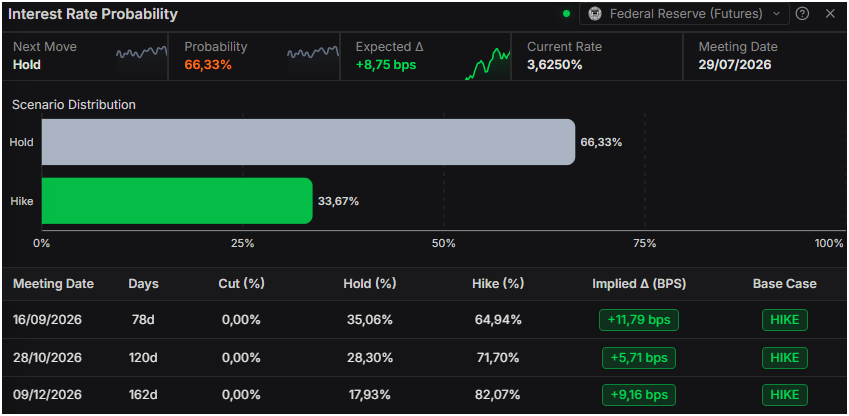
Money markets had priced in 35 basis points of Federal Reserve tightening by the end of 2026. For the July meeting, traders expect the US central bank to hold rates unchanged.
GBP/USD Price Forecast: Technical outlook
In the daily chart, GBP/USD trades at 1.3253, maintaining a bearish near-term tone as spot holds below the cluster of the 50-, 100- and 200-day simple moving averages (SMAs) grouped around 1.3420. The pair also trades beneath both the broken upward trendline at 1.3468 and the former downward resistance line now watched around 1.3526, suggesting rallies remain capped while the Relative Strength Index (RSI) at 42 stays in neutral-to-soft territory.
On the topside, initial resistance stands at the daily SMA cluster near 1.3420, followed by the upward trend-line break level at 1.3468, while a more significant barrier emerges at the prior downward resistance trend-line around 1.3526. On the downside, the lack of nearby mapped structural supports leaves the pair vulnerable to further slippage, with traders likely using intraday lows and psychological handles as interim floors until a clearer technical base develops below the current 1.3253 area.
(The technical analysis of this story was written with the help of an AI tool.)
Pound Sterling Price Today
The table below shows the percentage change of British Pound (GBP) against listed major currencies today. British Pound was the strongest against the Japanese Yen.
| USD | EUR | GBP | JPY | CAD | AUD | NZD | CHF | |
|---|---|---|---|---|---|---|---|---|
| USD | 0.06% | 0.02% | 0.44% | -0.01% | -0.35% | -0.41% | 0.12% | |
| EUR | -0.06% | -0.04% | 0.35% | -0.13% | -0.43% | -0.49% | 0.04% | |
| GBP | -0.02% | 0.04% | 0.39% | -0.09% | -0.36% | -0.44% | 0.08% | |
| JPY | -0.44% | -0.35% | -0.39% | -0.46% | -0.79% | -0.83% | -0.33% | |
| CAD | 0.01% | 0.13% | 0.09% | 0.46% | -0.34% | -0.37% | 0.14% | |
| AUD | 0.35% | 0.43% | 0.36% | 0.79% | 0.34% | -0.03% | 0.50% | |
| NZD | 0.41% | 0.49% | 0.44% | 0.83% | 0.37% | 0.03% | 0.47% | |
| CHF | -0.12% | -0.04% | -0.08% | 0.33% | -0.14% | -0.50% | -0.47% |
The heat map shows percentage changes of major currencies against each other. The base currency is picked from the left column, while the quote currency is picked from the top row. For example, if you pick the British Pound from the left column and move along the horizontal line to the US Dollar, the percentage change displayed in the box will represent GBP (base)/USD (quote).
Author

Christian Borjon Valencia
FXStreet
Markets analyst, news editor, and trading instructor with over 14 years of experience across FX, commodities, US equity indices, and global macro markets.