British Pound climbs on soft US data despite Warsh’s hawkish tilt
- Warsh rejects guidance, keeping price stability as the Fed's priority.
- ADP misses forecasts, hinting at softer private hiring momentum.
- Burnham's fiscal pledge keeps UK political risks contained.

The Pound Sterling (GBP) registers a 0.14% gain on Wednesday amid broad US Dollar (USD) strength and comments by the Federal Reserve (Fed) Chair Kevin Warsh, who reiterated that the central bank would not provide forward guidance, despite accepting that inflation remains too high. At the time of writing, the GBP/USD pair trades at 1.3277 after bouncing off daily lows of 1.3219.
GBP/USD rises as weak US jobs data offsets Dollar strength
At the European Central Bank’s annual policy symposium in Sintra, Portugal, Warsh acknowledged that the Fed doesn’t accept inflation above the 2% target, added that inflation is too high and that the labor market remains steady. He offered no further guidance but stated that the Fed would remain focused on price stability.
The Greenback barely moved on Warsh’s remarks, with the US Dollar Index (DXY), which measures the performance of the USD versus six other currencies, at 101.34, up 0.17%.
Data in the US was mixed, with the ADP Employment Change in June missing estimates of 113K, coming at 98K below May’s 122K. At the same time, the Challenger Job Cuts in June dropped 53%, from 97,006 to 45,849. Digging into the report, layoffs cooled in June due to seasonality, according to Andy Challenger, chief revenue officer at Challenger, Grey & Christmas, who added that employers announced 443,604 job cuts, down 40% compared to the same period last year.
In the UK, investors are focused on politics, following the resignation of Prime Minister Keir Starmer. Andy Burnham, the leader who will succeed him, calmed markets after reiterating that he will stick to the fiscal rules imposed by Chancellor Rachel Reeves.
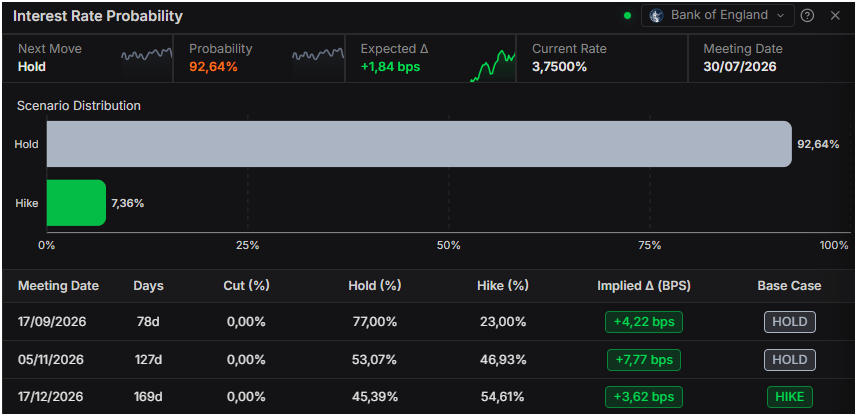
Aside from this, expectations that the Bank of England (BoE) will raise interest rates have tempered, following the US-Iran deal, bringing Oil prices lower. The swaps markets expect at least one rate hike from the BoE in 2026, according to Prime Terminal data.
What’s next in the economic calendar
Focus shifts to US Nonfarm Payrolls data on Thursday, with the US economy expected to add 110K people to its workforce. At the same time, the Unemployment Rate is projected to remain steady at 4.3%.
GBP/USD Price Forecast: Technical outlook
On the daily chart, GBP/USD trades at 1.3269, maintaining a bearish tone as it holds below the key simple moving average (SMA) cluster around 1.3415, while remaining capped well below the downward resistance trend line near 1.3524. The price location beneath these overhead levels suggests rallies are still corrective, with the Relative Strength Index (RSI) at about 44 hinting at subdued upside momentum rather than an immediate oversold rebound.
On the downside, initial support is seen near the upward support trend line starting around 1.3159, where buyers could attempt to slow the decline if the pair extends its pullback. On the topside, a close above the SMA cluster at 1.3415 would be needed to ease the current bearish pressure, while the descending resistance trend line around 1.3524 remains a higher cap that would need to be reclaimed to signal a more meaningful shift in the broader technical picture.
(The technical analysis of this story was written with the help of an AI tool.)
Pound Sterling FAQs
The Pound Sterling (GBP) is the oldest currency in the world (886 AD) and the official currency of the United Kingdom. It is the fourth most traded unit for foreign exchange (FX) in the world, accounting for 12% of all transactions, averaging $630 billion a day, according to 2022 data. Its key trading pairs are GBP/USD, also known as ‘Cable’, which accounts for 11% of FX, GBP/JPY, or the ‘Dragon’ as it is known by traders (3%), and EUR/GBP (2%). The Pound Sterling is issued by the Bank of England (BoE).
The single most important factor influencing the value of the Pound Sterling is monetary policy decided by the Bank of England. The BoE bases its decisions on whether it has achieved its primary goal of “price stability” – a steady inflation rate of around 2%. Its primary tool for achieving this is the adjustment of interest rates. When inflation is too high, the BoE will try to rein it in by raising interest rates, making it more expensive for people and businesses to access credit. This is generally positive for GBP, as higher interest rates make the UK a more attractive place for global investors to park their money. When inflation falls too low it is a sign economic growth is slowing. In this scenario, the BoE will consider lowering interest rates to cheapen credit so businesses will borrow more to invest in growth-generating projects.
Data releases gauge the health of the economy and can impact the value of the Pound Sterling. Indicators such as GDP, Manufacturing and Services PMIs, and employment can all influence the direction of the GBP. A strong economy is good for Sterling. Not only does it attract more foreign investment but it may encourage the BoE to put up interest rates, which will directly strengthen GBP. Otherwise, if economic data is weak, the Pound Sterling is likely to fall.
Another significant data release for the Pound Sterling is the Trade Balance. This indicator measures the difference between what a country earns from its exports and what it spends on imports over a given period. If a country produces highly sought-after exports, its currency will benefit purely from the extra demand created from foreign buyers seeking to purchase these goods. Therefore, a positive net Trade Balance strengthens a currency and vice versa for a negative balance.
Author

Christian Borjon Valencia
FXStreet
Markets analyst, news editor, and trading instructor with over 14 years of experience across FX, commodities, US equity indices, and global macro markets.

















