British Pound climbs as soft US inflation data hurt Fed hawkish bets
- GBP/USD rises as softer US PPI weighs on the US Dollar.
- Jobless claims increase, reinforcing September Fed hold expectations.
- UK GDP meets estimates, keeping BoE inflation data in focus.

The Pound Sterling (GBP) registers modest gains versus the Greenback on Thursday as US inflation data in the producer side came in below or in line with estimates, showing that the disinflation process continues. At the time of writing, the GBP/USD pair trades at 1.3503, up 0.06%.
GBP/USD firms as softer US PPI bolsters Fed hold expectations
Data from the US has weakened the Greenback, as indicated by the US Dollar Index (DXY), which tracks the performance of six currencies against the Greenback, down 0.14% to 99.83.
The US Producer Price Index (PPI) in July ticked lower from 5.5% to 4.7% YoY, below forecasts of 4.9%. Core figures, which exclude volatile items, decreased as expected from 4.7% to 4.2% YoY. At the same time, the US Department of Labor reported that Initial Jobless Claims for the week ending August 8 rose from 200K to 209K, above estimates of 202K
Recent US jobs data have suggested that the labor market remains solid but have also shown some signs of weakness. This, along with July’s benign inflation readings on the consumer and producer sides, might prevent an interest rate hike by the Federal Reserve (Fed) at the September 16 meeting.
Money markets continued to price in a 60% chance of a Fed hold at the September meeting, with a slim chance of a 25-basis-point rate hike, according to Prime Terminal data.
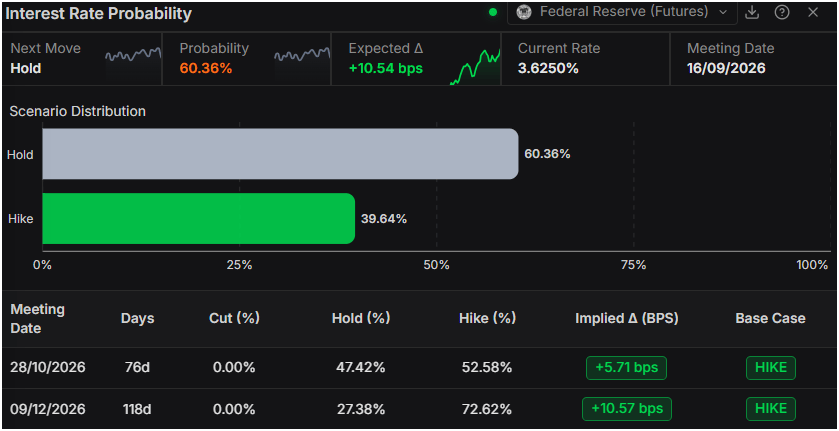
Fed officials remained hawkish
Cleveland Fed Beth Hammack crossed the wires, saying that the US central bank should raise rates to restrain growth and inflation. She commented that when talking to businesses, they’re excited to borrow so they can continue investing as they see “growth opportunities.” However, she added that a strong reacceleration of the economy could affect the disinflationary process.
Richmond Fed President Thomas Barkin said it is an “open question” whether a rate hike is needed to meet the inflation target. He said that inflationary pressures come from shocks which “should pass.”
In the UK, the economy showed that the Gross Domestic Product (GDP) grew 0.4% on a quarterly basis in Q2 2026. The reading was in line with estimates, a small dip from the 0.6% increase in the previous period, but it remains solid.
Ahead this week, the US economic docket will feature the release of the University of Michigan Consumer Sentiment. Across the pond, the UK schedule will feature a tranche of inflation data, which could trigger a reaction in the bond market regarding expectations for the Bank of England (BoE) monetary policy.
GBP/USD Price Forecast: Technical outlook
In the daily chart, GBP/USD trades at 1.3497, holding above the cluster of the 50/100/200-day simple moving averages (SMA) around 1.3370 and the reclaimed trend-line levels at 1.3425 and 1.3344, which together reinforce a bullish near-term bias. The Relative Strength Index (14) at 59.3 stays in positive territory without being overbought, hinting that upside momentum is constructive rather than stretched, while the FXS Fed Sentiment Index near 136.6 suggests a still-elevated but cooling policy anxiety backdrop that may keep directional moves sensitive to incoming US data.
On the topside, immediate resistance emerges at the descending trend line break near 1.3510, followed by the higher upward-support trend-line break around 1.3575, where the recent advance could meet stronger supply. On the downside, first support is seen at the former resistance trend line now turned floor around 1.3425, ahead of the grouped long-term SMAs near 1.3370 and the lower structural trend support at 1.3344, levels that would need to give way to undermine the current bullish technical tone.
(The technical analysis of this story was written with the help of an AI tool. Know more.)
Pound Sterling Price Today
The table below shows the percentage change of British Pound (GBP) against listed major currencies today. British Pound was the strongest against the New Zealand Dollar.
| USD | EUR | GBP | JPY | CAD | AUD | NZD | CHF | |
|---|---|---|---|---|---|---|---|---|
| USD | -0.08% | -0.02% | -0.06% | -0.02% | 0.05% | 0.18% | -0.12% | |
| EUR | 0.08% | 0.06% | 0.02% | 0.03% | 0.13% | 0.24% | -0.05% | |
| GBP | 0.02% | -0.06% | -0.04% | -0.02% | 0.08% | 0.19% | -0.12% | |
| JPY | 0.06% | -0.02% | 0.04% | 0.03% | 0.12% | 0.19% | -0.07% | |
| CAD | 0.02% | -0.03% | 0.02% | -0.03% | 0.08% | 0.19% | -0.11% | |
| AUD | -0.05% | -0.13% | -0.08% | -0.12% | -0.08% | 0.12% | -0.19% | |
| NZD | -0.18% | -0.24% | -0.19% | -0.19% | -0.19% | -0.12% | -0.27% | |
| CHF | 0.12% | 0.05% | 0.12% | 0.07% | 0.11% | 0.19% | 0.27% |
The heat map shows percentage changes of major currencies against each other. The base currency is picked from the left column, while the quote currency is picked from the top row. For example, if you pick the British Pound from the left column and move along the horizontal line to the US Dollar, the percentage change displayed in the box will represent GBP (base)/USD (quote).
Author

Christian Borjon Valencia
FXStreet
Markets analyst, news editor, and trading instructor with over 14 years of experience across FX, commodities, US equity indices, and global macro markets.