Banxico cuts rates 25 bps to 6.50% as expected
Banco de Mexico (Banxico) reduced borrowing costs by 25 basis points on Thursday, as expected by market participants, from 6.75% to 6.50%, even though the central bank revealed that the “balance of risks for the trajectory of inflation within the forecast horizon remains biased to the upside.”
The central bank's decision was not unanimous, as Deputy Governors Galia Borja and Jonathan Heath voted to keep rates unchanged.
Banxico’s board noted that the decision concludes the easing cycle that began in March 2024, while adding that “economic slack is expected to be greater than previously anticipated.”
Key highlights:
BOARD MEMBERS HEATH AND BORJA VOTED TO HOLD RATE
BOARD MEMBERS RODRIGUEZ, MEJIA AND CUADRA VOTED TO CUT RATE
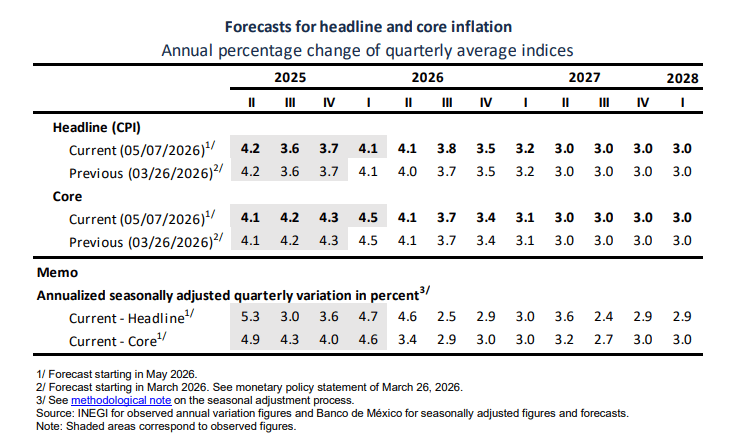
HEADLINE INFLATION IS PROJECTED TO CONVERGE TO TARGET IN Q2 OF 2027
LOOKING AHEAD, THE BOARD ESTIMATES IT WILL BE APPROPRIATE TO MAINTAIN THE RATE AT ITS CURRENT LEVEL
BALANCE OF RISKS FOR THE TRAJECTORY OF INFLATION WITHIN THE FORECAST HORIZON REMAINS BIASED TO THE UPSIDE
BOARD'S DECISION TOOK INTO ACCOUNT EXCHANGE RATE LEVELS, WEAKNESS OF ECONOMIC ACTIVITY, LEVEL OF MONETARY RESTRICTION IMPLEMENTED
ECONOMIC SLACK IS EXPECTED TO BE GREATER THAN PREVIOUSLY ANTICIPATED
THERE IS NO EVIDENCE OF SECOND-ROUND EFFECTS FROM THE FISCAL MEASURES ADOPTED AT THE BEGINNING OF THE YEAR
DECISION CONCLUDES THE CYCLE THAT BEGAN IN MARCH 2024
Banxico's inflation forecast
Mexican inflation does not justify Banxico’s decision
Earlier, the national statistics agency in Mexico (INEGI) reported that the Consumer Price Index (CPI) rose by 4.45% YoY in April. Core figures were also up by 4.26%, down a tenth of a percentage point from economists' estimates.
Banxico FAQs
The Bank of Mexico, also known as Banxico, is the country’s central bank. Its mission is to preserve the value of Mexico’s currency, the Mexican Peso (MXN), and to set the monetary policy. To this end, its main objective is to maintain low and stable inflation within target levels – at or close to its target of 3%, the midpoint in a tolerance band of between 2% and 4%.
The main tool of the Banxico to guide monetary policy is by setting interest rates. When inflation is above target, the bank will attempt to tame it by raising rates, making it more expensive for households and businesses to borrow money and thus cooling the economy. Higher interest rates are generally positive for the Mexican Peso (MXN) as they lead to higher yields, making the country a more attractive place for investors. On the contrary, lower interest rates tend to weaken MXN. The rate differential with the USD, or how the Banxico is expected to set interest rates compared with the US Federal Reserve (Fed), is a key factor.
Banxico meets eight times a year, and its monetary policy is greatly influenced by decisions of the US Federal Reserve (Fed). Therefore, the central bank’s decision-making committee usually gathers a week after the Fed. In doing so, Banxico reacts and sometimes anticipates monetary policy measures set by the Federal Reserve. For example, after the Covid-19 pandemic, before the Fed raised rates, Banxico did it first in an attempt to diminish the chances of a substantial depreciation of the Mexican Peso (MXN) and to prevent capital outflows that could destabilize the country.
Author

Christian Borjon Valencia
FXStreet
Markets analyst, news editor, and trading instructor with over 14 years of experience across FX, commodities, US equity indices, and global macro markets.














