Australian Dollar's resilience is imported from China
- The Australian Dollar is among the day's top-performing majors even as a batch of domestic data disappointed.
- China's firmer factory activity and resilient Iron Ore prices are carrying the move, not anything homegrown.
- The carry trade behind the rally is crowded and already fully priced.

The Australian Dollar (AUD) is sitting near the top of the major currency leaderboard, adding close to 0.3% on the day and pushing back toward 0.7200 after defending 0.7150. Almost none of that strength is homegrown. Tuesday's local data was a mess and the Aussie climbed anyway, which tells you the move is coming out of Beijing and the commodity complex, not from the Australian economy itself.
The home front is quietly ugly
Building Permits for April fell 3.4% MoM against expectations for a 1.5% drop, a soft print only flattered by a low prior base. Company Gross Operating Profits contracted 1.3% quarter-on-quarter (QoQ) in Q1 against a 0.5% consensus gain, and the Current Account deficit widened past A$27 billion, wider than the A$23 billion expected. None of this is the profile of a currency that should be leading the pack; on a normal session it would have the Aussie on the back foot.
Beijing does the heavy lifting
The offset is China. Monday's RatingDog China Manufacturing Purchasing Managers Index (PMI) for May came in at 51.8, easing from April's five-year high of 52.2 but still topping the 51.4 consensus, enough to remind the market why the Aussie still trades as the cleanest liquid proxy for Chinese growth. That private read flatters the picture, though. The official National Bureau of Statistics (NBS) Manufacturing PMI for May, out Sunday, sat exactly on the 50.0 line, matching consensus and softer than April's 50.3, so the large state-owned factories it captures are neither growing nor shrinking. The bid under the Aussie is leaning on the smaller private firms, not the broad official gauge. Iron Ore, Australia's signature export, has held above US$109 per tonne, well above the US$90 to US$100 range many analysts had budgeted for the year, and with the big miners near record highs and Copper firm, the commodity channel is doing what the soft local data could not.
The crowd is already long
There is a rates story too, and it is the part most exposed to a re-rating. The Reserve Bank of Australia (RBA) has hiked three times this year to a 4.35% cash rate, comfortably above the Federal Reserve (Fed) target, and the market now prices roughly an 80% chance of another 25 basis point move, to 4.60%, by August. That hawkish path is consensus, not an edge, so plenty of good news is already in the price. Positioning says the same: speculative net long Aussie bets have built to multi-year extremes, the kind of one-sided crowd that unwinds quickly on a single disappointment, much as it did when a similar setup cracked in early 2025. And it is happening while the US Dollar is not even weak, with the Dollar Index (DXY) firm on safe-haven and energy flows as US-Iran tensions flared and Crude Oil pushed higher. The Aussie is climbing into a bid Dollar, on a fully-priced rate story, with the crowd already leaning the same way: a lot has to keep going right.
What the charts actually say
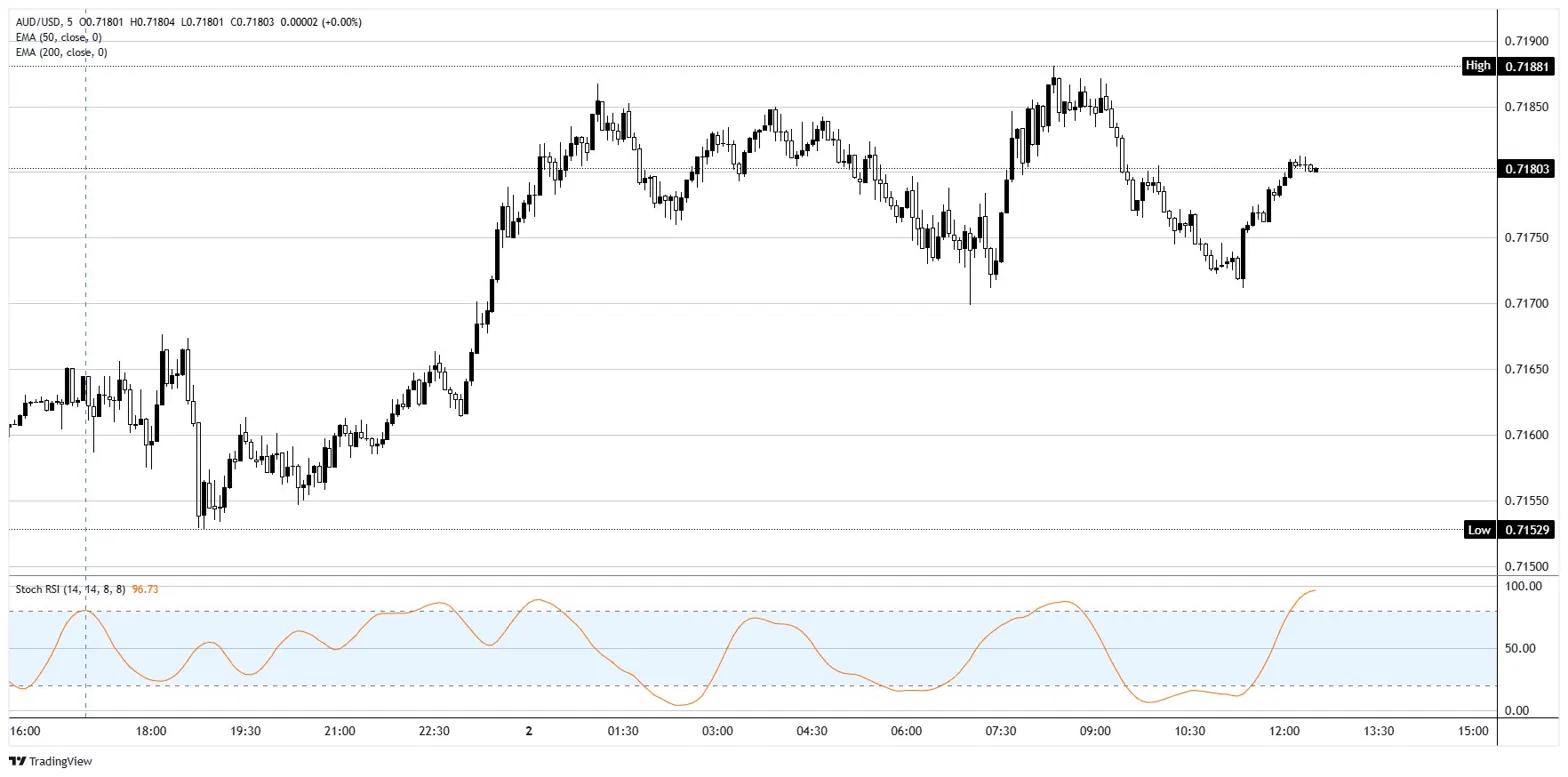
On the daily chart the pair holds above its 50-day Exponential Moving Average (EMA) near 0.7150 and well above the 200-day EMA around 0.6900, so the uptrend off the April low is intact. Momentum is less convincing: the daily Stochastic Relative Strength Index (Stoch RSI) has rolled toward the mid-20s even as price holds firm, while the five-minute Stoch RSI sits close to overbought after the bounce back toward the highs. The constructive bias holds while 0.7150 does, the zone that now also captures the rising 50 EMA. A break and hold above 0.7200 opens the late-May high region toward 0.7300, with 0.7250 the first hurdle; losing 0.7150 shifts focus to the 0.7100 handle. With a commodity-and-carry rally this stretched, the swing factors are the China headlines and the crowd's pain threshold, not the local numbers.
The real tests are still ahead
The marquee event lands Wednesday at 01:30 GMT, when Australia reports Q1 Gross Domestic Product (GDP). Consensus looks for 0.5% QoQ and 2.7% YoY, a step down from the prior 0.8% pace. The RBA's hawkishness is inflation-driven, with first-quarter inflation near 3.8% and the oil shock on top, not growth-driven, so a soft GDP print would leave the bank tightening into a slowing economy and the carry trade leaning on a rate path the data is undercutting. RBA Governor Bullock then speaks Thursday at 05:00 GMT, where any hint she is weighing sticky inflation against weaker activity will matter more than today's tape. Tonight's S&P Global and Ai Group surveys at 23:00 GMT are second-order.
AUD/USD 5-minute chart
Australian Dollar FAQs
One of the most significant factors for the Australian Dollar (AUD) is the level of interest rates set by the Reserve Bank of Australia (RBA). Because Australia is a resource-rich country another key driver is the price of its biggest export, Iron Ore. The health of the Chinese economy, its largest trading partner, is a factor, as well as inflation in Australia, its growth rate and Trade Balance. Market sentiment – whether investors are taking on more risky assets (risk-on) or seeking safe-havens (risk-off) – is also a factor, with risk-on positive for AUD.
The Reserve Bank of Australia (RBA) influences the Australian Dollar (AUD) by setting the level of interest rates that Australian banks can lend to each other. This influences the level of interest rates in the economy as a whole. The main goal of the RBA is to maintain a stable inflation rate of 2-3% by adjusting interest rates up or down. Relatively high interest rates compared to other major central banks support the AUD, and the opposite for relatively low. The RBA can also use quantitative easing and tightening to influence credit conditions, with the former AUD-negative and the latter AUD-positive.
China is Australia’s largest trading partner so the health of the Chinese economy is a major influence on the value of the Australian Dollar (AUD). When the Chinese economy is doing well it purchases more raw materials, goods and services from Australia, lifting demand for the AUD, and pushing up its value. The opposite is the case when the Chinese economy is not growing as fast as expected. Positive or negative surprises in Chinese growth data, therefore, often have a direct impact on the Australian Dollar and its pairs.
Iron Ore is Australia’s largest export, accounting for $118 billion a year according to data from 2021, with China as its primary destination. The price of Iron Ore, therefore, can be a driver of the Australian Dollar. Generally, if the price of Iron Ore rises, AUD also goes up, as aggregate demand for the currency increases. The opposite is the case if the price of Iron Ore falls. Higher Iron Ore prices also tend to result in a greater likelihood of a positive Trade Balance for Australia, which is also positive of the AUD.
The Trade Balance, which is the difference between what a country earns from its exports versus what it pays for its imports, is another factor that can influence the value of the Australian Dollar. If Australia produces highly sought after exports, then its currency will gain in value purely from the surplus demand created from foreign buyers seeking to purchase its exports versus what it spends to purchase imports. Therefore, a positive net Trade Balance strengthens the AUD, with the opposite effect if the Trade Balance is negative.
Author

Joshua Gibson
FXStreet
Joshua joins the FXStreet team as an Economics and Finance double major from Vancouver Island University with twelve years' experience as an independent trader focusing on technical analysis.