Australian Dollar retreats toward 0.6900 amid renewed signs of cooling inflation

The Australian Dollar (AUD) is confronting a notable shift in market momentum as fresh domestic data points to cooling inflation. While the currency recently experienced a sharp surge, a consecutive monthly decline in a key consumer price gauge suggests that a broader disinflationary trend is becoming firmly established. This macro shift has thrown a wrench into hawkish market expectations for additional interest rate hikes by the Reserve Bank of Australia (RBA), prompting major financial institutions to project a period of consolidation and downside vulnerability for the AUD/USD currency cross.
Established disinflation chips away at hawkish RBA bets
Macro strategists at BNY highlight that price pressures in Australia are easing, led by a drop in global fuel costs. The Melbourne Institute inflation gauge fell for a second consecutive month in June, with both headline and underlying trimmed mean figures pulling back significantly. This suggests that the central bank may abandon its hawkish-leaning policy stance.
The snapshot points to broader easing in both headline and underlying price pressure, suggesting disinflation is becoming more established. That could force the RBA to shift away from its neutral stance, with market pricing of 35bp of tightening by year-end now looking increasingly vulnerable if softer inflation momentum persists.
Technical fatigue sets in for the Australian Dollar after recent gains
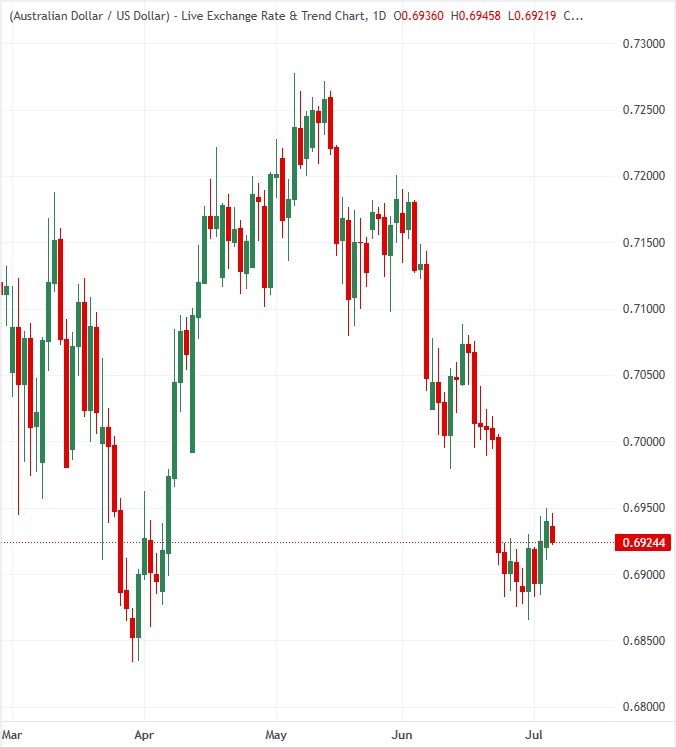
The strategy team at UOB observes that the Australian Dollar's previous bullish momentum has effectively run out of steam. Following a sharp multi-day rally, the AUD/USD pair has entered a minor holding pattern, with technical indicators flagging an early accumulation of downward bias that will likely cap near-term recovery efforts.
Despite the relatively quiet price action, there has been a tentative build-up in downward momentum. Today, the bias for AUD is tilted to the downside, but given the lacklustre momentum, any decline is likely limited to a test of 0.6910.
Banks anticipate downward-biased near-term trajectory for the Australian Dollar
The banks anticipate a cooling near-term trajectory for the Australian Dollar, indicating that its recent upward run has likely run its course. BNY indicates that if the softer domestic inflation momentum continues to chip away at the 35 basis points of priced-in RBA tightening, the currency's yield advantage will quickly erode.
Mirroring this cautious macro view, UOB projects an initial multi-week consolidation phase where the AUD/USD pair remains bound between 0.6870 and 0.6980, but remains structurally bearish over a longer one-to-three-month horizon, warning that a technical breakdown could eventually drag the asset down to major downside targets at 0.6835 and 0.6707.
(This article was created with the help of an Artificial Intelligence tool and reviewed by an editor. Know more.)
Author

FXStreet Insights Team
FXStreet
The FXStreet Insights Team is a group of journalists that handpicks selected market observations published by renowned experts. The content includes notes by commercial as well as additional insights by internal and external analysts.

















