Australian Dollar rallies on a peace deal missing one signature
- AUD/USD jumped after Trump canceled a third night of strikes on Iran and declared a deal all but done.
- Tehran has not confirmed any agreement, and Iranian media warned against taking the claim at face value.
- Crude Oil fell sharply as war premium drained out of energy markets, feeding the risk bid.

The Australian Dollar spent most of Thursday pinned beneath the 0.7000 handle while Washington and Tehran traded fire for a second straight day. The session turned just after 17:30 GMT, when President Trump announced he had canceled the evening's planned strikes and declared a deal to end the war essentially agreed.
AUD/USD ripped roughly three-quarters of a cent off its lows, a textbook risk-proxy reaction. The complication is that the rally rests on a peace agreement the other belligerent has not confirmed, announced by a president who had promised the hardest strikes of the war only hours earlier.
Two days of bombing, then a deal by dinner
The reversal capped a violent stretch. US forces resumed strikes on Iran on Tuesday and Wednesday after negotiations stalled, and Iranian fire brought down an Apache helicopter near the Strait of Hormuz. Tehran answered Thursday's pre-dawn raids with ballistic missiles aimed at US bases in Bahrain, Kuwait and Jordan.
Trump opened Thursday vowing to hit Iran very hard and threatening to seize Kharg Island and the rest of its energy export infrastructure. By late afternoon, the strikes were off, with the final points of a deal supposedly approved at the highest level of Iranian leadership. The naval blockade of Iranian ports, notably, stays in place.
The signature that is not there
The skeptical reading writes itself, because Trump's list of approving parties named the US, Israel, the Gulf states and assorted mediators, and conspicuously not Iran. Iranian semiofficial media advised treating the announcement like his earlier claims, and the Revolutionary Guard pointed to a war's worth of contradictory statements from Washington.
Tehran's own signal management is its own warning. Fars, a semiofficial agency, first reported that no text had been approved at all, then circulated a note putting high odds on approval since Washington had accepted a draft Iran itself wrote, while conceding no final answer exists.
A venue, a guest list, no counterparty
Washington is acting as if the ink is already drying. Trump is floating a signing as soon as this weekend in Europe, with the Vice President attending and the Strait of Hormuz reopening on signature. One side has a ceremony being planned; the other has a news agency quoting odds. That gap is the whole trade in miniature.
Markets have seen this film before. A March pause in strikes collapsed Brent by double digits before Iranian outlets denied any talks existed, and April's ceasefire, which disintegrated this week, was sold as a definitive off-ramp. De-escalation headlines in this war carry a shelf life measured in weeks.
A risk proxy doing risk proxy things
The Aussie's role here is the familiar one: the currency market's preferred thermometer for global risk appetite. Brent fell more than 3% to its weakest level since April, near $90 a barrel, and cheaper energy is relief for a world economy paying a war tax at the pump since February.
The irony is that Australia exports energy, so a sliding Crude Oil complex is no clean win for its terms of trade. Nothing here came from Australian data, and the Reserve Bank of Australia (RBA) was a spectator. This was a pure sentiment trade, which is exactly why it can be unwound at the speed of a deleted post.
The chart did all of it in two candles
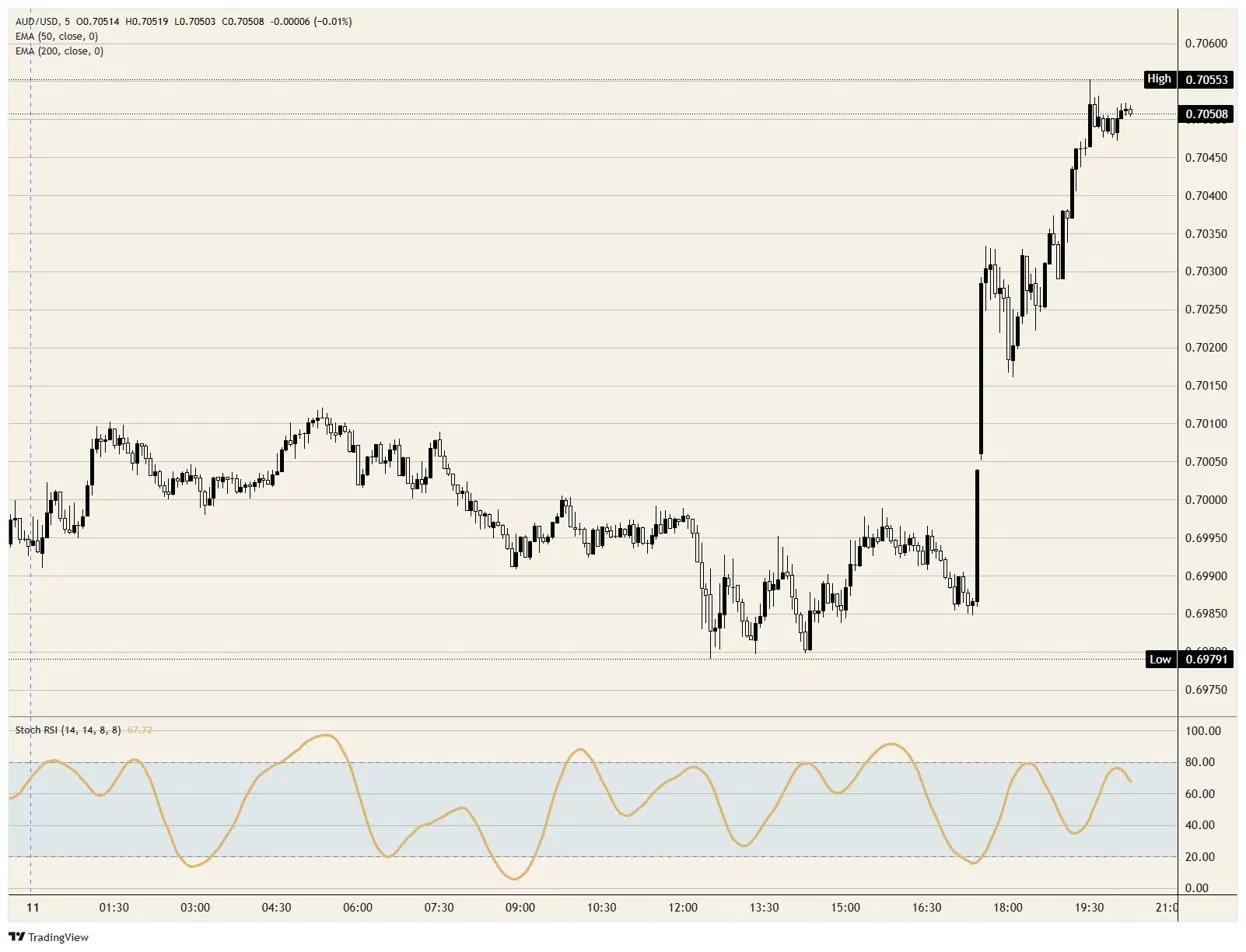
On the intraday chart, AUD/USD spent the whole session capped below 0.7000, printing its lows beneath the handle around midday before the spike cut straight through the range. The pair extended to a touch above 0.7050 into the evening and is consolidating near the highs.
Momentum offers the one early caution. The Stochastic Relative Strength Index (Stoch RSI) is rolling over from overbought territory while price grinds sideways, normal digestion after a 70-pip impulse rather than a reversal signal, though it argues against chasing the top of the range.
Trading a deal that is not signed
Upside: A sustained hold above 0.7050 keeps the squeeze pointed at the 0.7100 handle, with the weekend signing confirmed by Tehran, not just Washington, the catalyst that gets it there.
Downside: The 0.7000 handle is now the line that matters. An Iranian denial or a fresh strike order would send AUD/USD straight back into the old congestion, with 0.6950 the next shelf below.
Bias: Constructive while the peace tape holds, but longs are rented rather than owned, sized for the chance that the next post reverses the last one.
AUD/USD 5-minute chart
Australian Dollar FAQs
One of the most significant factors for the Australian Dollar (AUD) is the level of interest rates set by the Reserve Bank of Australia (RBA). Because Australia is a resource-rich country another key driver is the price of its biggest export, Iron Ore. The health of the Chinese economy, its largest trading partner, is a factor, as well as inflation in Australia, its growth rate and Trade Balance. Market sentiment – whether investors are taking on more risky assets (risk-on) or seeking safe-havens (risk-off) – is also a factor, with risk-on positive for AUD.
The Reserve Bank of Australia (RBA) influences the Australian Dollar (AUD) by setting the level of interest rates that Australian banks can lend to each other. This influences the level of interest rates in the economy as a whole. The main goal of the RBA is to maintain a stable inflation rate of 2-3% by adjusting interest rates up or down. Relatively high interest rates compared to other major central banks support the AUD, and the opposite for relatively low. The RBA can also use quantitative easing and tightening to influence credit conditions, with the former AUD-negative and the latter AUD-positive.
China is Australia’s largest trading partner so the health of the Chinese economy is a major influence on the value of the Australian Dollar (AUD). When the Chinese economy is doing well it purchases more raw materials, goods and services from Australia, lifting demand for the AUD, and pushing up its value. The opposite is the case when the Chinese economy is not growing as fast as expected. Positive or negative surprises in Chinese growth data, therefore, often have a direct impact on the Australian Dollar and its pairs.
Iron Ore is Australia’s largest export, accounting for $118 billion a year according to data from 2021, with China as its primary destination. The price of Iron Ore, therefore, can be a driver of the Australian Dollar. Generally, if the price of Iron Ore rises, AUD also goes up, as aggregate demand for the currency increases. The opposite is the case if the price of Iron Ore falls. Higher Iron Ore prices also tend to result in a greater likelihood of a positive Trade Balance for Australia, which is also positive of the AUD.
The Trade Balance, which is the difference between what a country earns from its exports versus what it pays for its imports, is another factor that can influence the value of the Australian Dollar. If Australia produces highly sought after exports, then its currency will gain in value purely from the surplus demand created from foreign buyers seeking to purchase its exports versus what it spends to purchase imports. Therefore, a positive net Trade Balance strengthens the AUD, with the opposite effect if the Trade Balance is negative.
Author

Joshua Gibson
FXStreet
Joshua joins the FXStreet team as an Economics and Finance double major from Vancouver Island University with twelve years' experience as an independent trader focusing on technical analysis.