Australian Dollar outperforms amid strong comeback in metal prices
- Australian Dollar trades higher against its major currency peers due to a strong recovery in metal prices.
- Hopes that the global AI trade unwinding has come to an end have lifted metal prices.
- Next week, investors will pay close attention to a string of US data.


The Australian Dollar (AUD) outperforms its major currency peers on Friday, trading 0.66% higher at around 0.6675 versus. the US Dollar (USD) in the European trade. The Australian currency attracts significant bids due to rising metal prices, given that Australia is a leading exporter of metals and metal ores.
Australian Dollar Price Today
The table below shows the percentage change of Australian Dollar (AUD) against listed major currencies today. Australian Dollar was the strongest against the Swiss Franc.
| USD | EUR | GBP | JPY | CAD | AUD | NZD | CHF | |
|---|---|---|---|---|---|---|---|---|
| USD | 0.08% | -0.14% | 0.13% | -0.02% | -0.62% | -0.23% | 0.25% | |
| EUR | -0.08% | -0.22% | 0.07% | -0.06% | -0.70% | -0.31% | 0.17% | |
| GBP | 0.14% | 0.22% | 0.27% | 0.13% | -0.48% | -0.12% | 0.39% | |
| JPY | -0.13% | -0.07% | -0.27% | -0.14% | -0.75% | -0.36% | 0.12% | |
| CAD | 0.02% | 0.06% | -0.13% | 0.14% | -0.60% | -0.22% | 0.26% | |
| AUD | 0.62% | 0.70% | 0.48% | 0.75% | 0.60% | 0.40% | 0.88% | |
| NZD | 0.23% | 0.31% | 0.12% | 0.36% | 0.22% | -0.40% | 0.49% | |
| CHF | -0.25% | -0.17% | -0.39% | -0.12% | -0.26% | -0.88% | -0.49% |
The heat map shows percentage changes of major currencies against each other. The base currency is picked from the left column, while the quote currency is picked from the top row. For example, if you pick the Australian Dollar from the left column and move along the horizontal line to the US Dollar, the percentage change displayed in the box will represent AUD (base)/USD (quote).
Prices of base metals, such as Copper and Aluminum, have rebounded sharply amid hopes that the recent global Artificial Intelligence (AI) trade recovery would last long.
Economists at Commerzbank acknowledge that the recent “losses in AI stocks have heightened doubts among many observers about whether the AI investment boom can continue.” However, they argue that “despite all risks, strong arguments suggest that AI companies will continue to significantly increase their investments at least next year, thereby boosting the US economy.”
According to Commerzbank, “AI companies have driven massive investments.” They note that “with over 800 billion dollars, the five US hypercalers and neoclouds – specialized cloud providers for AI and high-performance computing – will invest almost twice as much this year in AI models, servers, data centers, power supply, etc. as in the previous year.” On current plans, Commerzbank reports that “investments will exceed 1,400 billion dollars by 2029 and stabilize at this high level in the years after (Chart 1),” underscoring their view that the AI capex cycle still has considerable momentum.
Meanwhile, the US Dollar trades marginally higher while entering into the weekend. As of writing, the US Dollar Index (DXY), which gauges the Greenback’s value against six major currencies, trades 0.1% higher to near 103.87.
Next week, the US Dollar is expected to remain volatile as it will be United States (US) data-packed week, notably Nonfarm Payrolls (NFP) data for November, which will be released on Friday.
AUD/USD Technical Analysis
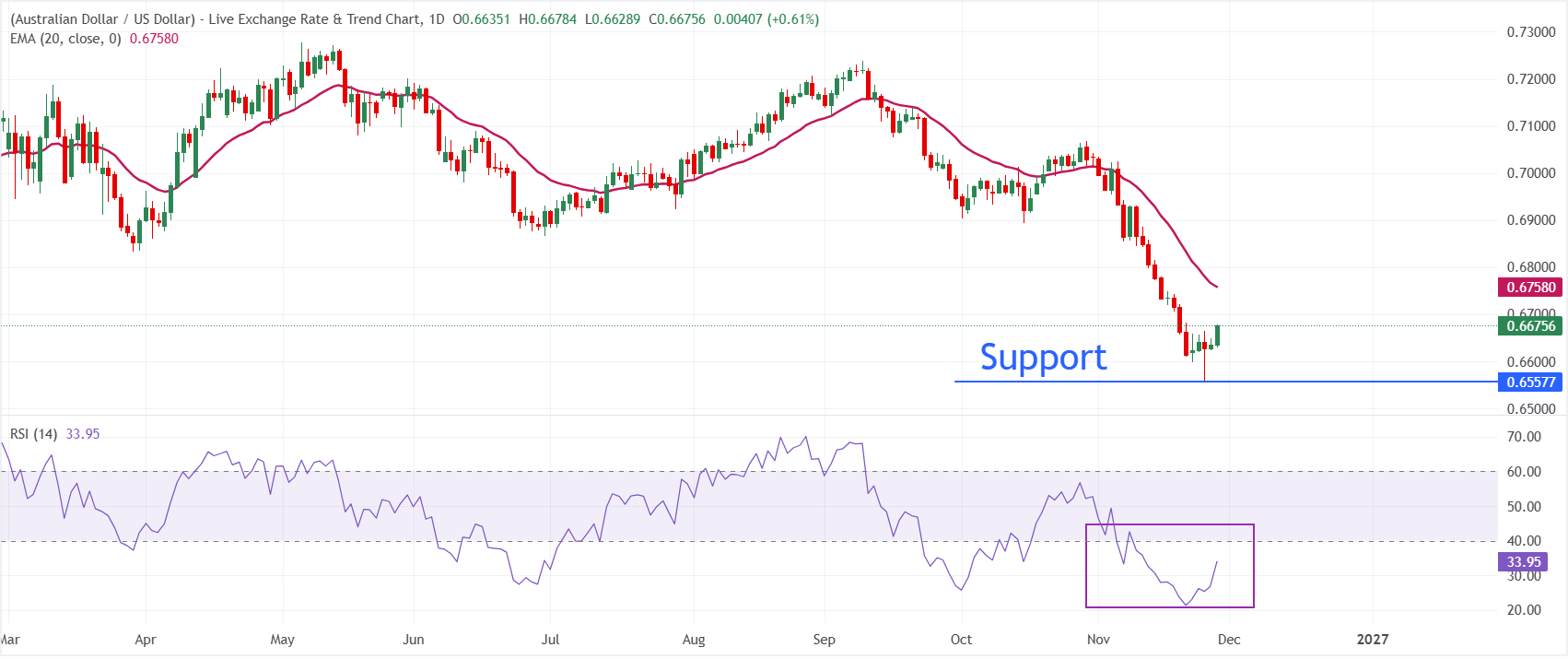
In the daily chart, AUD/USD trades at 0.6676, extending its decline and keeping a bearish near-term bias as spot holds below the 20-day Exponential Moving Average (EMA) at 0.6758. The pair remains pressured after slipping from the 0.70 area, while the Relative Strength Index (14) at 33.9 hovers just above oversold territory, hinting that selling pressure persists but is approaching stretched conditions.
On the topside, initial resistance is located at the 20-day EMA around 0.6758, which caps recovery attempts and defines the first hurdle for any corrective bounce. Looking down, the November 25 low at 0.6559 is the key support level.
(The technical analysis of this story was written with the help of an AI tool. Know more.)
Australian Dollar FAQs
One of the most significant factors for the Australian Dollar (AUD) is the level of interest rates set by the Reserve Bank of Australia (RBA). Because Australia is a resource-rich country another key driver is the price of its biggest export, Iron Ore. The health of the Chinese economy, its largest trading partner, is a factor, as well as inflation in Australia, its growth rate and Trade Balance. Market sentiment – whether investors are taking on more risky assets (risk-on) or seeking safe-havens (risk-off) – is also a factor, with risk-on positive for AUD.
The Reserve Bank of Australia (RBA) influences the Australian Dollar (AUD) by setting the level of interest rates that Australian banks can lend to each other. This influences the level of interest rates in the economy as a whole. The main goal of the RBA is to maintain a stable inflation rate of 2-3% by adjusting interest rates up or down. Relatively high interest rates compared to other major central banks support the AUD, and the opposite for relatively low. The RBA can also use quantitative easing and tightening to influence credit conditions, with the former AUD-negative and the latter AUD-positive.
China is Australia’s largest trading partner so the health of the Chinese economy is a major influence on the value of the Australian Dollar (AUD). When the Chinese economy is doing well it purchases more raw materials, goods and services from Australia, lifting demand for the AUD, and pushing up its value. The opposite is the case when the Chinese economy is not growing as fast as expected. Positive or negative surprises in Chinese growth data, therefore, often have a direct impact on the Australian Dollar and its pairs.
Iron Ore is Australia’s largest export, accounting for $118 billion a year according to data from 2021, with China as its primary destination. The price of Iron Ore, therefore, can be a driver of the Australian Dollar. Generally, if the price of Iron Ore rises, AUD also goes up, as aggregate demand for the currency increases. The opposite is the case if the price of Iron Ore falls. Higher Iron Ore prices also tend to result in a greater likelihood of a positive Trade Balance for Australia, which is also positive of the AUD.
The Trade Balance, which is the difference between what a country earns from its exports versus what it pays for its imports, is another factor that can influence the value of the Australian Dollar. If Australia produces highly sought after exports, then its currency will gain in value purely from the surplus demand created from foreign buyers seeking to purchase its exports versus what it spends to purchase imports. Therefore, a positive net Trade Balance strengthens the AUD, with the opposite effect if the Trade Balance is negative.
Author
Sagar Dua
FXStreet
Sagar Dua is associated with the financial markets from his college days. Along with pursuing post-graduation in Commerce in 2014, he started his markets training with chart analysis.