Australian Dollar sticks to hawkish RBA-inspired gains, seems poised to climb further
- The Australian Dollar attracts fresh buyers in reaction to RBA Governor Bullock's hawkish remarks.
- Bets for more Fed rate cuts act as a headwind for the USD and lend support to the AUD/USD pair.
- The divergent RBA-Fed outlooks favor the Aussie bulls amid the underlying bullish risk sentiment.

The Australian Dollar (AUD) struggles to capitalize on its intraday move up led by Reserve Bank of Australia (RBA) Governor Michele Bullock's hawkish remarks, saying that more rate cuts might not be needed. Bullock added that the board discussed circumstances in which the central bank might have to tighten. This, along with a softer US Dollar (USD), lifts the AUD/USD pair back closer to its highest level since September 18 during the Asian session on Tuesday.
However, the cautious market mood could act as a headwind for the risk-sensitive Aussie. Traders also seem reluctant to place aggressive bets and opt to wait for the highly anticipated US Federal Reserve (Fed) decision, scheduled to be announced on Wednesday. The Fed is expected to lower interest rates again, which keeps a lid on the recent USD recovery and offers some support to the AUD/USD pair. Moreover, the divergent RBA-Fed outlooks favor the Aussie bulls.
Australian Dollar bulls retain control amid the divergent RBA-Fed policy expectations
- The Reserve Bank of Australia decided to leave the Official Cash Rate (OCR) unchanged at 3.6% following the conclusion of the December monetary policy meeting this Tuesday. In the accompanying policy statement, the RBA said that the board will be attentive to the data and the evolving assessment of the outlook and risks to guide its decisions.
- In the post-meeting press conference, RBA Governor Michele Bullock said that inflation and jobs data will be important for the February meeting. It looks like more rate cuts are not needed, and that the Board discussed what they might have to do if rates need to go up, Bullock added further.
- There's been a notable repricing in the markets over the past two weeks that the Reserve Bank of Australia is done cutting rates for now, as price pressures are proving to be persistent. In fact, inflation remains above the RBA’s 2% to 3% annual target and raises questions about just how much headroom the central bank has to ease policy.
- Moreover, RBA Governor Michele Bullock said last week that if inflation proves to be persistent, it would have implications for future monetary policy. Some analysts even believe that the RBA might be done with easing and could even consider tightening heading into 2026 if domestic conditions stay firm and inflation doesn't cool.
- The US Commerce Department reported last Friday that the Personal Consumption Expenditures Price Index rose 2.8% on a yearly basis in September, matching estimates. The core gauge rose 2.8% compared to 2.9% in August, which, along with signs of a cooling US labor market, reaffirmed dovish Federal Reserve expectations.
- According to the CME Group's FedWatch Tool, traders are pricing in a nearly 90% chance that the US central bank will lower borrowing costs by 25 basis points at the end of a two-day policy meeting on Wednesday. This should cap a modest US Dollar recovery from its lowest level since late October and support the AUD/USD pair.
- Apart from the key central bank event risks, traders will take cues from a duo of US labor market reports on Tuesday – the ADP Weekly Employment Change and JOLTS Job Openings. The focus will then shift to the FOMC decision on Wednesday and the Australian monthly employment details, due for release on Thursday.
AUD/USD bullish setup backs case for a move towards YTD peak, just above 0.6700
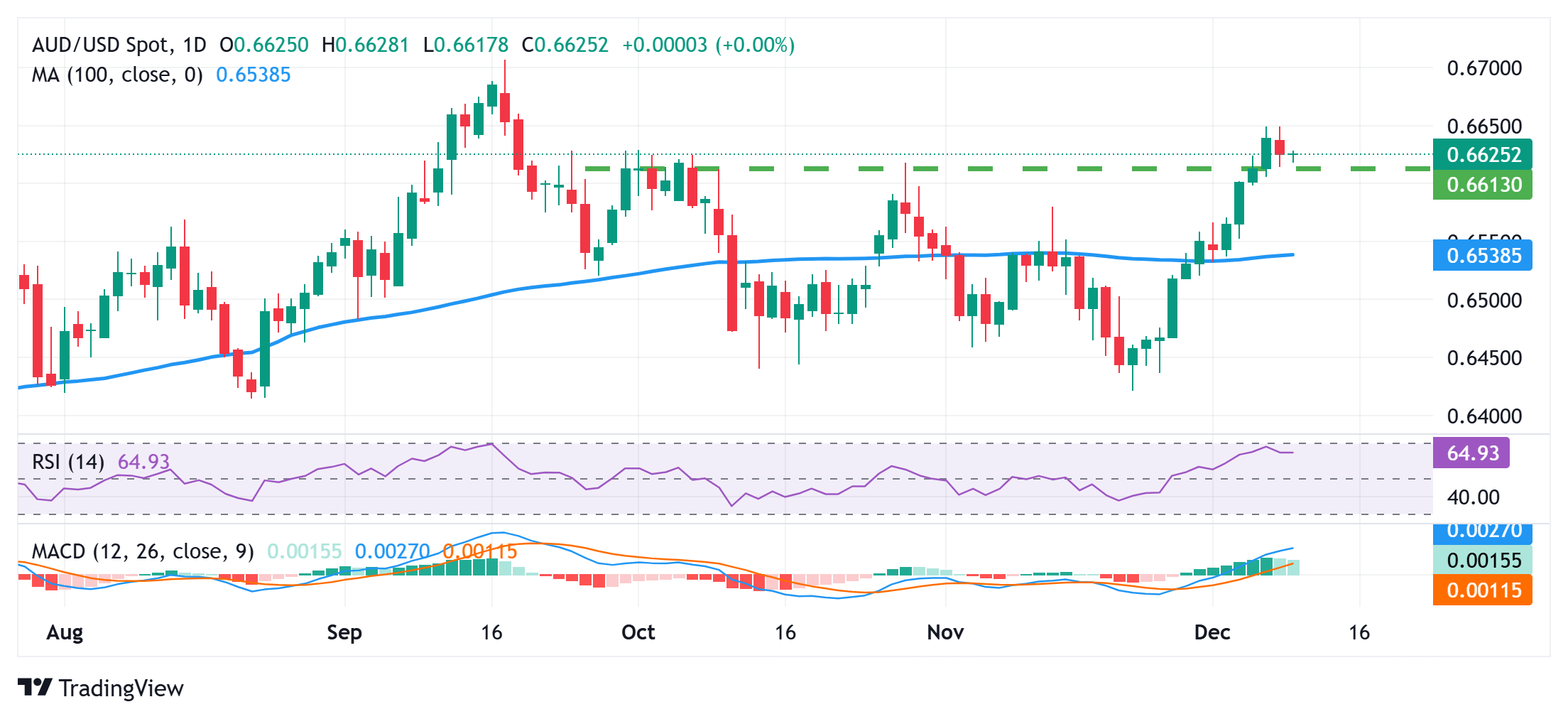
The AUD/USD pair finds some support near the 0.6615-0.6620 resistance breakpoint. Moreover, oscillators on the daily chart are holding comfortably in positive territory and are still away from being in the overbought zone, validating the near-term constructive outlook for the currency pair. Some follow-through buying beyond the 0.6645-0.6650 region, or a multi-month top touched on Monday, will set the stage for a move towards challenging the year-to-date peak, levels just above the 0.6700 mark, touched in September.
On the flip side, weakness below the 0.6600 round figure could be seen as a buying opportunity near the 0.6560-0.6555 region. This is followed by the 100-day Simple Moving Average (SMA), around the 0.6540-0.6535 area, below which the AUD/USD pair could weaken to the 0.6500 psychological mark en route to the 0.6480 horizontal zone. Failure to defend the said support levels would negate the positive outlook and shift the near-term bias in favor of bearish traders, exposing a multi-month low, around the 0.6420 region, touched in November.
Australian Dollar Price Today
The table below shows the percentage change of Australian Dollar (AUD) against listed major currencies today. Australian Dollar was the strongest against the Japanese Yen.
| USD | EUR | GBP | JPY | CAD | AUD | NZD | CHF | |
|---|---|---|---|---|---|---|---|---|
| USD | -0.06% | -0.05% | 0.05% | -0.01% | -0.22% | -0.07% | -0.12% | |
| EUR | 0.06% | 0.00% | 0.09% | 0.04% | -0.16% | -0.03% | -0.06% | |
| GBP | 0.05% | -0.01% | 0.10% | 0.03% | -0.17% | -0.04% | -0.07% | |
| JPY | -0.05% | -0.09% | -0.10% | -0.06% | -0.27% | -0.15% | -0.17% | |
| CAD | 0.01% | -0.04% | -0.03% | 0.06% | -0.20% | -0.08% | -0.10% | |
| AUD | 0.22% | 0.16% | 0.17% | 0.27% | 0.20% | 0.13% | 0.10% | |
| NZD | 0.07% | 0.03% | 0.04% | 0.15% | 0.08% | -0.13% | -0.03% | |
| CHF | 0.12% | 0.06% | 0.07% | 0.17% | 0.10% | -0.10% | 0.03% |
The heat map shows percentage changes of major currencies against each other. The base currency is picked from the left column, while the quote currency is picked from the top row. For example, if you pick the Australian Dollar from the left column and move along the horizontal line to the US Dollar, the percentage change displayed in the box will represent AUD (base)/USD (quote).
Author

Haresh Menghani
FXStreet
Haresh Menghani is a detail-oriented professional with 10+ years of extensive experience in analysing the global financial markets.