Australian Dollar back above the growth line, still just a passenger
- AUD/USD spiked to the top of its recent range after a weak US jobs report, then handed most of it back to close just above its 200-day average.
- The Reserve Bank of Australia remains among the more hawkish major central banks, yet the currency cannot turn that into a lasting bid.
- China services data, US ISM, and the Fed minutes headline a busy week that will set the next direction.


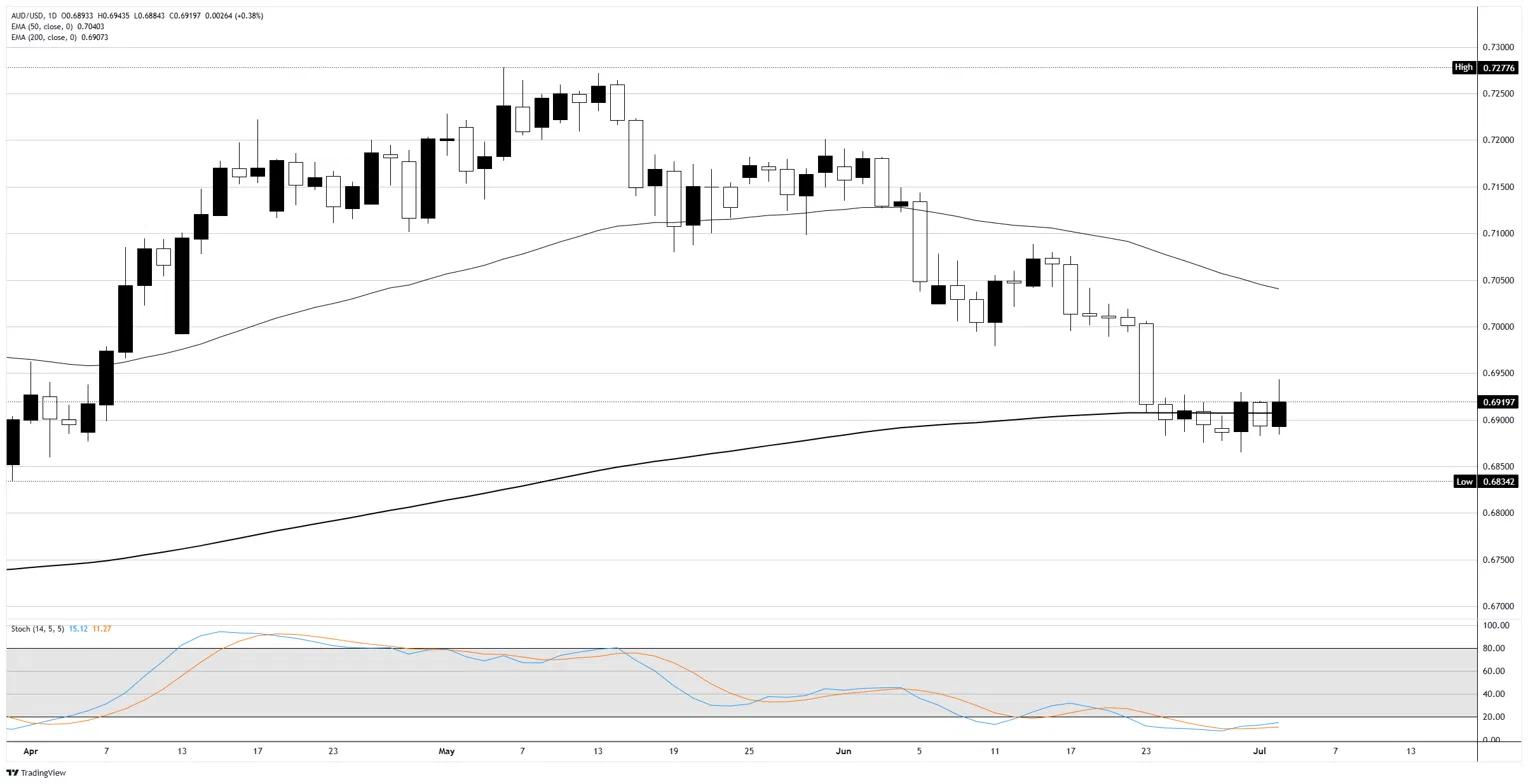
Thursday belonged to the US Dollar, not the Aussie. A soft American payrolls print sent AUD/USD spiking toward 0.6950 on release, before it gave most of that back to close well off its high. The irony is that the Australian side improved: the S&P Global composite Purchasing Managers Index (PMI) crept back into expansion at 50.4, with services at 50.5, both back above the 50 growth line. The market did not care; the Aussie traded as a passenger to the Dollar, as it has all quarter.
Payrolls scream, the jobless rate whispers
The headline figure was ugly enough to move the tape on its own: Nonfarm Payrolls (NFP) rose just 57K in June against a consensus near 110K, and AUD/USD ran to its session high before traders read the fine print. The unemployment rate fell to 4.2%, but only because participation slid to 61.5%, and in-line wages at 0.3% on the month left the dovish case thin enough for the Dollar to recover and drag the Aussie into the close. For the Federal Reserve (Fed), which held at 3.75% in June with hawkish guidance, the print cuts both ways: it feeds the easing case, while the firm jobless rate gives the hawks cover to wait.
A hawkish central bank the Aussie won't reward
The awkward part is that the currency's weakness runs against the textbook, because the Reserve Bank of Australia (RBA) is one of the most hawkish central banks in the developed world. It has hiked three times in 2026 to 4.35%, and held there in June while flagging it could go higher. Underlying inflation is not cooperating; the trimmed mean rate rose to 3.6% in May as firms passed on an energy shock that is only now fading. That leaves the Aussie a 60 basis point rate advantage over the Fed, the sort of gap that should attract buyers. It has not. The market treats the hikes as a problem, not a prize: the same tightening that flatters the carry story is biting a slowing economy, with unemployment near 4.5% and growth at a crawl.
The home data is a split screen
The trade balance swung from surplus to a roughly $3.0 billion deficit in May against an expected $2.2 billion surplus, as exports slumped 6.9% on the month; for an economy built on selling commodities to Asia, a lost surplus strips out support. Those PMI surveys back above 50 say the private sector is not rolling over as fast as the hard data implies, but the tape is watching the trade deficit and China, not the survey.
The week that decides it
The rest is down to the calendar, which front-loads what matters for the Aussie. China's services PMI lands first, early Friday at 01:45 GMT, and a soft read from Australia's biggest trading partner would sit squarely on the Aussie. Focus then swings back across the Pacific: the Institute for Supply Management (ISM) services survey on Monday at 14:00 GMT shows whether the payrolls wobble was a blip, and the Federal Open Market Committee (FOMC) minutes on Wednesday at 18:00 GMT get parsed for how much the cooling labour market troubles the Fed. Australian inflation on 29 July is the real domestic catalyst, arriving just before the RBA's 11 August decision.
Levels to watch
Resistance: The spike high near 0.6950 is the first cap, the level the rally could not hold; above it, the 0.7000 handle marks the shelf the pair fell from in late June, the first real test for any recovery.
Support: The 200-day Exponential Moving Average (EMA) around 0.6900 has held as the floor over the past fortnight; a daily close below there opens the late-June low close to 0.6850, with 0.6800 the next reference beneath. The daily Stochastic oscillator is deeply oversold and trying to flatten, arguing the immediate downside is tired, not turning.
Bias: Lower. The Aussie keeps failing at 0.6950, and until it closes a day above that level the base is a pause, not a bottom. The hawkish RBA argues against pressing fresh shorts at 0.6900 support, but it is no reason to chase the Aussie higher; Thursday's fade of the payrolls spike says buyers are absent. The path of least resistance is a grind toward 0.6900, with a break below opening 0.6850 if China or the US data disappoints.
AUD/USD daily chart
Australian Dollar FAQs
One of the most significant factors for the Australian Dollar (AUD) is the level of interest rates set by the Reserve Bank of Australia (RBA). Because Australia is a resource-rich country another key driver is the price of its biggest export, Iron Ore. The health of the Chinese economy, its largest trading partner, is a factor, as well as inflation in Australia, its growth rate and Trade Balance. Market sentiment – whether investors are taking on more risky assets (risk-on) or seeking safe-havens (risk-off) – is also a factor, with risk-on positive for AUD.
The Reserve Bank of Australia (RBA) influences the Australian Dollar (AUD) by setting the level of interest rates that Australian banks can lend to each other. This influences the level of interest rates in the economy as a whole. The main goal of the RBA is to maintain a stable inflation rate of 2-3% by adjusting interest rates up or down. Relatively high interest rates compared to other major central banks support the AUD, and the opposite for relatively low. The RBA can also use quantitative easing and tightening to influence credit conditions, with the former AUD-negative and the latter AUD-positive.
China is Australia’s largest trading partner so the health of the Chinese economy is a major influence on the value of the Australian Dollar (AUD). When the Chinese economy is doing well it purchases more raw materials, goods and services from Australia, lifting demand for the AUD, and pushing up its value. The opposite is the case when the Chinese economy is not growing as fast as expected. Positive or negative surprises in Chinese growth data, therefore, often have a direct impact on the Australian Dollar and its pairs.
Iron Ore is Australia’s largest export, accounting for $118 billion a year according to data from 2021, with China as its primary destination. The price of Iron Ore, therefore, can be a driver of the Australian Dollar. Generally, if the price of Iron Ore rises, AUD also goes up, as aggregate demand for the currency increases. The opposite is the case if the price of Iron Ore falls. Higher Iron Ore prices also tend to result in a greater likelihood of a positive Trade Balance for Australia, which is also positive of the AUD.
The Trade Balance, which is the difference between what a country earns from its exports versus what it pays for its imports, is another factor that can influence the value of the Australian Dollar. If Australia produces highly sought after exports, then its currency will gain in value purely from the surplus demand created from foreign buyers seeking to purchase its exports versus what it spends to purchase imports. Therefore, a positive net Trade Balance strengthens the AUD, with the opposite effect if the Trade Balance is negative.
Author
Joshua Gibson
FXStreet
Joshua joins the FXStreet team as an Economics and Finance double major from Vancouver Island University with twelve years' experience as an independent trader focusing on technical analysis.

















