Aussie drops over 1% as Powell flags stubborn inflation
- The Australian Dollar retreated sharply from the 0.7100 area after the Fed held rates and raised its 2026 inflation forecast.
- The Fed held rates and projected one cut for 2026; Chair Powell said inflation progress has been slower than hoped, with the 2026 core PCE forecast raised to 2.7%.
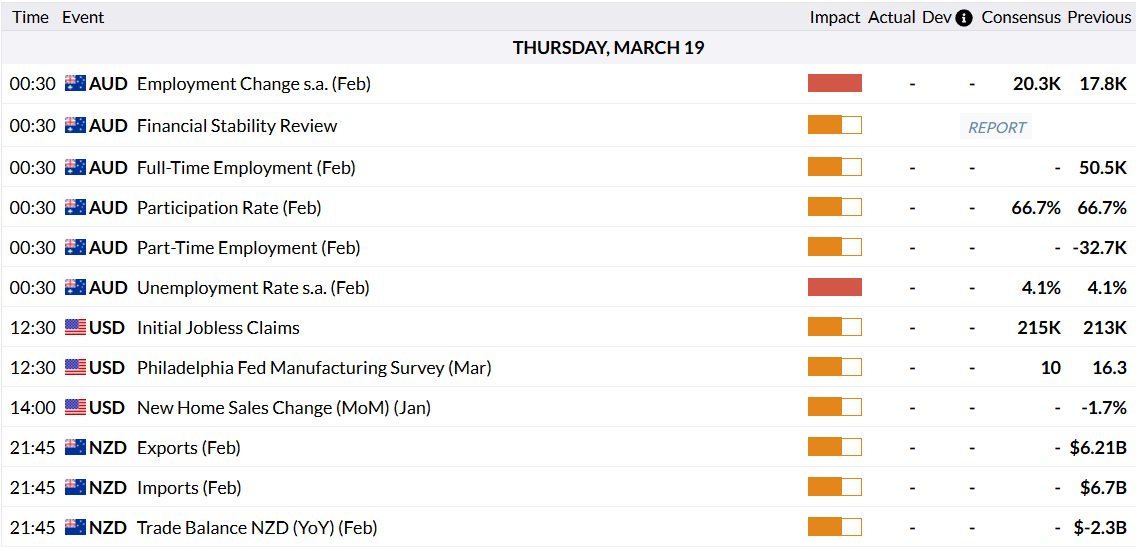
- Australia's February employment data is due Thursday, with consensus at 20.3K jobs added and the unemployment rate expected to hold at 4.1% following the RBA's second consecutive rate hike to 4.10%.

AUD/USD fell around 1.15% on Wednesday, chalking in another sharp rejection from the 0.7100 handle to settle near 0.7025. The pair pushed briefly above 0.7120 early in the session before sellers took control, extending a pattern of failed attempts to reclaim the year-to-date high close to 0.7190. Wednesday's large bearish candle erased the prior two sessions of gains and shifted the pair back toward the lower end of its recent consolidation range.
The Federal Reserve (Fed) held rates as expected, but Chair Jerome Powell's press conference tilted hawkish. Powell noted that inflation progress has been slower than the central bank had hoped, while the updated Summary of Economic Projections lifted the 2026 core inflation forecast to 2.7% from 2.5% in December. Wednesday's Producer Price Index (PPI) reinforced the theme, with headline PPI rising 0.7% MoM against a 0.3% consensus and the YoY reading jumping to 3.4% from 2.9%.
The Reserve Bank of Australia (RBA) raised rates for the second consecutive meeting on Tuesday, hiking 25 basis points to 4.10% in a narrow 5-4 vote. Governor Michele Bullock cited renewed capacity pressures and the inflationary impact of surging energy prices linked to the Middle East conflict. Thursday's Australian February employment report is the next key release, with markets expecting 20.3K jobs added and the unemployment rate to hold at 4.1%. The RBA's Financial Stability Review, also due Thursday, may offer further colour on how the Board views household risks from rising mortgage costs.
AUD/USD daily chart
Technical Analysis
In the daily chart, AUD/USD trades at 0.7022. The near-term bias is mildly bullish while price holds above the rising 50-day exponential moving average, which continues to point higher and sits well above the 200-day average, confirming an established medium-term uptrend. The pair is consolidating below recent highs after failing to extend beyond the 0.7150 area, but the Stochastic oscillator retreating from overbought and moving toward mid-range reflects a normal momentum cooling rather than a reversal signal as long as buyers defend the recent higher lows.
Initial support emerges at 0.7010, just beneath spot, with a daily close below this level opening the way toward the higher 0.6960 area where the 50-day EMA offers additional downside protection. A deeper pullback would expose 0.6900 as the next key support and potential line in the sand for the current bullish structure. On the upside, immediate resistance is located at 0.7075, followed by 0.7120, where prior swing highs cluster, while a break above 0.7150 would signal a continuation of the uptrend toward the 0.7200 region.
(The technical analysis of this story was written with the help of an AI tool.)
Australian Dollar FAQs
One of the most significant factors for the Australian Dollar (AUD) is the level of interest rates set by the Reserve Bank of Australia (RBA). Because Australia is a resource-rich country another key driver is the price of its biggest export, Iron Ore. The health of the Chinese economy, its largest trading partner, is a factor, as well as inflation in Australia, its growth rate and Trade Balance. Market sentiment – whether investors are taking on more risky assets (risk-on) or seeking safe-havens (risk-off) – is also a factor, with risk-on positive for AUD.
The Reserve Bank of Australia (RBA) influences the Australian Dollar (AUD) by setting the level of interest rates that Australian banks can lend to each other. This influences the level of interest rates in the economy as a whole. The main goal of the RBA is to maintain a stable inflation rate of 2-3% by adjusting interest rates up or down. Relatively high interest rates compared to other major central banks support the AUD, and the opposite for relatively low. The RBA can also use quantitative easing and tightening to influence credit conditions, with the former AUD-negative and the latter AUD-positive.
China is Australia’s largest trading partner so the health of the Chinese economy is a major influence on the value of the Australian Dollar (AUD). When the Chinese economy is doing well it purchases more raw materials, goods and services from Australia, lifting demand for the AUD, and pushing up its value. The opposite is the case when the Chinese economy is not growing as fast as expected. Positive or negative surprises in Chinese growth data, therefore, often have a direct impact on the Australian Dollar and its pairs.
Iron Ore is Australia’s largest export, accounting for $118 billion a year according to data from 2021, with China as its primary destination. The price of Iron Ore, therefore, can be a driver of the Australian Dollar. Generally, if the price of Iron Ore rises, AUD also goes up, as aggregate demand for the currency increases. The opposite is the case if the price of Iron Ore falls. Higher Iron Ore prices also tend to result in a greater likelihood of a positive Trade Balance for Australia, which is also positive of the AUD.
The Trade Balance, which is the difference between what a country earns from its exports versus what it pays for its imports, is another factor that can influence the value of the Australian Dollar. If Australia produces highly sought after exports, then its currency will gain in value purely from the surplus demand created from foreign buyers seeking to purchase its exports versus what it spends to purchase imports. Therefore, a positive net Trade Balance strengthens the AUD, with the opposite effect if the Trade Balance is negative.
Author

Joshua Gibson
FXStreet
Joshua joins the FXStreet team as an Economics and Finance double major from Vancouver Island University with twelve years' experience as an independent trader focusing on technical analysis.