AUD/USD prolongs losses for fourth straight day ahead of Aussie jobs report
- AUD/USD trades at 0.6762, down 0.70%, marking the fourth straight day of losses.
- US Department of Commerce data showed an MoM decline of -8.0% in Housing Starts, with Building Permits also falling by -3.7%.
- Market speculators expect the US Federal Reserve to halt rate hikes after a predicted 25 bps hike in July, with the first cut expected in March 2024.

AUD/USD extended its losses to four straight days, spurred by the pair’s failure to get traction and surpass 0.6900, exacerbating a correction, with sellers eyeing a test of the 200-day Exponential Moving Average (EMA) at 0.6751. Factors like a dovish tone of the latest Reserve Bank of Australia (RBA) minutes, and looming jobs data on the Aussie’s (AUD) side, keeps the AUD/USD from strengthening further. As of writing, the AUD/USD exchanges hands at 0.6762, down 0.70%.
AUD/USD falls under 0.6900, with sellers eyeing the 200-day EMA at 0.6751 amid a dovish RBA and looming jobs data.
Key US economic data revealed on Wednesday provided a lift on the greenback, which has been under heavy pressure. According to the latest data from the US Department of Commerce, Housing Starts experienced a -8.0% MoM decline. This decrease follows the prior month’s significant increase of 21.7%, which marked the highest growth rate in 11 months. The number of housing starts decreased from 1.631 million to 1.434 million. Furthermore, Building Permits also dropped by -3.7% compared to the previous month, in contrast to May’s growth of 5.6%. The number of permits issued decreased from 1.496 million to 1.440 million.
The AUD/USD reacted downwards on the data, pushing toward 0.6760 after the pair breached support at the S1 daily pivot at around 0.6790, extending its losses toward the daily low of 0.6750.
In the meantime, speculators seem convinced that the US Federal Reserve (Fed) is almost done raising rates, as the CME FedWatch Tool shows odds for July’s 25 bps hike at 99%, but no more increases are expected. The first Fed cut is awaited in March 2024.
Australia is scheduled to release its employment report for June on Thursday. Following a solid performance in May, where the economy added 75,900 jobs, the consensus forecast for June is more modest, at around 15,000 jobs being added. The unemployment rate is expected to remain stable at 3.6%. Resilience in the jobs market would keep the RBA pressured as it scrambles to tame inflation. The RBA stressed that it would be data-dependent, focused on inflation and jobs data, to attain its 2-3% inflation goal.
Given the backdrop, the AUD/USD would remain trading sideways amidst uncertainty around the US and Australian economic path, and it could seesaw around the 200-day EMA.
AUD/USD Price Analysis: Technical outlook
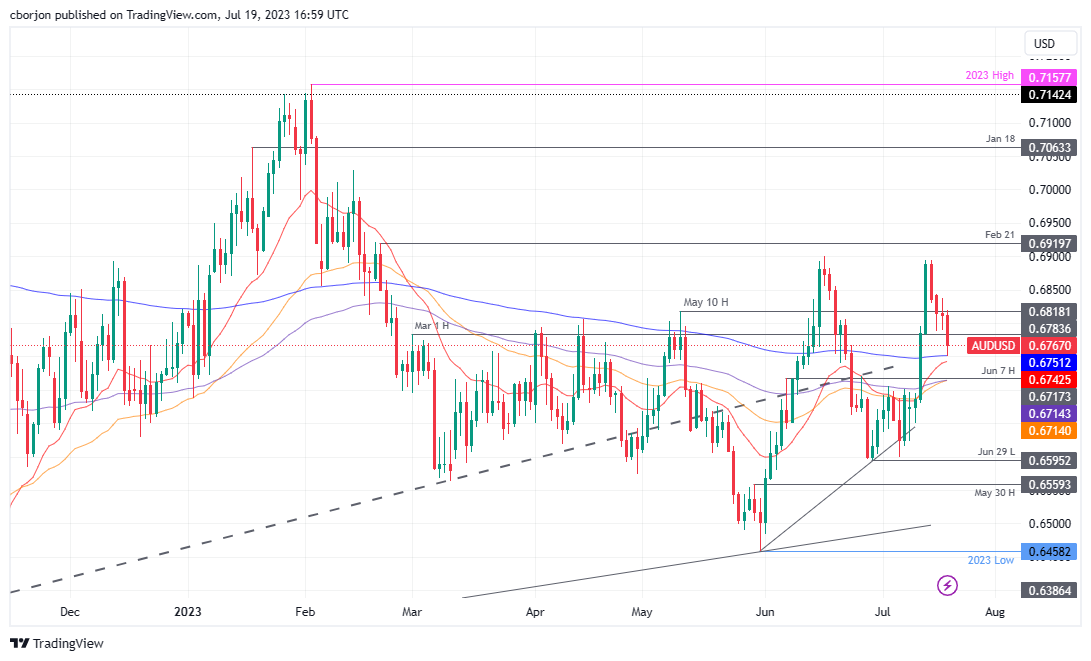
The AUD/USD daily chart portrays the pair as upward biased, but the recent fall towards the 200-day EMA puts the uptrend at risk, as a breach below that level could pave the way for consolidation. It means the AUD/USD would shift range-bound, with well-defined upside risks, at the YTD high of 0.6899. On the flip side, AUD/USD first support would emerge at 0.6717, the June 7 high, followed by the 0.67 figure.
Author

Christian Borjon Valencia
FXStreet
Markets analyst, news editor, and trading instructor with over 14 years of experience across FX, commodities, US equity indices, and global macro markets.