AUD/USD Price Forecast: Looks likely to reclaim multi-year high of 0.7190
- AUD/USD jumps to near 0.7137 as the Australian Dollar outperforms its peers.
- The US-Iran optimism has diminished the US Dollar’s safe-haven appeal.
- US President Trump expresses confidence regarding a permanent ceasefire with Iran.

The Australian Dollar (AUD) outperforms its major currency peers, trading 0.23% higher to near 0.7137 against the US Dollar (USD), during the early European session on Wednesday. The antipodean trades firmly as the market sentiment is risk-on due to optimism towards a permanent ceasefire between the United States (US) and Iran.
Australian Dollar Price Today
The table below shows the percentage change of Australian Dollar (AUD) against listed major currencies today. Australian Dollar was the strongest against the Japanese Yen.
| USD | EUR | GBP | JPY | CAD | AUD | NZD | CHF | |
|---|---|---|---|---|---|---|---|---|
| USD | 0.04% | 0.00% | 0.08% | 0.03% | -0.27% | -0.01% | 0.03% | |
| EUR | -0.04% | -0.03% | 0.07% | -0.01% | -0.21% | -0.04% | -0.01% | |
| GBP | -0.01% | 0.03% | 0.09% | 0.05% | -0.18% | -0.03% | 0.02% | |
| JPY | -0.08% | -0.07% | -0.09% | -0.07% | -0.29% | -0.15% | -0.09% | |
| CAD | -0.03% | 0.00% | -0.05% | 0.07% | -0.21% | -0.05% | -0.02% | |
| AUD | 0.27% | 0.21% | 0.18% | 0.29% | 0.21% | 0.17% | 0.22% | |
| NZD | 0.01% | 0.04% | 0.03% | 0.15% | 0.05% | -0.17% | 0.05% | |
| CHF | -0.03% | 0.00% | -0.02% | 0.09% | 0.02% | -0.22% | -0.05% |
The heat map shows percentage changes of major currencies against each other. The base currency is picked from the left column, while the quote currency is picked from the top row. For example, if you pick the Australian Dollar from the left column and move along the horizontal line to the US Dollar, the percentage change displayed in the box will represent AUD (base)/USD (quote).
As of writing, S&P 500 futures hold onto Tuesday’s gains around 6,970, reflecting an upbeat market mood. The US Dollar Index (DXY), which tracks the Greenback’s value against six major currencies, edges up to near 98.10, but is close to its almost seven-week low of 98.00.
US President Donald Trump has expressed confidence that Washington and Iran could reach a permanent ceasefire in the next two days. Trump said in an interview with ABC News that he doesn’t think extending the two-week ceasefire, adding, "I think you’re going to be watching an amazing two days ahead. I really do."
On the domestic front, the warning of stagflation from Reserve Bank of Australia (RBA) Deputy Governor Andrew Hauser, in a fire chat event on Tuesday, has raised concerns over the Australian economic outlook. Hauser said that the coming months will be “challenging” for Australia in the wake of an energy crisis due to Middle East conflicts and high inflationary pressures.
AUD/USD technical analysis
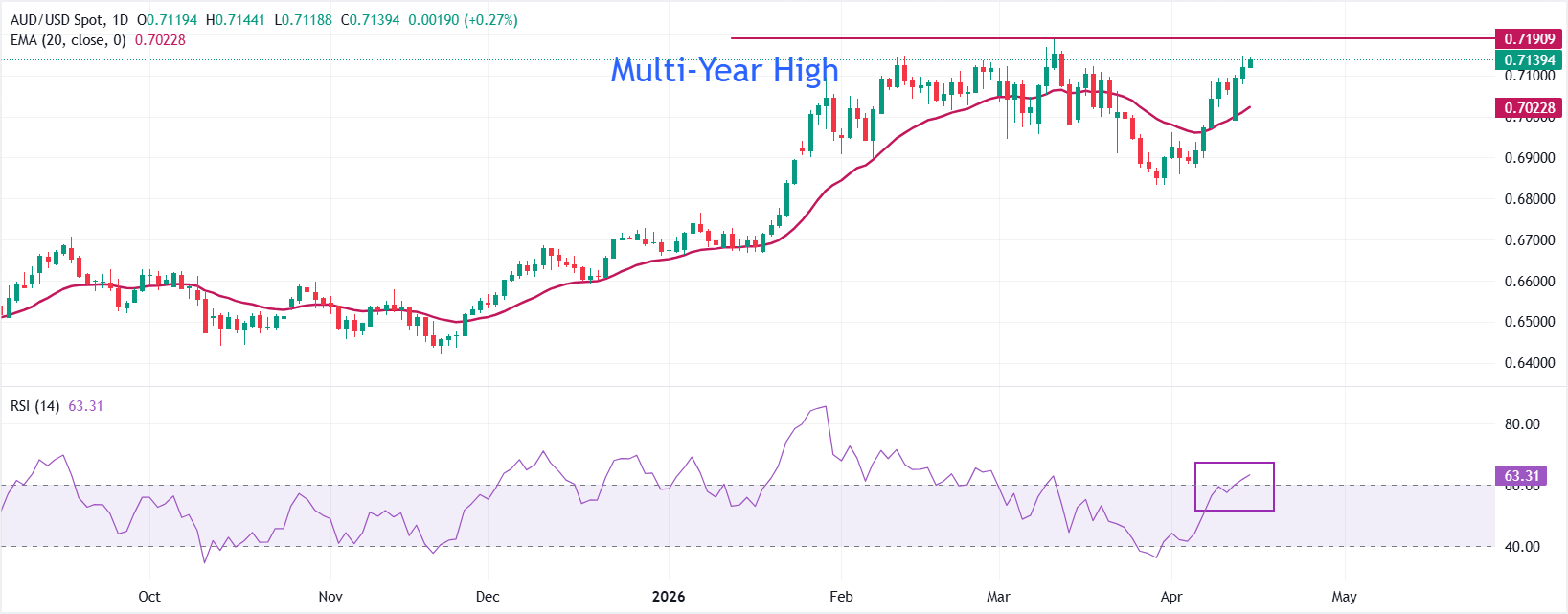
AUD/USD trades higher at around at 0.7140 at the press time. The pair holds a constructive near-term bias as it remains above the 20-day Exponential Moving Average (EMA) at 0.7023, suggesting that recent dips have been bought and that the short-term trend is underpinned by rising demand.
The Relative Strength Index (RSI) at 63.3 leans into bullish territory without yet signaling overbought conditions, hinting that upside momentum is still developing rather than exhausted.
On the downside, initial support is located at the 20-day EMA at 0.7023, where a break would likely weaken the current bullish structure and open the door to a deeper correction toward prior congestion levels around 0.6935. As long as spot continues to trade above this moving average and RSI holds above the midline, pullbacks are likely to be treated as corrective pauses within the broader upward bias, and it could attempt to reclaim the multi-year high near 0.7200.
(The technical analysis of this story was written with the help of an AI tool.)
US Dollar FAQs
The US Dollar (USD) is the official currency of the United States of America, and the ‘de facto’ currency of a significant number of other countries where it is found in circulation alongside local notes. It is the most heavily traded currency in the world, accounting for over 88% of all global foreign exchange turnover, or an average of $6.6 trillion in transactions per day, according to data from 2022. Following the second world war, the USD took over from the British Pound as the world’s reserve currency. For most of its history, the US Dollar was backed by Gold, until the Bretton Woods Agreement in 1971 when the Gold Standard went away.
The most important single factor impacting on the value of the US Dollar is monetary policy, which is shaped by the Federal Reserve (Fed). The Fed has two mandates: to achieve price stability (control inflation) and foster full employment. Its primary tool to achieve these two goals is by adjusting interest rates. When prices are rising too quickly and inflation is above the Fed’s 2% target, the Fed will raise rates, which helps the USD value. When inflation falls below 2% or the Unemployment Rate is too high, the Fed may lower interest rates, which weighs on the Greenback.
In extreme situations, the Federal Reserve can also print more Dollars and enact quantitative easing (QE). QE is the process by which the Fed substantially increases the flow of credit in a stuck financial system. It is a non-standard policy measure used when credit has dried up because banks will not lend to each other (out of the fear of counterparty default). It is a last resort when simply lowering interest rates is unlikely to achieve the necessary result. It was the Fed’s weapon of choice to combat the credit crunch that occurred during the Great Financial Crisis in 2008. It involves the Fed printing more Dollars and using them to buy US government bonds predominantly from financial institutions. QE usually leads to a weaker US Dollar.
Quantitative tightening (QT) is the reverse process whereby the Federal Reserve stops buying bonds from financial institutions and does not reinvest the principal from the bonds it holds maturing in new purchases. It is usually positive for the US Dollar.
Author

Sagar Dua
FXStreet
Sagar Dua is associated with the financial markets from his college days. Along with pursuing post-graduation in Commerce in 2014, he started his markets training with chart analysis.