AUD/USD languishes near recent lows
- AUD/USD tried to stage a Monday rally, but fizzled.
- Aussie markets are set to be dark most of the week, but China data remains.
- Key US figures this week loom ahead with Friday’s ISM PMI.

AUD/USD churned on Monday, aiming for higher ground but waffling back into the day’s opening bids near 0.6220 as holiday market volumes remain too thin to produce anything except jerky intraday movements that go nowhere. Aussie flows are set to be particularly constrained this week as Australian markets take the entire front half of the trading week off, but some key Chinese economic activity data could spark some knock-on moves.
China will be hitting the ground running while most markets remain tepid through the rollover into the new trading year. China’s NBS Manufacturing and Non-Manufacturing Purchasing Managers Index (PMI) figures land early on Tuesday, with Caixin Manufacturing PMI component numbers due on Thursday after the New Year’s Day holiday on Wednesday. NBS China Manufacturing PMI for December is expected to hold flat at 50.3, while the Non-Manufacturing and Caixin Manufacturing components are both expected to register slight upticks.
Things remain equally tepid on the US side with market flows set to remain thin until after the New Year’s holiday on Wednesday. US ISM Manufacturing PMI figures will be the key figure for Greenback traders this week, slated for Friday and expected to tick down to 48.3 in December from the previous 48.4.
AUD/USD price forecast
AUD/USD continues to churn near a 26-month low set at 0.6199 in mid-December, and a bullish recovery attempt has made little progress, leaving bids to struggle at the low end of near-term consolidation. The pair is headed for a fresh retest of multi-year lows, with the 50-day Exponential Moving Average (EMA) declining through 0.6435 and adding additional downside pressure to price action.
AUD/USD daily chart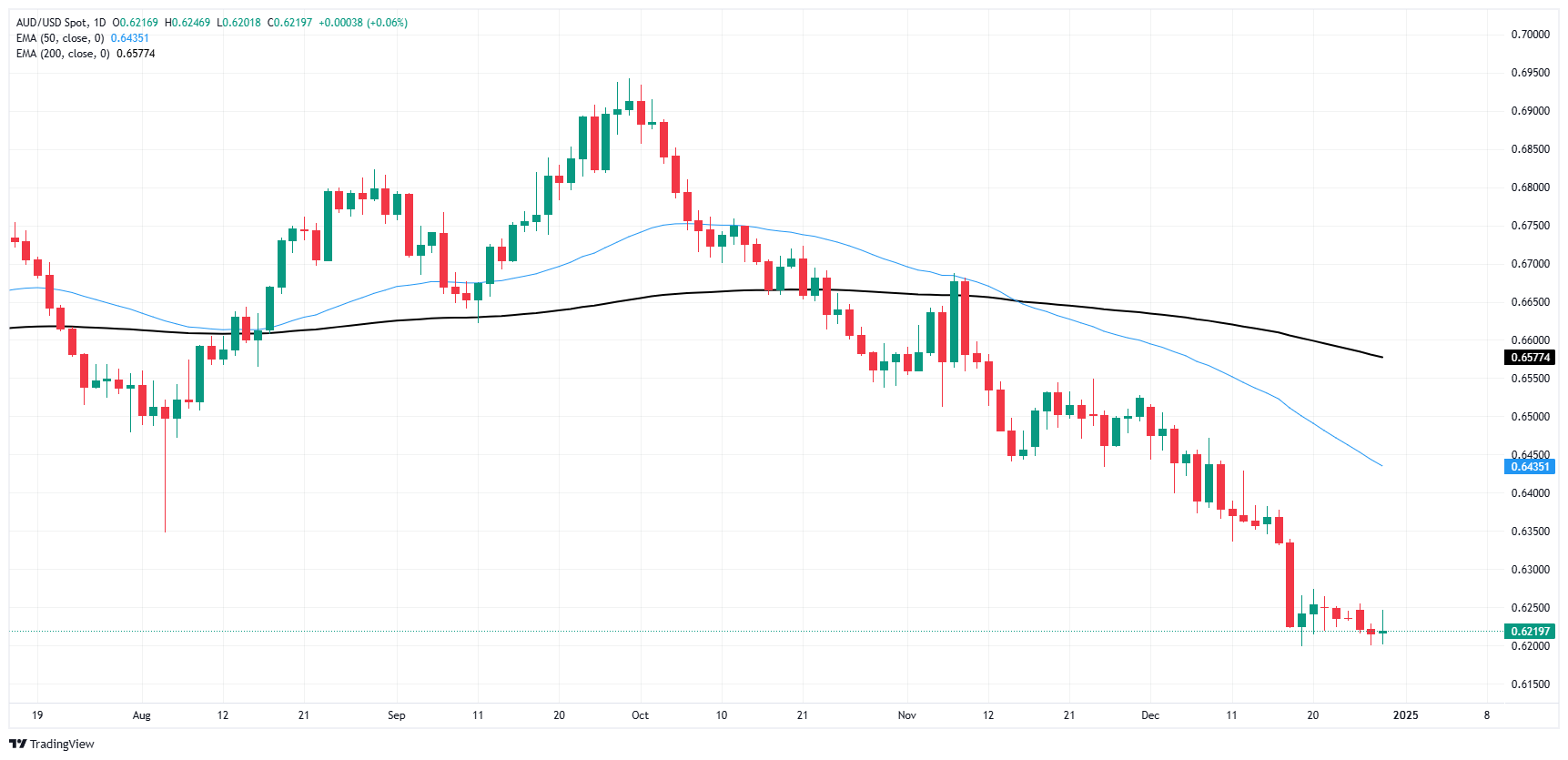
Australian Dollar FAQs
One of the most significant factors for the Australian Dollar (AUD) is the level of interest rates set by the Reserve Bank of Australia (RBA). Because Australia is a resource-rich country another key driver is the price of its biggest export, Iron Ore. The health of the Chinese economy, its largest trading partner, is a factor, as well as inflation in Australia, its growth rate and Trade Balance. Market sentiment – whether investors are taking on more risky assets (risk-on) or seeking safe-havens (risk-off) – is also a factor, with risk-on positive for AUD.
The Reserve Bank of Australia (RBA) influences the Australian Dollar (AUD) by setting the level of interest rates that Australian banks can lend to each other. This influences the level of interest rates in the economy as a whole. The main goal of the RBA is to maintain a stable inflation rate of 2-3% by adjusting interest rates up or down. Relatively high interest rates compared to other major central banks support the AUD, and the opposite for relatively low. The RBA can also use quantitative easing and tightening to influence credit conditions, with the former AUD-negative and the latter AUD-positive.
China is Australia’s largest trading partner so the health of the Chinese economy is a major influence on the value of the Australian Dollar (AUD). When the Chinese economy is doing well it purchases more raw materials, goods and services from Australia, lifting demand for the AUD, and pushing up its value. The opposite is the case when the Chinese economy is not growing as fast as expected. Positive or negative surprises in Chinese growth data, therefore, often have a direct impact on the Australian Dollar and its pairs.
Iron Ore is Australia’s largest export, accounting for $118 billion a year according to data from 2021, with China as its primary destination. The price of Iron Ore, therefore, can be a driver of the Australian Dollar. Generally, if the price of Iron Ore rises, AUD also goes up, as aggregate demand for the currency increases. The opposite is the case if the price of Iron Ore falls. Higher Iron Ore prices also tend to result in a greater likelihood of a positive Trade Balance for Australia, which is also positive of the AUD.
The Trade Balance, which is the difference between what a country earns from its exports versus what it pays for its imports, is another factor that can influence the value of the Australian Dollar. If Australia produces highly sought after exports, then its currency will gain in value purely from the surplus demand created from foreign buyers seeking to purchase its exports versus what it spends to purchase imports. Therefore, a positive net Trade Balance strengthens the AUD, with the opposite effect if the Trade Balance is negative.
Author

Joshua Gibson
FXStreet
Joshua joins the FXStreet team as an Economics and Finance double major from Vancouver Island University with twelve years' experience as an independent trader focusing on technical analysis.

















