|

AUD/JPY Price Analysis: Bears take control as pair slips below 20-day SMA

  • AUD/JPY declines by 0.42% to 96.30 on Monday, extending its recent losing streak.
  • RSI drops to negative territory, signaling increasing bearish pressure.
  • The breach of the 20-day SMA confirms a shift in sentiment, putting sellers in control.

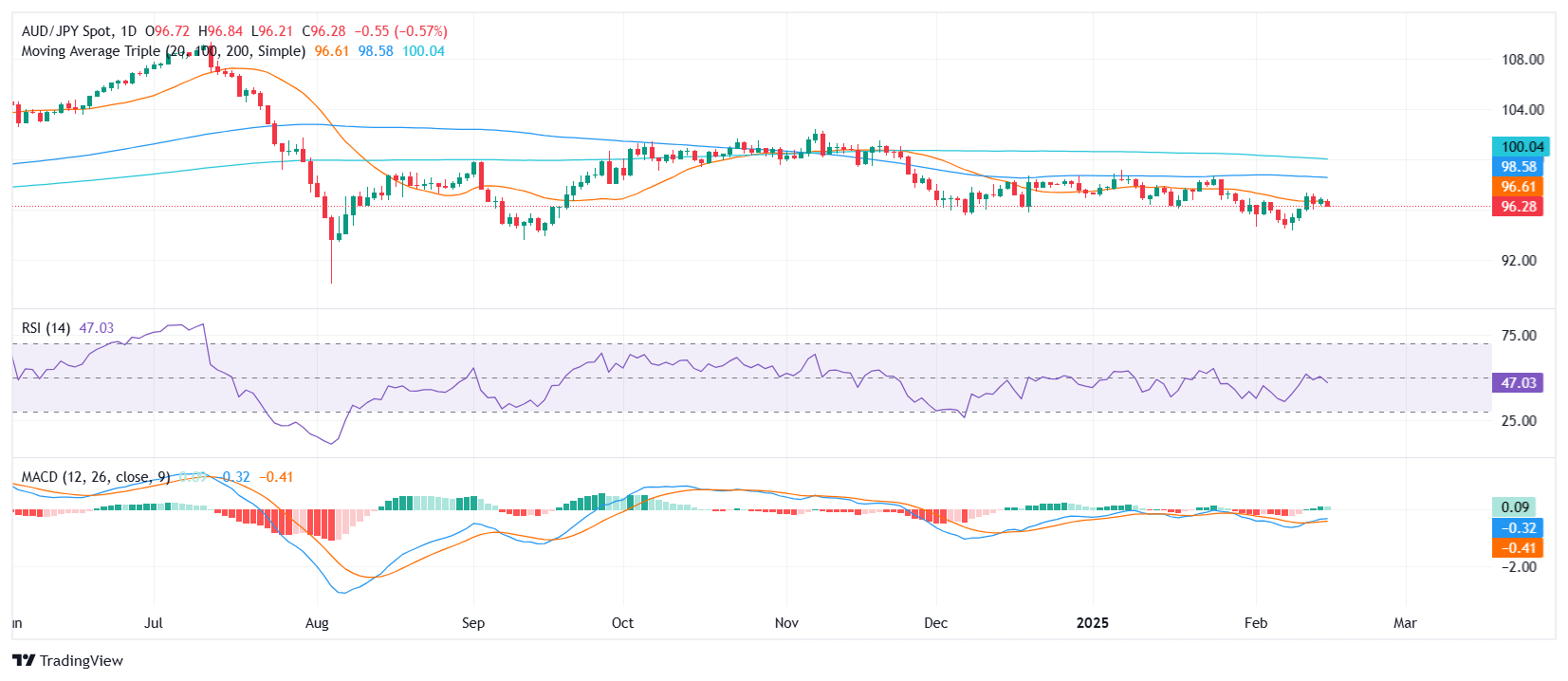
AUD/JPY continued its downward movement on Monday, losing 0.42% to settle around 96.30. The break below the 20-day Simple Moving Average (SMA) reinforces the weakening trend, as buyers struggle to regain momentum. The pair has now given up most of its recent gains, with sellers gaining traction.

Momentum indicators paint a bearish picture. The Relative Strength Index (RSI) has fallen sharply to 48, reflecting increased downside pressure, while the Moving Average Convergence Divergence (MACD) histogram shows decreasing green bars, suggesting that bullish attempts are fading. The pair’s inability to hold above the 20-day SMA indicates that selling momentum could intensify.

If the downward trend persists, the next key support lies around 96.00, followed by 95.50. On the upside, buyers would need to push AUD/JPY back above the 20-day SMA near 96.60 to regain short-term control and shift sentiment toward a more neutral stance.

AUD/JPY daily chart
Author

Patricio Martín

Patricio is an economist from Argentina passionate about global finance and understanding the daily movements of the markets.


More from Patricio Martín
Share:

Editor's Picks

AUD/USD consolidates above 0.7000; remains close to monthly top

AUD/USD holds steady above 0.7000 during the Asian session on Friday, trading just below the previous day's monthly low amid diverging forces. A hawkish RBA continues to support the Aussie, while the recent decline in US bond yields keeps the US Dollar depressed near a three-week low. However, oil-driven inflation fears reinforce Fed hike bets, which, along with geopolitical risks, could benefit the safe-haven buck and cap the currency pair.

USD/JPY bounces off one-month low; climbs to 157.00 amid reviving USD demand

USD/JPY rebounds from the 156.00 neighborhood, or a one-month low touched during Friday’s Asian session, with bulls looking to extend momentum beyond 157.00 amid the emergence of some US Dollar buying. Meanwhile, Japan's National CPI rose to a nine-month peak and reaffirmed BoJ rate-hike bets, which could support the Japanese Yen and cap gains for the currency pair.

Gold stalls recovery from three-month low as Fed hike bets and USD uptick cap gains

Gold struggles to capitalize on a modest intraday bounce from levels below the $4,000 psychological mark, or a three-month low set during the Asian session, and sticks to a negative tone for the second straight day. The Federal Reserve recently signaled that there is no urgency to raise interest rates. Traders, however, are still pricing in around an 80% chance that the US central bank will raise borrowing costs again at its December policy meeting.

Bitcoin, Ethereum, and Ripple rebound as major support levels cap recent sell-off

Bitcoin, Ethereum and Ripple rebound modestly on Friday after correcting and testing their key support zone the previous day. BTC holds the 50-day EMA, ETH finds support around the 100-day EMA, while XRP holds the horizontal floor near $1.300. The price action of these top three cryptocurrencies suggests a recovery if this critical support zone holds; a decisive close below these levels suggests a deeper correction.

The week ahead – UK budget, Shell, BP and HSBC and NatWest results
Financial markets have undergone another turbulent week with concerns about public sector debt levels, the impact of energy policy and higher oil and gas prices, and what events in France might mean for the UK economy going forward.
What November 3 means for the Fed's rate path and the US Dollar

The USD faces a decisive period ahead of the November 3 midterm elections. While markets anticipate another interest rate increase from the Fed in December, the battle for control of Congress could reshape fiscal policy expectations and, indirectly, the path of US monetary policy in 2027.