"Anything else would likely put the Japanese Yen under significant pressure": Commerzbank on why BoJ should hike rates

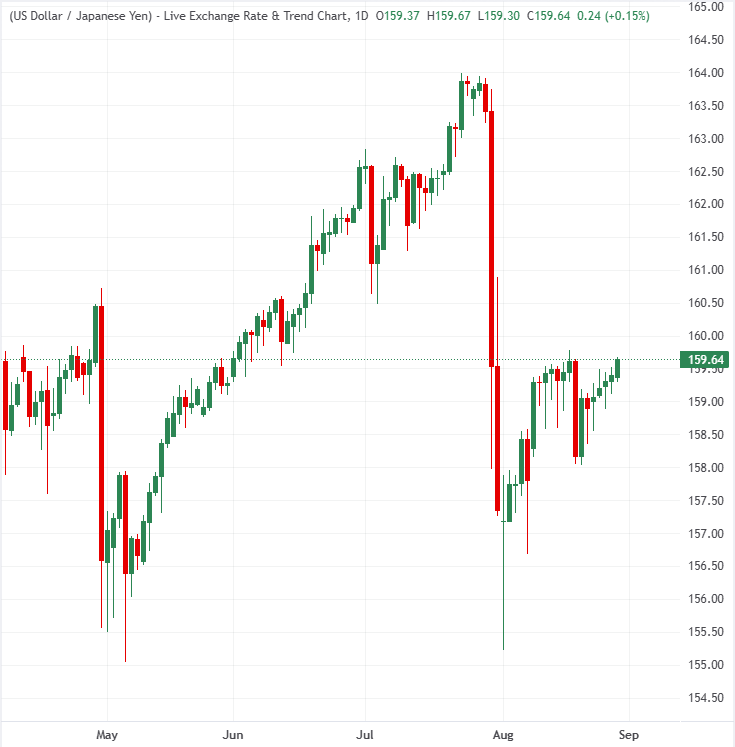
The Japanese Yen (JPY) is holding within a narrow trading range against the US Dollar (USD) at around 159.35, but pressures are rising following an acceleration in Tokyo inflation data. With Tokyo headline CPI reaching 1.9% in August and service sector price gains hitting nearly a one-year high, market odds for a Bank of Japan (BoJ) interest rate hike in September have surged.
While technical indicators point to short-term range-bound action, economists warn that any delay by the BoJ to tighten policy risks triggering renewed downside pressure on the Japanese Yen.
Accelerating Tokyo inflation strengthens case for September BoJ hike
According to Commerzbank, Tokyo’s inflation metrics confirm that price pressures in Japan have firmly reached the central bank's 2% target, particularly across underlying service categories. With the BoJ's current policy rate sitting at the bottom of its neutral range, failing to raise rates in September would risk undermining JPY stability.
Nothing stands in the Bank of Japan’s way anymore (...) A bit of uncertainty emains. However, the signs clearly point to an interest rate hike in September. Anything else would likely put the JPY under significant pressure.
Technical momentum confines USD/JPY to broad 157.90-159.80 channel
Analysts at UOB observe that USD/JPY remains firmly trapped within established technical parameters. Despite a minor uptick in upward momentum, price action reflects consolidation rather than the beginning of a directional trend.
Although there has been a slight increase in upward momentum, this is likely to lead to a higher range of 159.15-159.65 rather than a continued advance (...) Our most recent narrative was that USD is likely to trade in a range between 157.90 and 159.80. We continue to hold the same view for now.
Will the Bank of Japan raise rates in September?
Based on the combined perspective of both institutions, USD/JPY is caught between near-term technical range constraints and mounting fundamental rate hike pressures. While UOB expects the currency pair to remain bound within the 157.90 to 159.80 range over the coming weeks, Commerzbank emphasizes that the ultimate trajectory depends on the BoJ meeting in September, where a failure to deliver the priced rate hike could trigger a sharp depreciation in the Yen.
(This article was created with the help of an Artificial Intelligence tool and reviewed by an editor. Know more.)
Author

FXStreet Insights Team
FXStreet
The FXStreet Insights Team is a group of journalists that handpicks selected market observations published by renowned experts. The content includes notes by commercial as well as additional insights by internal and external analysts.
















