Anthropic’s IPO: What Claude must earn to justify $1.4 trillion


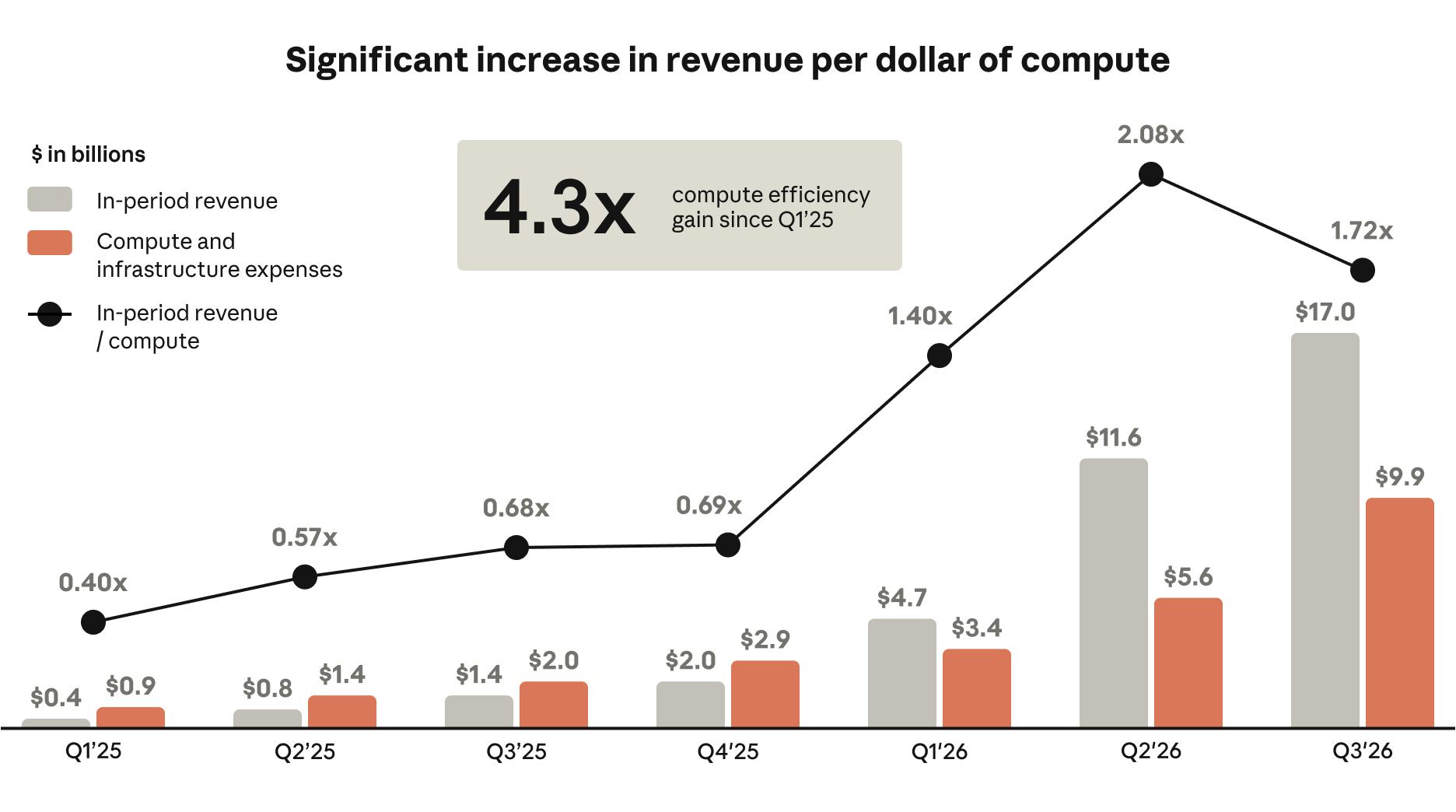
Anthropic’s sales grew thirteenfold in the first nine months of 2026. Yet in its latest quarter, computing costs rose faster than revenue and its adjusted operating margin fell. Both figures matter as the company prepares to go public. Claude has found a large paying audience; the question for shareholders is whether Anthropic can serve that audience profitably as its computing commitments come due.
What Anthropic does and how it makes money
Anthropic is a U.S. artificial intelligence company founded in 2021. It develops the models behind Claude, its general AI assistant. It also sells Claude Code, which helps software developers work with code, and Cowork, which applies Claude to office tasks such as analyzing documents and preparing reports. Businesses can use Claude directly or connect it to their own software through an application programming interface, or API.
The company earns money through subscriptions and usage fees. In the first nine months of 2026, usage generated $26.3 billion, or 79% of revenue, while subscriptions accounted for $6.9 billion, or 21%. The advantage of usage pricing is that customers can spend more without adding employees or buying more seats. A retailer that builds Claude into its customer service system, for example, can generate more revenue for Anthropic with every increase in the volume of conversations it handles.
That model also creates a financial risk. Each interaction consumes computing resources, and some supplier contracts require Anthropic to pay for capacity whether it uses it or not. Customer spending can slow faster than Anthropic can reduce its costs. Conversely, when demand exceeds available capacity, the company may need to rent more computing power at higher short term rates.
What the financial statements show
| First nine months of each year | 2025 | 2026 |
|---|---|---|
Revenue | $2.55 billion | $33.24 billion |
Compute and infrastructure expense as a share of revenue | 172% | 57% |
GAAP operating margin | −205% | −4% |
Adjusted operating margin | −123% | 12% |
Operating cash flow | −$2.02 billion | $6.57 billion |
Operating cash flow as a share of revenue | −80% | 20% |
The strength is that sales growth reached the cash flow statement. The number of customers generating at least $100,000 in annual revenue for Anthropic rose from more than 950 to more than 11,900. And although total computing expense more than quadrupled, sales grew faster over the comparable nine-month periods. The prior-year GAAP margin included a $1.5 billion legal settlement, which makes that comparison particularly favorable. Even so, the improvement in adjusted margin and operating cash flow shows the progress extended beyond the settlement.
The weakness is that the latest quarter moved in the opposite direction. From the second to the third quarter, revenue increased 47%, while computing and infrastructure expense rose 77%. Its share of revenue climbed from 48% to 58%, and adjusted operating margin fell from 19% to 15%. Anthropic attributed much of the compression to approximately $5 billion in short term compute expense. At the same time, lower model prices and contractual discounts offset about $600 million of revenue growth. That combination matters: volume can keep rising even as the company earns less on each dollar of sales.
The $104 billion reported net loss also needs context. It included $94.3 billion of largely noncash revaluations of convertible notes and related financing instruments. The nine-month operating loss of $1.26 billion is a better starting point for judging the business itself. Meanwhile, about $3.6 billion remained from operating cash flow after deducting equipment purchases, prepayments for leased assets and finance lease principal payments. That calculation captures cash left after those specific outlays; it says little about the cost of capacity that has yet to come online.
What an IPO is and when Anthropic is expected to list
An initial public offering, or IPO, is the first sale of a company’s shares to the public. The company receives the proceeds from new shares it issues, while existing shareholders receive the proceeds from shares they sell. The IPO price is what investors who receive an allocation pay. Once trading starts, buyers and sellers establish an opening market price, which can differ substantially.
Anthropic expects to set its IPO price on Wednesday, November 18, New York time, and begin trading on Thursday, November 19, on the Nasdaq Global Select Market under ANT. Its preliminary range is $70 to $78 per share. The final price was still pending at the time of writing.
The proposed public offering comprises 825 million shares, including 801.4 million new shares and 23.6 million sold by existing holders. That puts the base deal at $57.75 billion to $64.35 billion before fees and any additional shares sold through the underwriters’ option. A separate $26 billion private placement, conditional on the IPO closing, includes $10 billion each from Nvidia and Google. Google’s purchase fulfills part of an existing commitment. At the $74 midpoint, Anthropic estimates $84.6 billion in combined net proceeds to the company, before an estimated $3.8 billion in tax withholding related to employee share awards.
The balance sheet buys time, customer demand has to fill the capacity
Anthropic held $131.8 billion in cash, cash equivalents and short term investments at September 30. That is a substantial cushion, built largely through financing: the company raised $110.7 billion in net financing cash flow during the first nine months. The IPO would increase that cushion and give Anthropic more room to manage the timing of its investments.
The amended prospectus discloses $900.9 billion in aggregate contractual obligations, mostly for computing and infrastructure. About $70.7 billion is expected to be paid in the 12 months after September 30, and $451.6 billion is expected to be incurred by the end of 2030. These are commitments spread over many years, distinct from balance sheet debt. About $186.2 billion is subject to conditions or termination rights before commencement. The headline total also excludes a separate $150 billion to $175 billion of estimated payments under arrangements without fixed dollar commitments.
Compare that with $13.8 billion in revenue remaining to be recognized under noncancelable customer arrangements at September 30. Anthropic expects to recognize roughly three quarters over the following year. That figure excludes future usage customers have yet to commit to, so comparing it with expected cash payments does not produce a funding gap. It does show how much of the buildout depends on future demand arriving on time and at prices that cover its cost.
What the valuation requires
At $78 per share, the disclosed post-offering share count implies about $1.02 trillion in equity value. The reported $1.4 trillion estimate uses a broader, fully diluted count that includes potential shares from convertibles and other reserves. On that basis, the valuation is about 40 times the $35.3 billion of revenue reported over the latest four quarters. It falls to roughly 17 times October’s $81 billion annualized run rate, but that figure extrapolates recent activity. It is neither contracted revenue nor a forecast.
Consider the cash flow hurdle. For a $1.4 trillion equity valuation to deliver 10% annual price appreciation over five years, it would need to reach about $2.25 trillion, assuming no dividends or further dilution. At an exit valuation of 30 times annual free cash flow to equity, that implies roughly $75 billion in annual cash flow. A 25% cash flow margin would require about $301 billion in annual revenue. At a 20% margin, the revenue requirement rises to roughly $376 billion. This is an illustration of what the entry price demands, rather than a forecast.
Dilution deserves particular attention in the first earnings report. The prospectus estimates about $14.2 billion in cumulative stock compensation expense tied to certain employee share awards when the offering is completed, based on its stated assumptions. That charge is largely noncash, but the underlying shares still matter to investors. Public shareholders will also have limited voting influence: the founders’ entity would hold 50.1% of the vote on general shareholder matters, while a separate trust would have the right to elect a majority of board seats.
What to watch after the debut
The base case is that Claude usage keeps growing while margins remain uneven as new capacity comes online. The strongest confirmation would be several quarters of rising revenue, falling compute expense as a share of sales, and improving cash flow after equipment and lease payments. If prices keep falling while those costs remain high, revenue growth alone will do less to support the valuation.
On debut day, the offer price is a useful reference for judging demand for the shares. The more consequential test comes later. The IPO gives Anthropic the capital to build ahead of demand. The valuation depends on whether that investment produces more cash per diluted share as Claude scales.
Author
Ali Mortazavi
Errante
BEc, CMSA, Member of IFTA - International Federation of Technical Analysis, Associate Member of STA - Society of Technical Analysis (UK).