Adobe earnings preview: Are AI fears overblown?

The 2025 Q4 earnings season is nearly over, with more than 96% of S&P 500 companies already delivering their results. It’s overall been another great cycle, with growth remaining strong while beats percentages aren’t too far off from historical levels.
Adobe (ADBE) helps kick off the 2026 Q1 cycle, though the period will pick up much more steam with the release of the big banks’ results, which are due in about a month. But how do expectations stack up for the beaten-down software favorite?
Will AI disrupt Adobe?
Adobe shares have seen negative sentiment over recent months, with AI disruption fears being reflected in the share performance. While there are still no surefire signs that the company is in imminent danger due to the AI craze, the argument remains valid nonetheless. Most software stocks have faced pressure from the sentiment, with Adobe not alone in this regard.
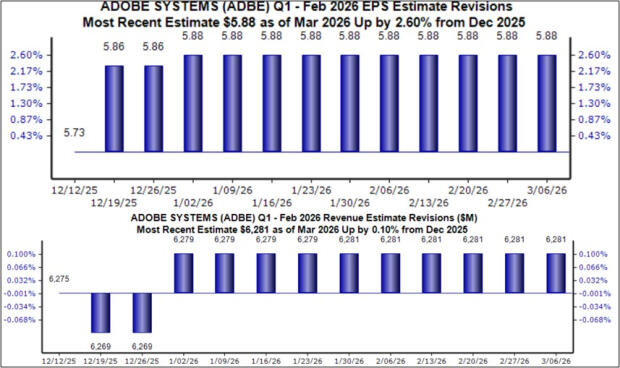
EPS and sales revisions for the quarter to be reported have also remained stable, with the current $5.88 Zacks Consensus EPS estimate suggesting 15% YoY growth. Revenue revisions paint a similar picture, with the $6.3 billion Zacks Consensus EPS estimate suggesting 10% YoY growth.
Putting it together
While the stability in estimates is a positive takeaway, Adobe (ADBEt) still remains vulnerable to a high level of disruption from AI-related technologies, keeping the overall outlook cloudy at this point. It seems like a more risk-averse idea to wait until we hear from the company about its response to the fears, but it’s worth noting that it won’t explicitly state it’s at risk, of course. Guidance and revisions following the earnings report will be a key factor, with the current cloudy outlook not all that reassuring at present.
That being said, the valuation picture here still can’t be overlooked, with the current 11.6X forward 12-month earnings multiple a fraction of the 32.1X five-year median, also reflecting a steep 47% discount relative to the S&P 500. Much of the negativity has likely already been priced in, but that doesn’t necessarily mean that the stock has great upside given the current disruption risks.
Want the latest recommendations from Zacks Investment Research? Download 7 Best Stocks for the Next 30 Days. Click to get this free report
Author

Zacks
Zacks Investment Research
Zacks Investment Research provides unbiased investment research and tools to help individuals and institutional investors make confident investing decisions.