3.4% in 12 months: what are US consumers bracing for?
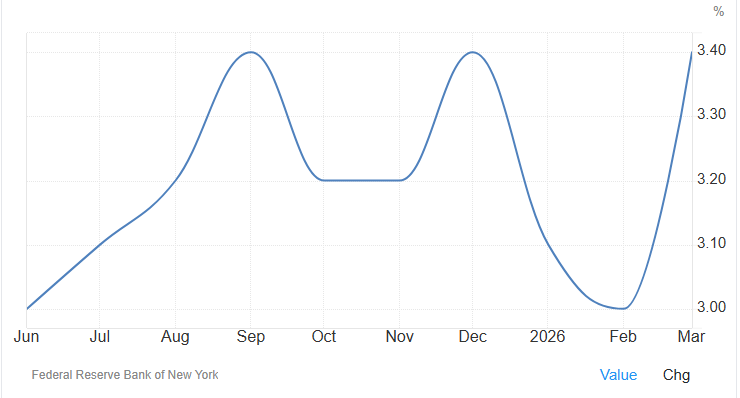
The Federal Reserve (Fed) Bank of New York's Survey of Consumer Expectations (SCE) for March showed one-year-ahead inflation expectations jumping to 3.4%, up 0.4 percentage points from February's 3.0% reading. That's the largest monthly increase in a year and lands well above the survey's long-run average of 3.34%. Consumers pointed to anticipated rises in gas and food prices as the primary drivers, with the escalation of conflict in the Middle East adding a geopolitical risk premium to everyday cost-of-living expectations.
Consumer inflation expectations completely reverse course:
The detail worth watching is the term structure. While the short-end spiked, three-year expectations nudged only slightly higher to 3.1%, and five-year expectations held flat at 3.0%. That divergence matters. If longer-term expectations had moved in lockstep, the Federal Reserve (Fed) would have a much bigger problem on its hands. For now, the data suggests consumers see current price pressures as temporary, war-driven, and not yet embedded in the broader inflation outlook.
Rising inflation expectations to hobble trajectory on rate cuts
Still, the timing is uncomfortable for the Fed. The central bank held rates steady at its March meeting and its updated dot plot signaled only one cut for the remainder of 2026, a hawkish shift that markets have taken to heart, with CME FedWatch now pricing in an 89.2% probability of a hold through June, and better-than even odds that the market will see no cuts whatsoever through the remainder of the year. JPMorgan's chief US economist, Michael Feroli, has gone further, forecasting zero cuts this year and a 25-basis-point hike in Q3 2027. A sticky consumer inflation expectations print like today's only reinforces the "higher for longer" narrative and gives policymakers little reason to rush toward easing.
Further weight will now be added to this week's upcoming Federal Open Market Committee (FOMC) Meeting Minutes, which are slated to release on Wednesday. Investors will be looking for further signs of hawkish tilts within the Fed's internal discussions moving forward.
Inflation FAQs
Inflation measures the rise in the price of a representative basket of goods and services. Headline inflation is usually expressed as a percentage change on a month-on-month (MoM) and year-on-year (YoY) basis. Core inflation excludes more volatile elements such as food and fuel which can fluctuate because of geopolitical and seasonal factors. Core inflation is the figure economists focus on and is the level targeted by central banks, which are mandated to keep inflation at a manageable level, usually around 2%.
The Consumer Price Index (CPI) measures the change in prices of a basket of goods and services over a period of time. It is usually expressed as a percentage change on a month-on-month (MoM) and year-on-year (YoY) basis. Core CPI is the figure targeted by central banks as it excludes volatile food and fuel inputs. When Core CPI rises above 2% it usually results in higher interest rates and vice versa when it falls below 2%. Since higher interest rates are positive for a currency, higher inflation usually results in a stronger currency. The opposite is true when inflation falls.
Although it may seem counter-intuitive, high inflation in a country pushes up the value of its currency and vice versa for lower inflation. This is because the central bank will normally raise interest rates to combat the higher inflation, which attract more global capital inflows from investors looking for a lucrative place to park their money.
Formerly, Gold was the asset investors turned to in times of high inflation because it preserved its value, and whilst investors will often still buy Gold for its safe-haven properties in times of extreme market turmoil, this is not the case most of the time. This is because when inflation is high, central banks will put up interest rates to combat it. Higher interest rates are negative for Gold because they increase the opportunity-cost of holding Gold vis-a-vis an interest-bearing asset or placing the money in a cash deposit account. On the flipside, lower inflation tends to be positive for Gold as it brings interest rates down, making the bright metal a more viable investment alternative.
Author

Joshua Gibson
FXStreet
Joshua joins the FXStreet team as an Economics and Finance double major from Vancouver Island University with twelve years' experience as an independent trader focusing on technical analysis.