1.3990: Why the Canadian Dollar is sliding toward the resistance zone that could decide the next move
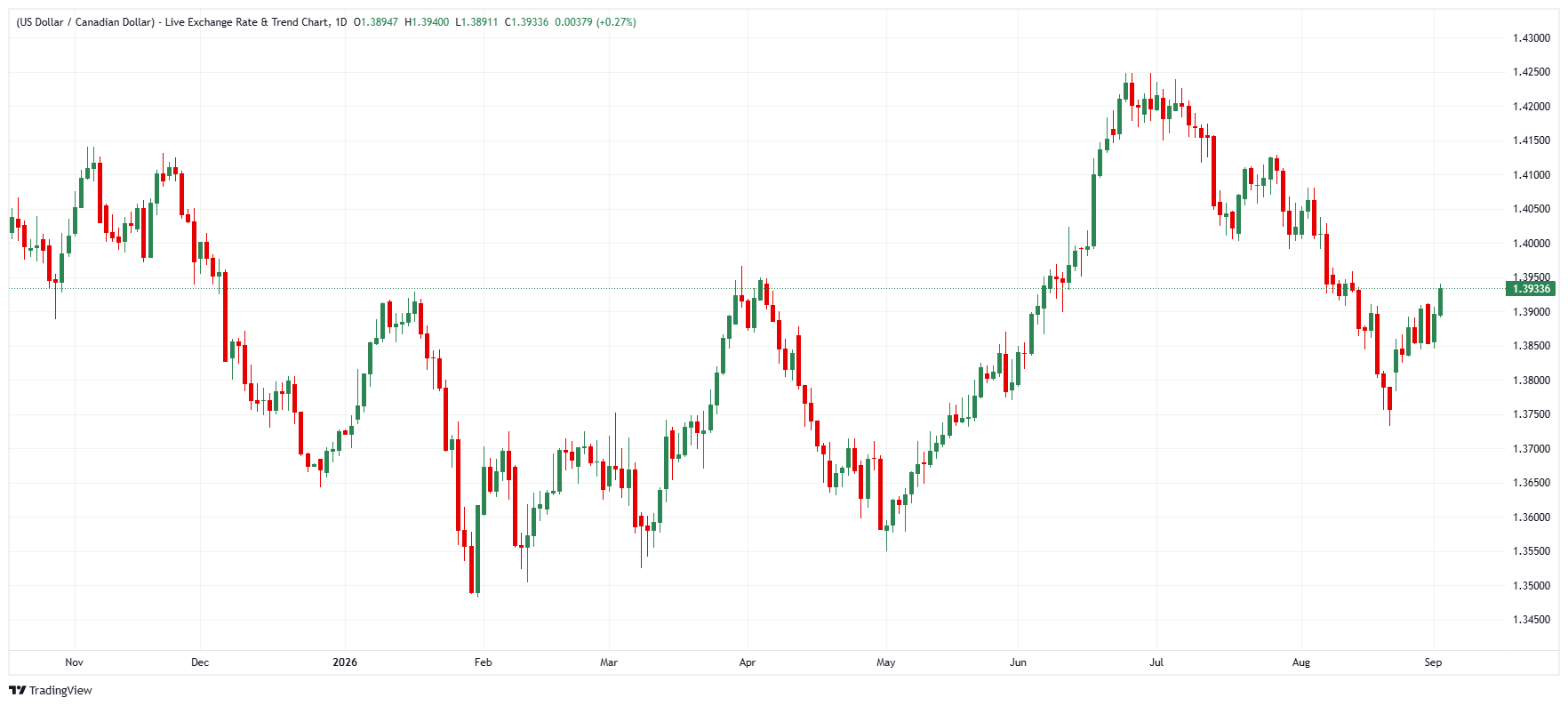
USD/CAD has staged a rebound from recent lows near 1.3730 as markets digest a steady policy stance from the Bank of Canada (BoC) amid renewed United States (US)-Canada trade friction. While Canada's headline inflation ticked up to 3.0% in July, core CPI remains firmly anchored at 1.9%, allowing BoC Governor Tiff Macklem to keep the benchmark policy rate unchanged at 2.25%. However, emerging tariff tensions with the US and shifting rate differentials are creating a tug-of-war between strong overhead technical resistance and downside economic risks for the Canadian Dollar.
Technical resistance at 1.3990/1.4030 tests USD/CAD rebound
According to strategists at Societe Generale, USD/CAD’s recovery from its 1.3730 pivot faces a major technical hurdle at the 1.3990/1.4030 resistance band. A failure to clear this zone would keep the pair's broader downward trend intact, with a loss of 1.3840 support threatening further downside. However, with Canadian core inflation running near target and money markets pricing in future tightening, yield differentials will need to narrow from 133 bps to justify sustained Loonie strength.
"The July low and the 50-DMA at 1.3990/1.4030 could act as a key resistance zone in the short term. If the rebound stalls below this hurdle, the current phase of decline may continue. The recent pivot low around 1.3840 is first support... The question is whether the confidence is challenged following the resumption of tariff hostilities with the US last week."
North American trade friction adds upside risks toward 1.4000
Taking a broader macroeconomic perspective, Francesco Pesole at ING emphasizes that while strong 2Q Gross Domestic Product (GDP) growth (3.3% annualized) and solid employment figures validate a policy hold at 2.25%, trade uncertainty remains a significant drag on CAD. Although monetary policy is not designed to fix trade disputes, escalating tariff measures could weigh heavily on business hiring and capital expenditure, reinforcing a bullish stance on USD/CAD toward the 1.4000 level.
"A few strong jobs market reads and a respectable 3.3% annualised growth in 2Q have been clouded by the latest escalation in the US-Canada trade and diplomatic spat... We suspect Governor Tiff Macklem will stress that monetary policy isn’t a corrective tool for trade policies, and keep the door open to some tightening if necessary... Paired with our bullish call on USD, we see USD/CAD upside risks extending to 1.4000 this month."
Banks project USD/CAD upside capped near 1.4000 unless trade chaos deepens
Based on the combined assessments of both institutions, USD/CAD is facing a critical technical and fundamental inflection point. Societe Generale maintains that unless spot prices decisively break through the 1.3990/1.4030 technical ceiling, the pair risks resuming its broader downtrend toward 1.3840. Concurrently, ING projects that persistent US-Canada trade friction and broad US Dollar strength will continue to lean in favor of the greenback, keeping upside risks toward 1.4000 active in the near term.
(This article was created with the help of an Artificial Intelligence tool and reviewed by an editor. Know more.)
Author

FXStreet Insights Team
FXStreet
The FXStreet Insights Team is a group of journalists that handpicks selected market observations published by renowned experts. The content includes notes by commercial as well as additional insights by internal and external analysts.
















