UK Preliminary GDP expands by 0.7% QoQ in Q3, meets estimates

The UK economy grew at a quarterly rate of 0.7% in the three months to September 2026, following a 1% contraction in the second quarter (Q2) (revised from 0.5% growth). The data came in line with the market forecast.
UK GDP grew 1.9% year-over-year (YoY) in Q3 2026 vs. 1.9% expected and 1.4% growth in Q2.
The monthly UK GDP arrived at 0.2% in September, compared to 0% in August (revised from 0.1%), above the market consensus of 0%.
Other data from the UK showed that Industrial Production increased 0.3% over the month in September, while Manufacturing Production rose 0.7% MoM during the same period. Both readings came in stronger than market expectations.
Market reaction to the UK data
The British Pound (GBP) edges slightly higher following the UK GDP data. At the time of press, the GBP/USD pair is down 0.08% on the day to trade at 1.3264.
Pound Sterling Price Today
The table below shows the percentage change of British Pound (GBP) against listed major currencies today. British Pound was the weakest against the Swiss Franc.
| USD | EUR | GBP | JPY | CAD | AUD | NZD | CHF | |
|---|---|---|---|---|---|---|---|---|
| USD | 0.10% | 0.08% | -0.03% | 0.03% | 0.24% | 0.15% | -0.02% | |
| EUR | -0.10% | -0.02% | -0.11% | -0.08% | 0.15% | 0.04% | -0.13% | |
| GBP | -0.08% | 0.02% | -0.08% | -0.07% | 0.16% | 0.06% | -0.11% | |
| JPY | 0.03% | 0.11% | 0.08% | 0.04% | 0.26% | 0.14% | -0.01% | |
| CAD | -0.03% | 0.08% | 0.07% | -0.04% | 0.22% | 0.12% | -0.05% | |
| AUD | -0.24% | -0.15% | -0.16% | -0.26% | -0.22% | -0.09% | -0.27% | |
| NZD | -0.15% | -0.04% | -0.06% | -0.14% | -0.12% | 0.09% | -0.14% | |
| CHF | 0.02% | 0.13% | 0.11% | 0.01% | 0.05% | 0.27% | 0.14% |
The heat map shows percentage changes of major currencies against each other. The base currency is picked from the left column, while the quote currency is picked from the top row. For example, if you pick the British Pound from the left column and move along the horizontal line to the US Dollar, the percentage change displayed in the box will represent GBP (base)/USD (quote).
This section below was published at 03:00 GMT on Thursday as a preview of the UK GDP data.
- The UK GDP is expected to show stronger economic growth in Q3.
- The Gross Domestic Product is seen accelerating further in the three months to September, boosted by strong manufacturing activity.
- The Pound Sterling against the US Dollar maintains a near-term positive trend, with bulls focusing on the 1.3500 area.
The highlight of the United Kingdom’s (UK) economic calendar this week will be the preliminary estimate of third-quarter Gross Domestic Product (GDP), which the Office for National Statistics will release on Thursday. The market is bracing for 0.7% growth in the three months to September, following 0.5% growth in the second quarter of 2026, with the annual rate accelerating to 1.9%, from 1.4% in the previous month.
Strong Industrial Production data, which is expected to have grown 3% in the 12 months to September, from 1.6% in August, is seen as one of the main drivers of the UK’s economic growth, which, if confirmed, would provide a favourable background for the Bank of England’s (BoE) monetary policy to extend the tightening cycle started last week.
UK GDP forecast: What numbers could tell us
Recent macroeconomic figures from the UK have shown surprising resilience to uncertainty from the war in the Middle East and higher Oil prices, which has improved market expectations about economic growth in the third quarter.
Monthly GDP data from August beat expectations last month, with the economy growing 0.1%, against market expectations of a 0.1% decline, thanks to the strong performance of the manufacturing sector. Factory output grew 0.8% in August, largely offsetting the flat performance of the services sector and a 0.2% decline in construction output.
Beyond that, UK Manufacturing and Services Purchasing Managers’ Index (PMI) figures revealed that business activity continued growing in October, while unemployment declined to its lowest rate since July last year. All in all, a fairly healthy macroeconomic picture, which has prompted the International Monetary Fund to raise the UK's growth projections for 2026 to 1.3% from the previous 1%.
On the political front, a neutral UK budget has contributed to the economic bonanza, calming fears about the hefty public debt, at least for now, and providing support to the British Pound. Lower charges on food and energy bills are expected to be paid for by higher taxes on banks and gambling companies. The feared bond markets have not shown any significant objection to these plans.
All this acknowledged, the third quarter’s GDP report will be analysed with particular attention after last week’s Bank of England rate hike. Economic growth is not a specific target of the BoE’s mandate, but a healthy GDP will doubtless make the central bank’s rate-setting work much easier, considering the stubbornly high consumer inflation data.
Last week, the BoE tightened its monetary policy for the first time in three years. Some policymakers, including Governor Bailey, suggested the bank might need to hike rates further to bring inflation to target. BoE’s Deputy Governor, Clare Lombardelli, went further on Tuesday, affirming that she “would not rule out rate hike possibility in December”. Against this backdrop, a strong GDP reading on Thursday would endorse those views and might spur speculative demand for the Pound.
When will the UK release Q3 Gross Domestic Product, and how could it affect GBP/USD?
As noted, the UK will release the preliminary Q3 GDP estimate on Thursday at 07:00 GMT. Data is expected to show moderate economic growth in the three months to September, with the GBP/USD risk skewed to the upside, as a stronger-than-expected reading will boost odds of another BoE rate hike, most likely in February.
The GBP/USD pair trades around 1.3320 at the time of writing, following a sharp reversal on Tuesday, as strong US inflation data and hawkish comments by Fed speakers boosted the US Dollar across the board. Bears have pushed price action below the bottom of the ascending channel from October, and momentum indicators on the 4-hour chart have turned bearish, with the Relative Strength Index (14) approaching oversold levels and the Moving Average Convergence Divergence (MACD) histogram showing widening red bars.
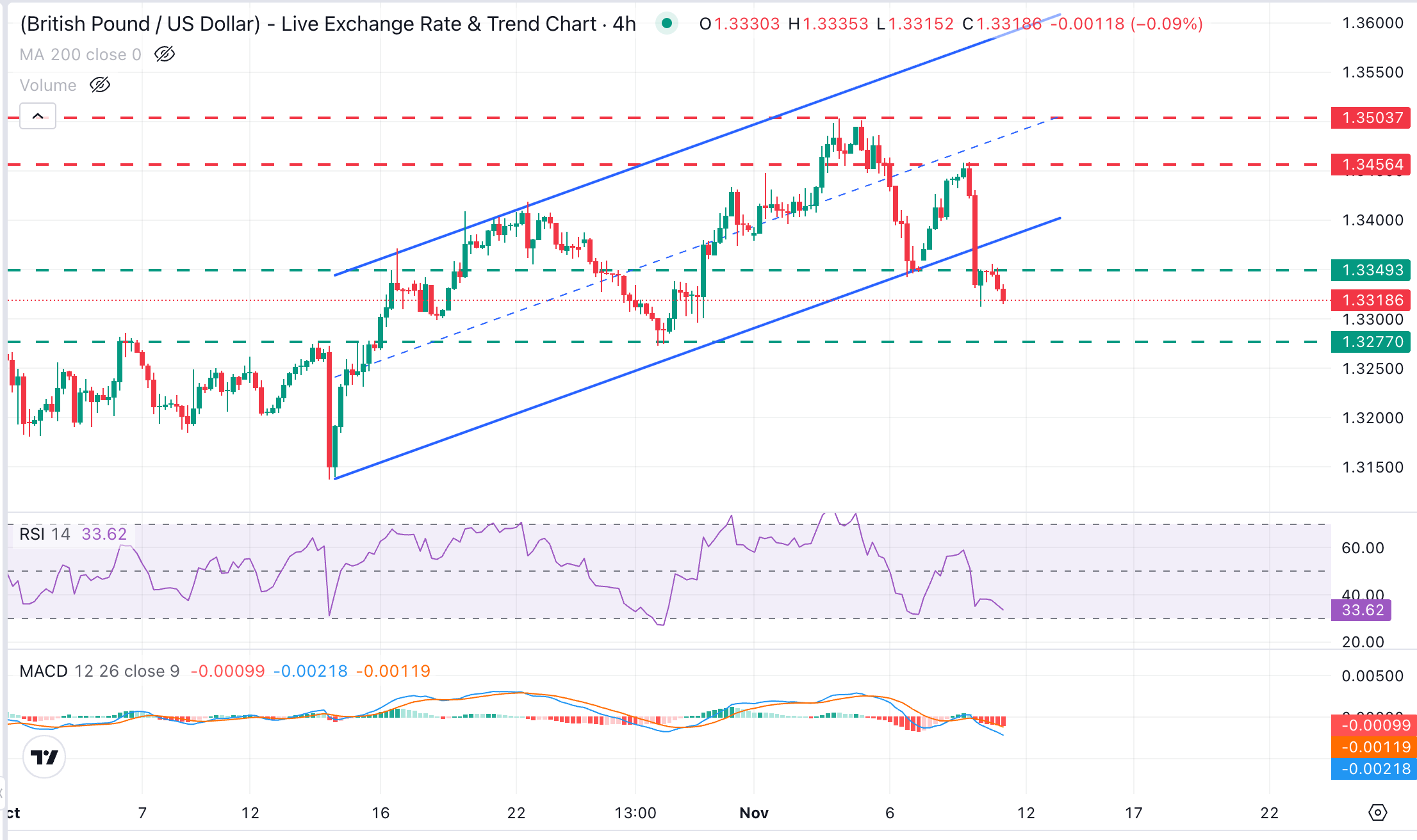
According to Guillermo Alcalá, FX Analyst at FXStreet, “Recent GBP/USD price action suggests that the corrective recovery from mid-October lows might have come to an end, and that the pair is ready to resume the broader bearish trend.”
“While below the channel bottom and the November 6 low, near 1.3340, bears are likely to be tempted to revisit the late October lows near 1.3270, with their gaze on the key resistance area near 1.3130,” says Alcalá.
On the upside, Alcalá argues that “The pair would need to return above the broken trendline support, now around 1.3380, to ease bearish pressure, and shift the focus back towards the November 10 high near 1.3460 and the November peak, in the 1.3500 area.”
(This story was corrected on November 12 at 05:25 GMT to say When will the UK release Q3 Gross Domestic Product, not Q2; the UK will release the preliminary Q3 GDP estimate, not Q2 GDP. And to show moderate economic growth in the three months to September, not to June.)
BoE FAQs
The Bank of England (BoE) decides monetary policy for the United Kingdom. Its primary goal is to achieve ‘price stability’, or a steady inflation rate of 2%. Its tool for achieving this is via the adjustment of base lending rates. The BoE sets the rate at which it lends to commercial banks and banks lend to each other, determining the level of interest rates in the economy overall. This also impacts the value of the Pound Sterling (GBP).
When inflation is above the Bank of England’s target it responds by raising interest rates, making it more expensive for people and businesses to access credit. This is positive for the Pound Sterling because higher interest rates make the UK a more attractive place for global investors to park their money. When inflation falls below target, it is a sign economic growth is slowing, and the BoE will consider lowering interest rates to cheapen credit in the hope businesses will borrow to invest in growth-generating projects – a negative for the Pound Sterling.
In extreme situations, the Bank of England can enact a policy called Quantitative Easing (QE). QE is the process by which the BoE substantially increases the flow of credit in a stuck financial system. QE is a last resort policy when lowering interest rates will not achieve the necessary result. The process of QE involves the BoE printing money to buy assets – usually government or AAA-rated corporate bonds – from banks and other financial institutions. QE usually results in a weaker Pound Sterling.
Quantitative tightening (QT) is the reverse of QE, enacted when the economy is strengthening and inflation starts rising. Whilst in QE the Bank of England (BoE) purchases government and corporate bonds from financial institutions to encourage them to lend; in QT, the BoE stops buying more bonds, and stops reinvesting the principal maturing on the bonds it already holds. It is usually positive for the Pound Sterling.
Author

FXStreet Team
FXStreet
Composed of a group of economic journalists and FX experts, the FXStreet content team produces and oversees all content published on FXStreet. It provides a purely journalistic approach to the Forex market.