Dow Jones Industrial Average slides behind a Federal Reserve hike
- DJIA drops 576 points to just above 51,500 as the Fed raises rates.
- Fed goes to 3.75-4.00% with no dissent, its first increase since 2023.
- Fifth straight fall on a Fed decision day, averaging 1.5% each time.

The Dow Jones Industrial Average (DJIA) trades just above 51,500 on Wednesday, down 576 points and 1.11%, its worst session of the month. The Federal Reserve (Fed) raised its rate a quarter-point to 3.75-4.00%, which everyone had priced, and the index spent the two hours afterward finding out what came with it. The broad market has now fallen on five consecutive Fed decision days this year, losing an average of 1.5% each time, which is the longest such run since a stretch of seven that ended in 2018.
A quarter-point on overnight money, thirty ways
The rate the Fed sets is what banks pay to borrow from each other overnight, and it reaches this index in two directions. It lifts what the 30 companies pay on floating-rate debt, and it widens what JPMorgan (JPM) and Goldman Sachs (GS) earn on the gap between their lending and their deposits. Those two partly cancel. What does not cancel is the forecast, because the committee's own numbers now put the rate at 4.1% at the end of this year and 4.1% again at the end of next, with four of the eighteen seeing any reduction by then. Thirty borrowers have just had next year's interest bill rewritten upward.
The Chair said the test has not been met
At the press conference, Fed Chair Kevin Warsh set out a test: the committee has to be confident that underlying inflation is heading to 2% clearly and fast enough, and today it judged that test unmet. The summer's inflation numbers, he said, do not show the underlying trend getting better. Against that, he described an economy running more or less at full employment, with productivity strong and capital investment robust. That combination is the awkward part for an equity index. The case for the companies is also the case for charging them more.
Levels and bias
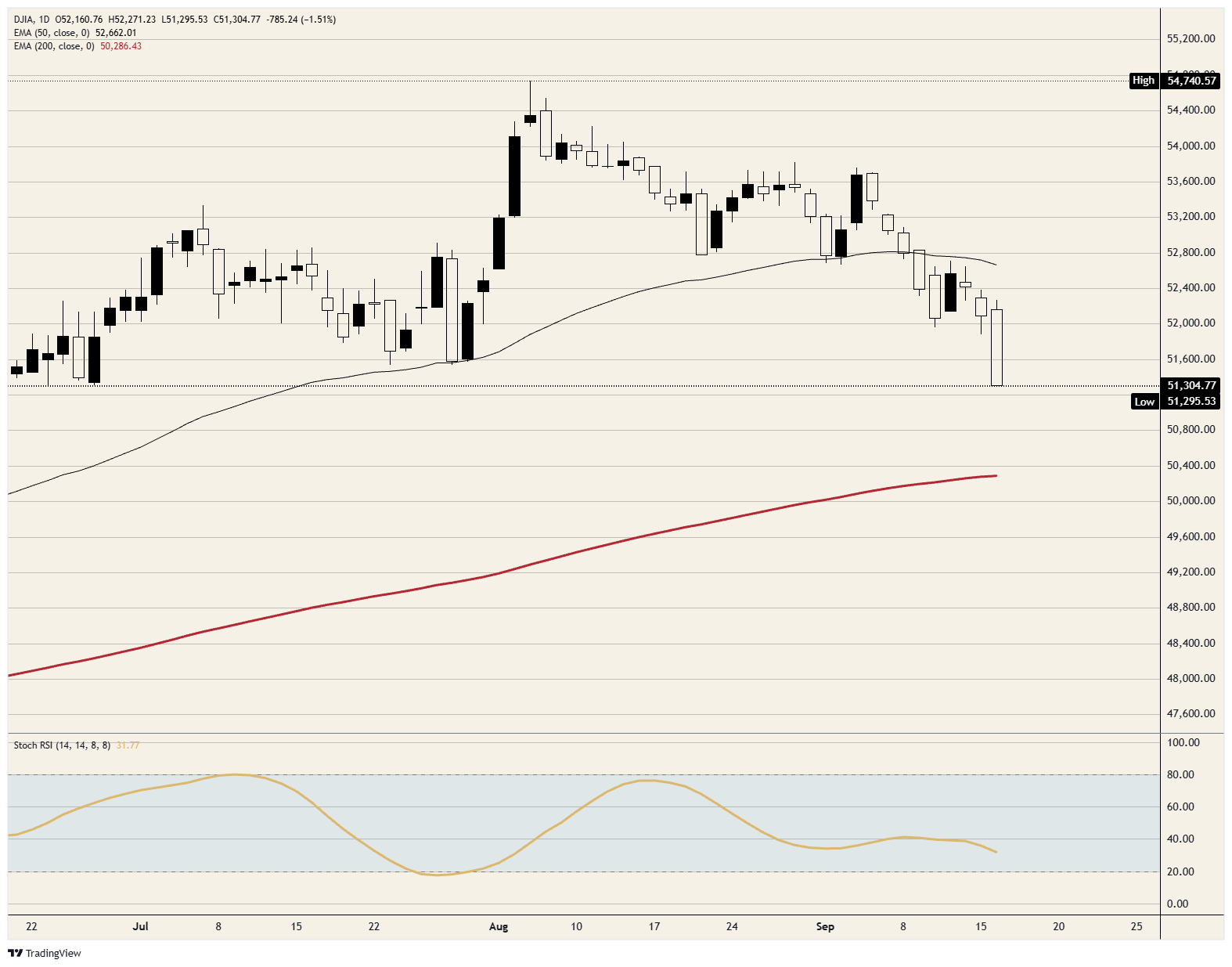
Resistance: The 51,750 area is the first thing overhead, and 52,000 sits above it, the level the index held through the morning. The 50-day Exponential Moving Average (EMA) near 52,700 has capped every attempt since the start of September.
Support: Today's low just under 51,500 is the floor. Below it, the late-June base near 51,300 is the next stop and the lowest the index has traded in three months.
Bias: Bearish while 52,000 caps, with the late-June base near 51,300 the first objective and 51,000 behind it. The daily Stochastic Relative Strength Index (Stoch RSI), a momentum gauge, points down from near 32, so the selling is not exhausted. A daily close back above 52,250 voids the case.
Dow Jones 5-minute chart
Interest rates FAQs
Interest rates are charged by financial institutions on loans to borrowers and are paid as interest to savers and depositors. They are influenced by base lending rates, which are set by central banks in response to changes in the economy. Central banks normally have a mandate to ensure price stability, which in most cases means targeting a core inflation rate of around 2%. If inflation falls below target the central bank may cut base lending rates, with a view to stimulating lending and boosting the economy. If inflation rises substantially above 2% it normally results in the central bank raising base lending rates in an attempt to lower inflation.
Higher interest rates generally help strengthen a country’s currency as they make it a more attractive place for global investors to park their money.
Higher interest rates overall weigh on the price of Gold because they increase the opportunity cost of holding Gold instead of investing in an interest-bearing asset or placing cash in the bank. If interest rates are high that usually pushes up the price of the US Dollar (USD), and since Gold is priced in Dollars, this has the effect of lowering the price of Gold.
The Fed funds rate is the overnight rate at which US banks lend to each other. It is the oft-quoted headline rate set by the Federal Reserve at its FOMC meetings. It is set as a range, for example 4.75%-5.00%, though the upper limit (in that case 5.00%) is the quoted figure. Market expectations for future Fed funds rate are tracked by the CME FedWatch tool, which shapes how many financial markets behave in anticipation of future Federal Reserve monetary policy decisions.
Author

Joshua Gibson
FXStreet
Joshua joins the FXStreet team as an Economics and Finance double major from Vancouver Island University with twelve years' experience as an independent trader focusing on technical analysis.















