Mexican Peso plunges as US-Mexico interest rate differential reduces
- USD/MXN jumps 1.8% as stalled Iran talks sour sentiment.
- Soaring Treasury yields strengthen Dollar as Fed hawks persist.
- Banxico says Peso weakness remains within existing inflation forecasts.

The Mexican Peso collapses against the US Dollar, depreciating on Monday as market mood sours amid stalled US-Iran talks. News headlines reported that a potential agreement is near, but officials denied the progress. The Bank of Mexico (Banxico) Governor Victoria Rodriguez said that despite recent fluctuations, the exchange rate favors the Mexican currency. The USD/MXN trades at 17.99, up 1.80%
USD/MXN jumps as geopolitical uncertainty and hawkish Fed expectations batter Peso
The Middle East conflict seems far from resolving, even though Iran’s Foreign Minister Abbas Araghchi will meet mediators in New York on Monday. Recently, US President Trump denied Axios claims that the US offered sanctions relief to Iran and the potential unfreezing of Iran’s regime assets.
Soaring US Treasury yields favored the Greenback, which, according to the US Dollar Index (DXY), which measures the American currency value against six other currencies, is up 0.14% at 101.17.
Fed Governor Lisa Cook was hawkish, expecting continued inflationary pressures in the coming months from AI and hostilities in the Middle East.
Aside from this, Banxico’s Governor Rodriguez Ceja said at an interview with El Financiero that "the depreciation [of the peso] relative to levels seen at our previous meeting does not represent additional pressures beyond those already incorporated into our inflation projections, which continue to anticipate a gradual decline in inflation toward the 3 percent target."
Rodriguez added that geopolitical conflicts increase uncertainty in our forecasts and refrained from providing forward guidance regarding the main reference rate, adding that monetary policy in Mexico would “not react mechanically to potential adjustments to the Fed funds rate.”
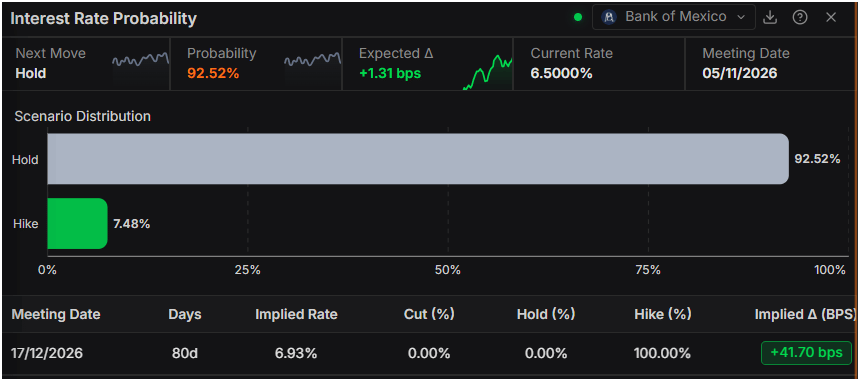
Money markets had priced in a 92% chance that Banxico would hold rates at 6.50% for the November 5 meeting, according to Prime Terminal.
The US economic docket ahead features JOLTS job openings, ADP Employment Change, the release of the Fed’s preferred inflation gauge, the Core Personal Consumption Expenditures (PCE) Price Index, and September’s Nonfarm Payrolls.
USD/MXN Price Forecast: Technical outlook
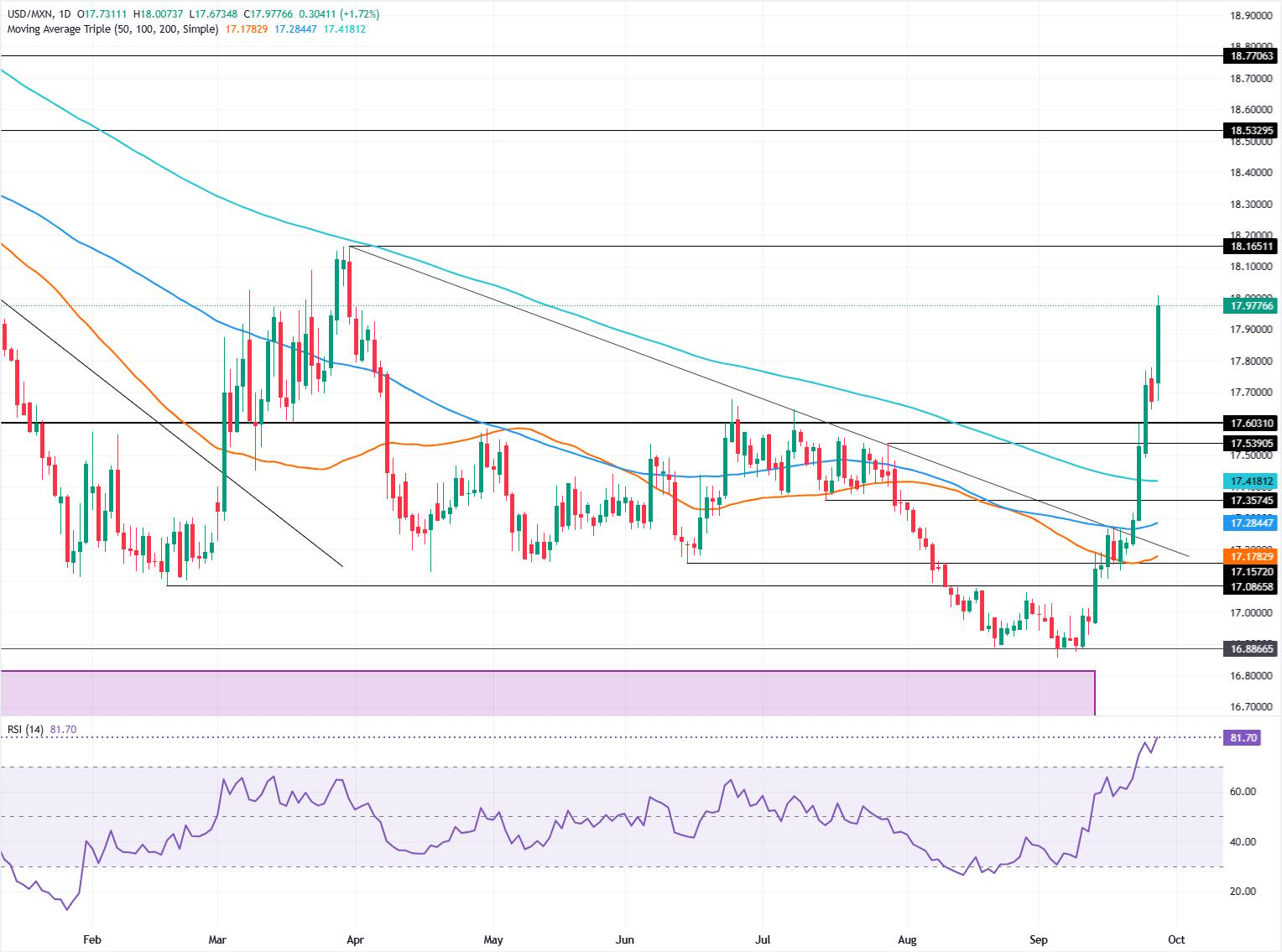
The USD/MXN daily chart shows the exotic pair turned bullish after clearing key daily Simple Moving Averages (SMAs), including the 200-day SMA at 17.41.
Bullish momentum continues to build, as depicted by the Relative Strength Index (RSI), which has turned overbought, spiking past the 70 level and approaching extreme conditions, with no signs of easing in the short term. Hence, the path of least resistance for the USD/MXN is upwards.
The first resistance is at 18.00. A breach will expose the year-to-date (YTD) high of 18.16, before testing the November 21, 2025, swing high of 18.53. Above, the next key resistance is the November 5, 2025, high at 18.77, before launching an attack on the psychological 19.00 level.
Mexican Peso FAQs
The Mexican Peso (MXN) is the most traded currency among its Latin American peers. Its value is broadly determined by the performance of the Mexican economy, the country’s central bank’s policy, the amount of foreign investment in the country and even the levels of remittances sent by Mexicans who live abroad, particularly in the United States. Geopolitical trends can also move MXN: for example, the process of nearshoring – or the decision by some firms to relocate manufacturing capacity and supply chains closer to their home countries – is also seen as a catalyst for the Mexican currency as the country is considered a key manufacturing hub in the American continent. Another catalyst for MXN is Oil prices as Mexico is a key exporter of the commodity.
The main objective of Mexico’s central bank, also known as Banxico, is to maintain inflation at low and stable levels (at or close to its target of 3%, the midpoint in a tolerance band of between 2% and 4%). To this end, the bank sets an appropriate level of interest rates. When inflation is too high, Banxico will attempt to tame it by raising interest rates, making it more expensive for households and businesses to borrow money, thus cooling demand and the overall economy. Higher interest rates are generally positive for the Mexican Peso (MXN) as they lead to higher yields, making the country a more attractive place for investors. On the contrary, lower interest rates tend to weaken MXN.
Macroeconomic data releases are key to assess the state of the economy and can have an impact on the Mexican Peso (MXN) valuation. A strong Mexican economy, based on high economic growth, low unemployment and high confidence is good for MXN. Not only does it attract more foreign investment but it may encourage the Bank of Mexico (Banxico) to increase interest rates, particularly if this strength comes together with elevated inflation. However, if economic data is weak, MXN is likely to depreciate.
As an emerging-market currency, the Mexican Peso (MXN) tends to strive during risk-on periods, or when investors perceive that broader market risks are low and thus are eager to engage with investments that carry a higher risk. Conversely, MXN tends to weaken at times of market turbulence or economic uncertainty as investors tend to sell higher-risk assets and flee to the more-stable safe havens.
Author

Christian Borjon Valencia
FXStreet
Markets analyst, news editor, and trading instructor with over 14 years of experience across FX, commodities, US equity indices, and global macro markets.