Gold breaks $3,886 floor to new YTD low as Fed hawks press on
- Gold plunges over 3.3%, hitting a fresh yearly low at $3,880.
- Break below $3,886 confirms bearish pressure, exposing further downside risks.
- December hike odds fall to 70% despite Fed officials backing additional tightening.
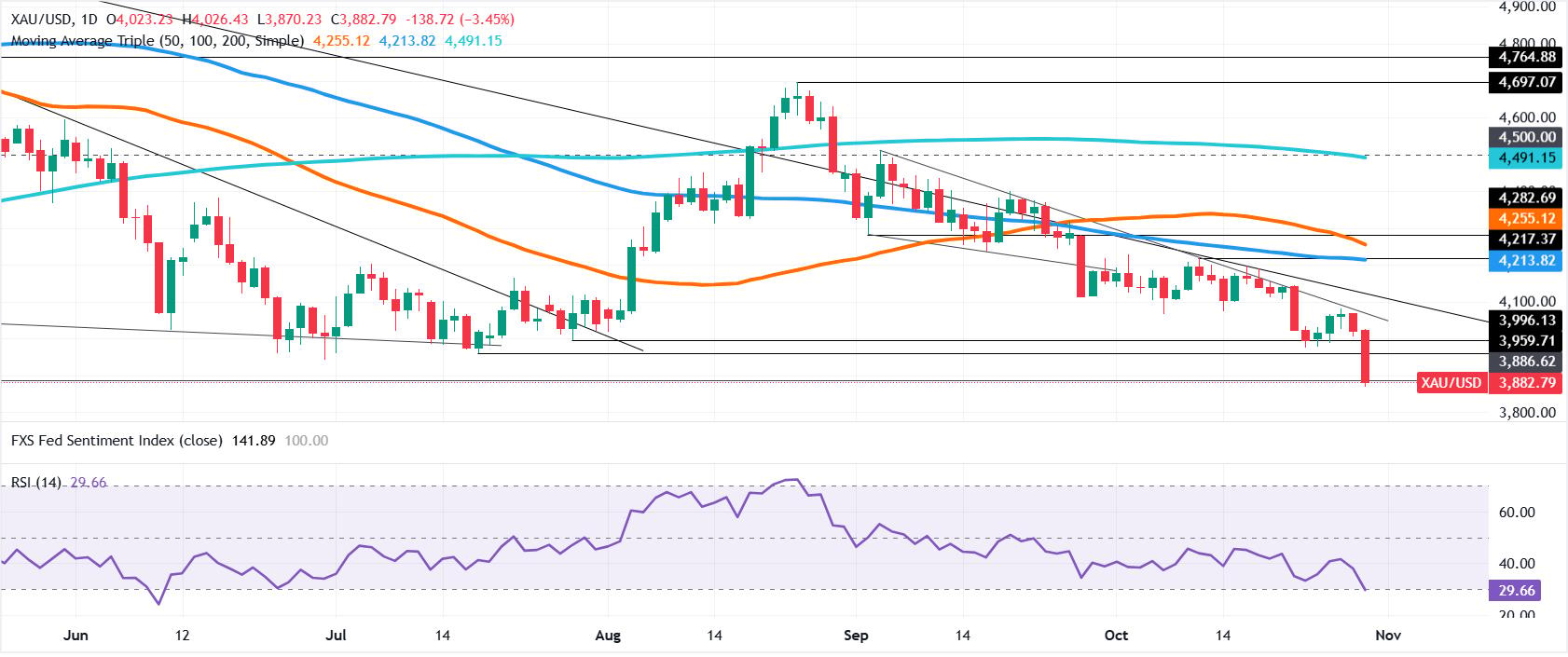
Gold (XAU/USD) tanked to a new year-to-date (YTD) low of $3,880 on Friday, clearing the $3,900 threshold for the first time since October of last year. The Greenback and US Treasury yields edged higher, while risk appetite deteriorated and hawkish Fed rhetoric pushed prices lower. The XAU/USD trades at $3,884, down more than 3.3%.
XAU/USD extends its bearish breakdown on hawkish Fed rhetoric and high Oil prices
Price action suggests further downside in Bullion prices after clearing the key support level of $3,886 on October 28, 2025. Two of three Federal Reserve (Fed) officials called for additional tightening, while the three support a gradual approach.
Dallas Fed President Lorie Logan called for two more rate hikes. St. Louis Fed President Alberto Musalem called for another rate hike soon and added that policy remains too loose.
In the meantime, Richmond Fed President Thomas Barkin stated that he favors a gradual approach, though he recognized that inflationary pressure isspreading.
Despite the backdrop. the US Dollar failed to advance, while US Treasury yields edged lower.
In the US, the economy grew at a healthy 3.4% YoY in Q3, far exceeding forecasts. Core PCE inflation remained high at 3.1% YoY, up from September’s reading but in line with estimates. Although this could increase the likelihood of a Fed rate hike, investors have lowered the odds from around 84% on Wednesday, following the Fed’s decision, to 70%, according to the CME FedWatch Tool.
Bullion is also weighed down by the rise in energy prices, even though talks between the US and Iran are still ongoing, according to Axios. West Texas Intermediate (WTI), the US Oil benchmark, is up 0.5% near $102 per barrel.
Next week’s US economic calendar will be packed. Markets will be watching the October ISM Manufacturing and Services PMIs, along with a slew of jobs data. Labour-market figures include JOLTS, the ADP Employment Change, Initial Jobless Claims and the week’s highlight, Nonfarm Payrolls.
XAU/USD technical outlook: Gold prolongs its agony below $3,900
The overall trend is downward after Gold cleared $3,900, opening the door to a 12-month low. Momentum is bearish and about to turn oversold, meaning that the downtrend is strengthening as depicted by the Relative Strength Index (RSI).
If XAU/USD closes on the daily chart below the October 28, 2025, low of $3,886, the next stop is $3,800. Once surpassed, the next area of interest is the April 22, 2025, swing high-turned-support at $3,500.
For a bullish reversal, buyers must drive prices above $3,900 and $4,000. This would pave the way to test the $4,100 mark, ahead of the 100-day Simple Moving Average (SMA) of $4,213.
Gold FAQs
Gold has played a key role in human’s history as it has been widely used as a store of value and medium of exchange. Currently, apart from its shine and usage for jewelry, the precious metal is widely seen as a safe-haven asset, meaning that it is considered a good investment during turbulent times. Gold is also widely seen as a hedge against inflation and against depreciating currencies as it doesn’t rely on any specific issuer or government.
Central banks are the biggest Gold holders. In their aim to support their currencies in turbulent times, central banks tend to diversify their reserves and buy Gold to improve the perceived strength of the economy and the currency. High Gold reserves can be a source of trust for a country’s solvency. Central banks added 1,136 tonnes of Gold worth around $70 billion to their reserves in 2022, according to data from the World Gold Council. This is the highest yearly purchase since records began. Central banks from emerging economies such as China, India and Turkey are quickly increasing their Gold reserves.
Gold has an inverse correlation with the US Dollar and US Treasuries, which are both major reserve and safe-haven assets. When the Dollar depreciates, Gold tends to rise, enabling investors and central banks to diversify their assets in turbulent times. Gold is also inversely correlated with risk assets. A rally in the stock market tends to weaken Gold price, while sell-offs in riskier markets tend to favor the precious metal.
The price can move due to a wide range of factors. Geopolitical instability or fears of a deep recession can quickly make Gold price escalate due to its safe-haven status. As a yield-less asset, Gold tends to rise with lower interest rates, while higher cost of money usually weighs down on the yellow metal. Still, most moves depend on how the US Dollar (USD) behaves as the asset is priced in dollars (XAU/USD). A strong Dollar tends to keep the price of Gold controlled, whereas a weaker Dollar is likely to push Gold prices up.
Author

Christian Borjon Valencia
FXStreet
Markets analyst, news editor, and trading instructor with over 14 years of experience across FX, commodities, US equity indices, and global macro markets.

















