Banxico unexpectedly cuts rates by 25 basis points to 6.25%

On Thursday, the Bank of Mexico (Banxico) cut rates by 25 basis points to 6.25%. The unexpected move caught market participants off guard, who had expected rates to remain unchanged at 6.50%.
Banxico’s decision to reduce rates was not unanimous, as Deputy Governors Galia Borja and Jonathan Heath voted to hold rates unchanged at 6.50%.
In its monetary policy statement, the Governing Board said that “maintaining the reference rate at the attained level for an extended period will support the convergence of inflation to its target.” The board added that inflation risks are tilted upward and called this rate cut a “one-time adjustment.”
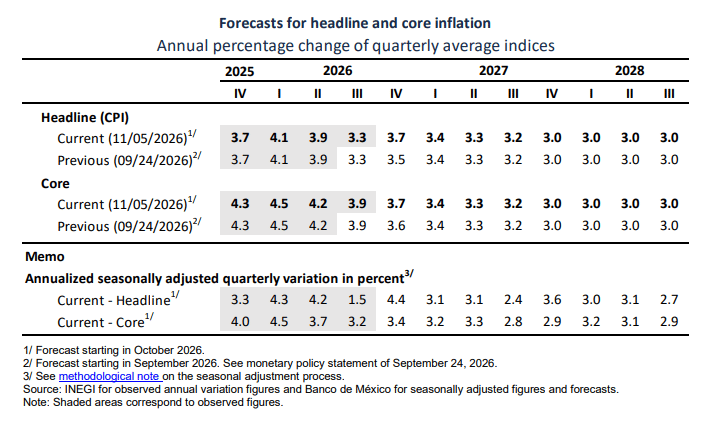
Despite cutting rates, Banxico raised its headline inflation forecast for Q4 to 3.7% YoY from 3.5%, while the core reading for the same period is forecast at 3.7% YoY from 3.6%.
For Q4 2027, the central bank projects annual headline and core inflation at 3%, unchanged versus the previous forecast.
Banxico's inflation forecasts
Key highlights:
Board was not unanimous on rate decision
Looking ahead, the governing board considers that maintaining the reference rate at the attained level for an extended period will support the convergence of inflation to its target
Forecasts Q4 2026 average annual headline inflation at 3.7% versus previous forecast of 3.5%
Forecasts Q4 2027 average annual headline inflation at 3.0% versus previous forecast of 3.0%
Forecasts Q4 2026 average annual core inflation at 3.7% versus previous forecast of 3.6%
Forecasts Q4 2027 average annual core inflation at 3.0% versus previous forecast of 3.0%
Balance of risks for the trajectory of inflation within the forecast horizon remains biased to the upside
Will make its decisions considering the observed and expected behavior of inflation and its determinants
Calls rate cut a one-time adjustment
Economic Indicator
Banxico Interest Rate Decision
The Bank of Mexico (Banxico) announces its interest rate decision at the end of its eight scheduled meetings per year. If Banxico is hawkish about the inflationary outlook of the economy and raises interest rates, it is usually bullish for the Mexican Peso (MXN). Likewise, if Banxico adopts a dovish view on the Mexican economy and keeps interest rates unchanged, or cuts them, it is generally seen as bearish for MXN.
Read more.Last release: Thu Nov 05, 2026 19:00
Frequency: Irregular
Actual: 6.25%
Consensus: 6.5%
Previous: 6.5%
Source: Banxico
Banxico FAQs
The Bank of Mexico, also known as Banxico, is the country’s central bank. Its mission is to preserve the value of Mexico’s currency, the Mexican Peso (MXN), and to set the monetary policy. To this end, its main objective is to maintain low and stable inflation within target levels – at or close to its target of 3%, the midpoint in a tolerance band of between 2% and 4%.
The main tool of the Banxico to guide monetary policy is by setting interest rates. When inflation is above target, the bank will attempt to tame it by raising rates, making it more expensive for households and businesses to borrow money and thus cooling the economy. Higher interest rates are generally positive for the Mexican Peso (MXN) as they lead to higher yields, making the country a more attractive place for investors. On the contrary, lower interest rates tend to weaken MXN. The rate differential with the USD, or how the Banxico is expected to set interest rates compared with the US Federal Reserve (Fed), is a key factor.
Banxico meets eight times a year, and its monetary policy is greatly influenced by decisions of the US Federal Reserve (Fed). Therefore, the central bank’s decision-making committee usually gathers a week after the Fed. In doing so, Banxico reacts and sometimes anticipates monetary policy measures set by the Federal Reserve. For example, after the Covid-19 pandemic, before the Fed raised rates, Banxico did it first in an attempt to diminish the chances of a substantial depreciation of the Mexican Peso (MXN) and to prevent capital outflows that could destabilize the country.
Author

Christian Borjon Valencia
FXStreet
Markets analyst, news editor, and trading instructor with over 14 years of experience across FX, commodities, US equity indices, and global macro markets.