AI trade back in doldrums as Anthropic sinks below IPO price, Nvidia sputters
- Nvidia stock shifts lower after Monday's monstrous rally.
- Anthropic shares plunge despite bullish Oppenheimer price target.
- Market wonders whether Jensen Huang can continue financing the AI industry.


Well, that was quick! Following Monday's rip-roaring recovery on the back of Nvidia's (NVDA) reinstatement of CEO Jensen Huang to the C-suite, a surprise move that sent the NASDAQ 100 (NDX) up 6.9%, the tech-focused index is trading 2.2% lower in Tuesday's late morning trade.
Nvidia is once again to blame, with investors taking profits after the 31.5% spike to start the week. NVDA shares are off more than 7% near $152 at last look as the market turns a sober eye toward the consequences of Huang's return.
It hasn't helped the wider market that The Wall Street Journal reports that US Trade Representative Jamieson Greer is expected to announce the results of a lengthy investigation into the industrial policies of China, the European Union, and 14 other nations as soon as this week. The reporting suggests that the Trump administration is preparing to raise tariffs on China and other trading partners it believes are illegally subsidizing their domestic industries.
Congressional hearing dims Nvidia outlook, Anthropic stock sinks below IPO
Politicians from both major parties criticized President Donald Trump's decision to pressure Nvidia's board into reinstating the CEO. Republican Nebraska Rep. Don Bacon criticized the President's decision to ignore the national security implications. The extent of Huang's engagement with an alleged Chinese asset, who is said to have circumvented US export controls on Nvidia chips, remains a question among most critics. A Senate committee is already scheduled to hear Huang testify on December 3, and Democratic Senator Elizabeth Warren said the board owes Congress an explanation about its compliance protocols.
The Congressional oversight of the Nvidia CEO threatens to place a storm cloud over Nvidia's share price despite Monday's euphoric turnaround.
Jason Thomas, a managing director at the Carlyle Group, said Huang had informally been the leader of the AI boom as he was willing to finance many of the VC-backed firms that swell the ranks of the burgeoning industry to ensure that deals got done. "So the question that [Huang] is back is good news for shareholders," Thomas said in an interview with CNBC on Tuesday, "but there's an open question whether that policy remains in place or is now going to be more bureaucratized or subject to new risk management strictures."
Bloomberg reports that Nvidia's five-year CDS spreads reached 142 basis points on Tuesday, up more than 4 basis points and just below the one-year high at 145. The average over the past year has been circa 61 basis points.
Nvidia's continued stumbles are being felt throughout the AI trade as well. Anthropic's (ANT) heavily oversubscribed IPO just last Thursday is now trading below its $83 IPO price on Tuesday. Shares have plunged 13% at the time of writing to $76 a share.
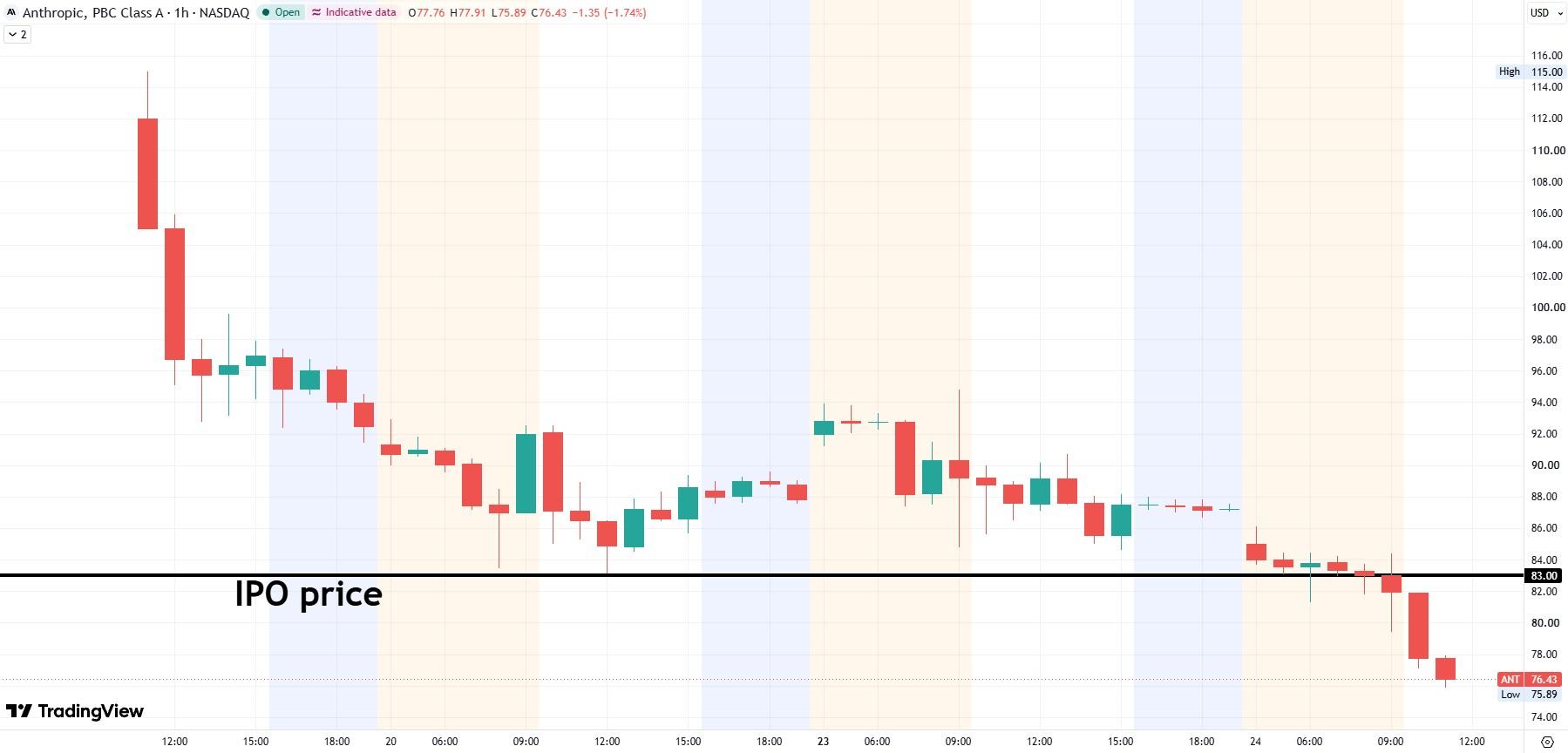
Anthropic has only been public for four trading days so far, but if the present trend continues on Tuesday, all four will have closed below the opening price. This depressed price dynamic was completely unaltered by Oppenheimer issuing a $150 price target on ANT shares on Tuesday.
"Improving efficiency lowers cost per task, while broader adoption creates a network effect through more production feedback to inform model development," wrote Oppenheimer analyst Param Singh in a client note. "Combined with Claude-assisted research, we believe this cycle reinforces frontier competitiveness and expands economically viable use cases."
Oppenheimer forecasts Anthropic revenue of $275 billion for 2028 and projects a $5.3 trillion total addressable market (TAM) for enterprise AI by 2030. Canaccord has a $135 price target on ANT shares, while Wedbush has issued a $120 price target.
Semiconductors connected to the AI trade are once again cratering in unison, a trend that investors have seen many times in October and November. Analog Devices (ADI) stock is down 19% at the time of writing. Hewlett Packard Enterprise (HPE), which issued a lower outlook than the market expected, dropped 15%. Advanced Micro Devices (AMD), Nvidia's closed peer, Sandisk (SNDK) and Dell Technologies (DELL) also sank by double digits before lunchtime.
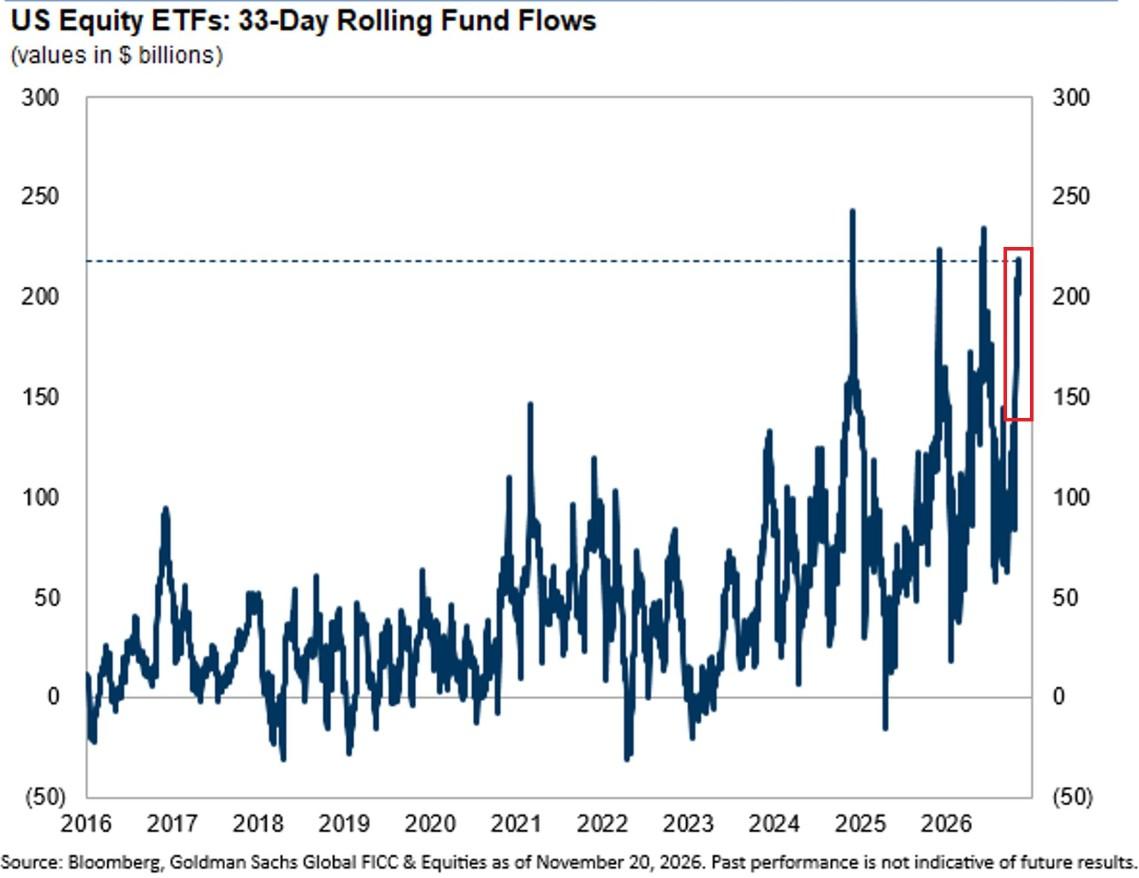
In one of the few good signs for US equity investors, Goldman Sachs said its data shows that investors are buying the dip. US equity ETFs attracted more than $220 billion in inflows over the 33 trading days ending November 20, which has only happened three other times on record. This is about triple the level of fund flows seen just several months earlier.
Author
Clay Webster
FXStreet
Clay Webster grew up in the US outside Buffalo, New York and Lancaster, Pennsylvania. He began investing after college following the 2008 financial crisis.